
At TheHealthBoard, we're committed to delivering accurate, trustworthy information. Our expert-authored content is rigorously fact-checked and sourced from credible authorities. Discover how we uphold the highest standards in providing you with reliable knowledge.
What is Heparin?
 Mary McMahon
Mary McMahon
Mary McMahon
Heparin is an anticoagulant produced naturally in the lungs and liver. It may be administered as a medication to address blood clotting disorders such as thrombosis, typically in a hospital setting. This drug can be extremely dangerous if it is used improperly or without supervision, and a number of precautions need to be observed when administering the drug to ensure it does not cause complications in the patient.
The heparin used as a drug is extracted from pigs and cows. It is among a class of drugs known as blood thinners. In this case, the drug inhibits clotting. While it cannot dissolve clots, it can prevent the formation of clots, and it will keep existing clots from getting any larger. The drug can be used to treat a range of clotting disorders.

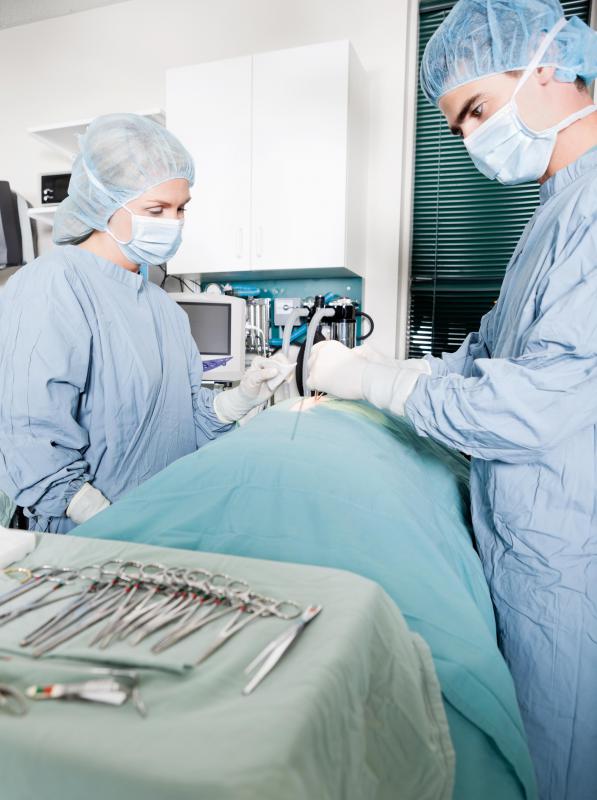
Surgeons may administer this drug during surgery to prevent clotting, and the drug can also be given to people with intravenous catheters and other medical devices which could contribute to the development of clots. People with specific clotting disorders may be prescribed heparin to address these disorders. The drug is typically delivered by injection in a sodium chloride solution.

If someone takes too much of this drug, it can cause fatal hemorrhage and other bleeding problems. Many people on the drug experience “bleeding events,” in which a small cut or an event like a menstrual period results in a much more blood than normal. Irritation around the injection site is common, and some people develop hypersensitivity to textures and temperature changes while on the medication.

Studies on pregnant women seem to suggest that the drug is not immediately dangerous to the fetus, and when an anticoagulant is needed, heparin may be recommended in lieu of more dangerous drugs. However, an increased rate of miscarriage has been reported for women on the drug, although the medical community is not sure about whether this is caused by the drug, or by the underlying medical conditions leading to the need for an anticoagulant. The drug also appears to be safe for use while breastfeeding, although additional research is needed.

Heparin can react badly with a number of drugs, from aspirin to herbal medicine. It's important for patients to disclose all of the drugs they are using, prescription or not, so that the doctor can confirm that a cross-reaction will not occur. The drug can also be dangerous for people who have recently fallen, along with people who suffer from certain illnesses.
Mary McMahon
Ever since she began contributing to the site several years ago, Mary has embraced the exciting challenge of being a TheHealthBoard researcher and writer. Mary has a liberal arts degree from Goddard College and spends her free time reading, cooking, and exploring the great outdoors.
Learn more...
Mary McMahon
Ever since she began contributing to the site several years ago, Mary has embraced the exciting challenge of being a TheHealthBoard researcher and writer. Mary has a liberal arts degree from Goddard College and spends her free time reading, cooking, and exploring the great outdoors.
Learn more...AS FEATURED ON:
AS FEATURED ON:


-
![Heparin is sometimes given to people with intravenous catheters to help prevent clots from forming.]() By: Aleksandrs JermakoviHeparin is sometimes given to people with intravenous catheters to help prevent clots from forming.
By: Aleksandrs JermakoviHeparin is sometimes given to people with intravenous catheters to help prevent clots from forming. -
![The heparin used as a drug is extracted from pigs.]() By: AnatoliiThe heparin used as a drug is extracted from pigs.
By: AnatoliiThe heparin used as a drug is extracted from pigs. -
![Heparin may be administered when a patient is at risk of developing a blood clot.]() By: NorGalHeparin may be administered when a patient is at risk of developing a blood clot.
By: NorGalHeparin may be administered when a patient is at risk of developing a blood clot. -
![An increased rate of miscarriage has been reported for women taking heparin.]() By: Farina3000An increased rate of miscarriage has been reported for women taking heparin.
By: Farina3000An increased rate of miscarriage has been reported for women taking heparin. -
![Heparin can react badly with aspirin.]() By: bahrialtayHeparin can react badly with aspirin.
By: bahrialtayHeparin can react badly with aspirin. -
![Anticoagulant effects of heparin will help prevent thrombosis in the legs.]() By: DirimaAnticoagulant effects of heparin will help prevent thrombosis in the legs.
By: DirimaAnticoagulant effects of heparin will help prevent thrombosis in the legs. -
![Heparin is safe for use while breastfeeding.]() By: Claudio DiviziaHeparin is safe for use while breastfeeding.
By: Claudio DiviziaHeparin is safe for use while breastfeeding. -
![Surgeons often administer heparin during surgery to prevent clotting.]() By: Tyler OlsonSurgeons often administer heparin during surgery to prevent clotting.
By: Tyler OlsonSurgeons often administer heparin during surgery to prevent clotting.






Discussion Comments
why when we use heparin, we have to check a PTT, and check INR when using warfarin?
I think it goes the other way. I think a form of blood thinner is used as rat poison.
Does this make you feel like sleeping all the time?
Does it have rat poison in its ingredients?
is there rat poison in heparin or any blood thinners?
Post your comments