
At WiseGEEK, we're committed to delivering accurate, trustworthy information. Our expert-authored content is rigorously fact-checked and sourced from credible authorities. Discover how we uphold the highest standards in providing you with reliable knowledge.
What is Hebrew?
 Niki Foster
Niki Foster
Niki Foster
Hebrew is a Semitic language of the Afro-Asiatic family. It was once a dialect of the Canaanite language, but other dialects have died out. This language was spoken in ancient times until the turn of the 4th century CE, when it began to be replaced by Aramaic, but it persisted as a literary language, largely due to the Hebrew Bible used by the Jewish faith. Today, it is once again a spoken language in Israel and other Jewish communities, and it boasts around 15 million speakers worldwide.
There are many different dialects of this language, with the various versions spoken in ancient Palestine between the 10th century BCE and and 4th century CE being collectively referred to as Classical Hebrew. It is further subdivided into the earlier Biblical Hebrew, which was spoken up to the 1st century CE, and the later Mishnaic, which existed during the 1st to 4th century CE. Amoraic was a strictly literary language that coexisted with Mishnaic, and both forms, collectively called Rabbinic Hebrew, were used in the Talmud, a record of rabbinic commentary on Jewish law and culture written between the 3rd and 5th centuries CE. In the Medieval era, there were many regional dialects, the most important of which, Tiberian or or Masoretic, is sometimes referred to as Biblical Hebrew because it is used to pronounce the Bible. However, this form must be distinguished from the true Biblical form, spoken during the time of the Bible, of which no record of pronunciation exists.

Before Hebrew reemerged as a spoken language, it was used in Jewish religious practices around the world, and liturgical pronunciation styles differ according to region. Ashkenazi Hebrew is the dialect of Central and Eastern Europe, and it is still used in Ashkenazi religious study and services around the world. Sephardi Hebrew, the basis of the language used by native speakers in Israel, arose in the Iberian peninsula and the former Ottoman Empire. Mizrahi or Oriental Hebrew encompasses a number of Middle-Eastern dialects.

Its resurgence as a secular language began in the mid-19th century, when Jewish writers began to use it in novels and poetry. Eliezer Ben-Yehuda, a resident of Palestine around the turn of the 20th century, developed the Standard Hebrew spoken in Israel today. He was also instrumental in developing schools and textbooks to promote the spoken language, and after a large influx of mostly Russian Jews to Palestine between 1904 and 1914, the movement towards a spoken language took off. The British Mandate of Palestine established it as an official language in 1922.
Hebrew benefited Palestinian Jews, as they came from diverse areas of the world and did not have a common tongue. The Academy of the Hebrew Language was founded around the turn of the 20th century as well and continues to regulate the language. Today, there are two dialects of the spoken language, in addition to the liturgical dialects discussed above. These are Standard and Oriental, and they differ mainly in phonology, or pronunciation.
Niki Foster
In addition to her role as a WiseGEEK editor, Niki enjoys educating herself about interesting and unusual topics in order to get ideas for her own articles. She is a graduate of UCLA, where she majored in Linguistics and Anthropology.
Learn more...
Niki Foster
In addition to her role as a WiseGEEK editor, Niki enjoys educating herself about interesting and unusual topics in order to get ideas for her own articles. She is a graduate of UCLA, where she majored in Linguistics and Anthropology.
Learn more...AS FEATURED ON:
AS FEATURED ON:









-
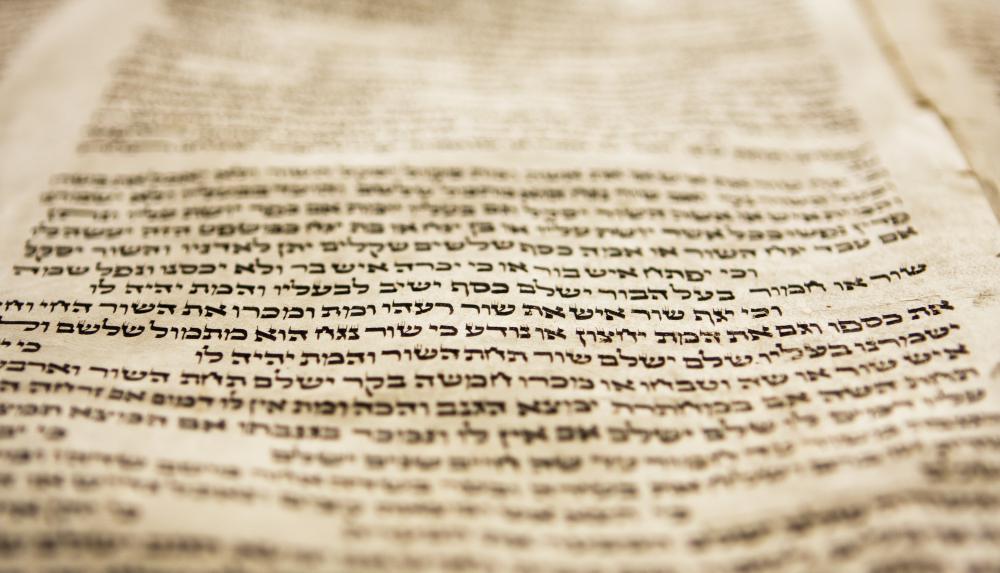
![The Hebrew language has continued on thanks in part to the Hebrew Bible.]() By: searagenThe Hebrew language has continued on thanks in part to the Hebrew Bible.
By: searagenThe Hebrew language has continued on thanks in part to the Hebrew Bible. -
![Hasidic man praying at the Kotel (Wailing Wall).]() By: Brian Jeffery BeggerlyHasidic man praying at the Kotel (Wailing Wall).
By: Brian Jeffery BeggerlyHasidic man praying at the Kotel (Wailing Wall).

Discussion Comments
Is there an easy way to type Hebrew fonts on my keyboard?
A big part of my motivation is that I have been getting pretty deep into Bible study and I really want to understand the context surrounding the book throughout the ages. In order to get anywhere near that long tradition I need to understand Hebrew. Any advice you can provide would be most appreciated.
@anon51516 - Yiddish is a Germanic language, related to German, English, Swedish, and Dutch. It is most similar to German, but it is written in the Hebrew alphabet rather than the Roman alphabet. It has been the language of European Jews for centuries.
Hebrew is a Semitic language, related to Arabic, Persian, and other languages of the Middle East. It is much older than Yiddish and from the middle ages. Until recently it was only used in religious contexts, like Latin in the Catholic Church.
what is the difference between Hebrew and Yiddish?
Post your comments