
At TheHealthBoard, we're committed to delivering accurate, trustworthy information. Our expert-authored content is rigorously fact-checked and sourced from credible authorities. Discover how we uphold the highest standards in providing you with reliable knowledge.
What is Head Lice?
Pediculosis capitis, or head lice, are small parasitic insects that infest the hair on the head. Unlike body lice, they do not pose any immediate health hazards, although they do present problems secondary to their presence. Most individuals with lice suffer from intense scalp itching and may also suffer from a rash or irritated skin as a result. Contrary to popular belief, these lice do not affect animals, but rather, are like the human version of fleas. They do not jump or fly, but crawl.
Head lice are a common problem among school-aged children, mostly due to many children being in close contact with one another, allowing the lice to spread. They are not an indicator of poor hygiene, however. It can be difficult to spot lice on the head, and often, an infestation is not noticed until severe itching prompts close inspection. Treatment is essential to relieve the host from the secondary symptoms of itching and irritated scalp as well as to prevent the continued spread of the bugs.

It's often easiest to spot lice at the nape of the neck and in the hair behind and just above the ears; however, the entire scalp should be thoroughly inspected. To thoroughly inspect the heads of children or adults, another person must part the suspected host’s hair into small sections and check the scalp and the hair shafts. Adult lice can be found crawling about the scalp, but nits, or lice eggs, will be attached to the hair shaft close to the scalp. Adult lice are about the size of a sesame seed and nits are oval shaped, off-white to tan in color, and if present, will be attached to one side of the hair shaft. They will not flake off like dandruff, but can be removed by sliding them down and off the end of the hair with the force of fingernails or a comb.

If either live head lice or nits are found on inspection, the host should be treated. Medicated shampoo and scalp treatment that kills the lice and their eggs is available over the counter at any pharmacy. In most cases, if the directions are followed to the letter, the treatment will be successful. In some cases, a prescription strength pesticide scalp treatment may be recommended. An infested person’s bedding and clothing should all be washed thoroughly in hot water at the time of treatment to avoid immediate reinfestation. In the home, carpets should be thoroughly vacuumed.

With careful attention, lice can be eliminated without too much difficulty. If they are a recurring problem, the source has likely not been treated. When a child or someone else in a home is having a recurring problem, a parent or other individual should check with his or her school, daycare, or office. If the problem is persistent or unusual symptoms such as fever or redness are present, the individual should see a healthcare professional.
AS FEATURED ON:
AS FEATURED ON:


-
![A head louse.]() By: Carolina K Smith MDA head louse.
By: Carolina K Smith MDA head louse. -
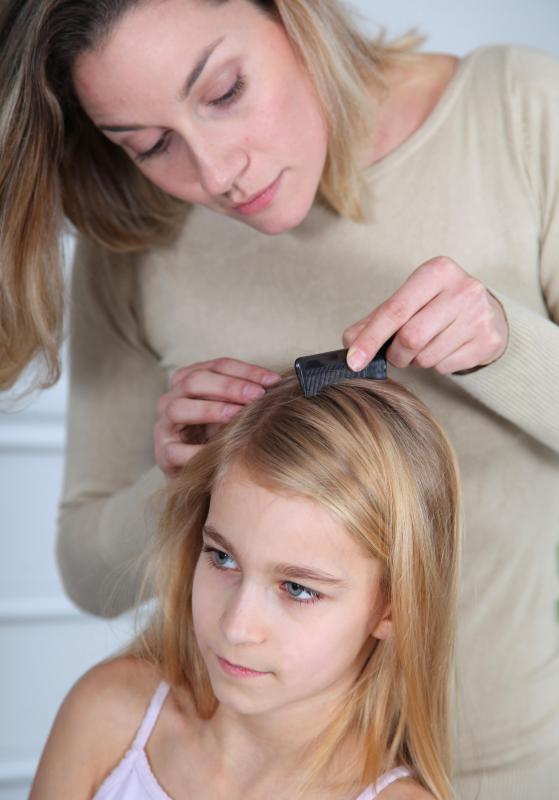
![Close inspection of a person's hair and scalp may be necessary to spot head lice and eggs.]() By: goodluzClose inspection of a person's hair and scalp may be necessary to spot head lice and eggs.
By: goodluzClose inspection of a person's hair and scalp may be necessary to spot head lice and eggs. -
![Lice are small parasites that infect the head and hair.]() By: VoyagerixLice are small parasites that infect the head and hair.
By: VoyagerixLice are small parasites that infect the head and hair. -
![Recurring head lice problems should be reported to the child's school or daycare center.]() By: sdennessRecurring head lice problems should be reported to the child's school or daycare center.
By: sdennessRecurring head lice problems should be reported to the child's school or daycare center.



Discussion Comments
i have come across a great way to eliminate nits and lice.
First, treat the hair with a lice treatment, as recommended on the box, then condition and detangle hair with a normal comb, then comb through with the nit comb. After hair is dry, use a hair iron e.g. GHD. I find it loosens the eggs with the heat and by straightening the hair with the ghd, actually burns the nits and they slide off very easily. I find this method great because my eight year old has very curly hair!
My daughter seems to have some lice eggs but no infestation or live lice is present. These have been found on her head for months. Should I treat her?
The adult form of the insect is called louse. Even though lice suck blood of the host, the itching is caused by their saliva and excretions.
If you have treated your child's head lice with an over the counter product and then rinsed thoroughly with warm water, as directed, and you see another live head lice on the scalp after the hair has just dried is there a problem with the treatment? In other words, should they all be dead following a treatment if performed properly?
Post your comments