
At Sports&Hobbies, we're committed to delivering accurate, trustworthy information. Our expert-authored content is rigorously fact-checked and sourced from credible authorities. Discover how we uphold the highest standards in providing you with reliable knowledge.
What is Hapkido?
 Mary McMahon
Mary McMahon
Mary McMahon
Hapkido is a type of Korean martial art which focuses on defense rather than offense, and is designed to neutralize an opponent through a range of techniques. It is a discipline that is also designed to clarify and calm the spirit, and those who practice hapkido are also attempting to develop themselves as individuals. While not as widely practiced as some other Asian martial arts, this form is enjoying increasing popularity in the West.
The practice of hapkido developed out of various other martial arts that have been performed for many, many years. The form as it is known today is considered to be a relatively modern martial art, with inception dates set around the mid 1900s. Two Grand Masters, Han Jae Ji and Yong-Sul Choi, are credited with shaping the discipline and introducing it to the West. Some, however, credit Yong-Sul Choi alone. Both Grand Masters came to the United States in the 1980s with the aim of opening hapkido schools and increasing Western awareness of the martial art, and were followed in later years by other masters who wanted to preserve the teachings of these two men.

In Korean, hapkido means the way (do) of life energy (ki) and harmony (hap). Hapkido is designed to be a martial art that harmonizes body energy while maintaining a state of non-aggression. Many martial arts focus on non-aggression, and can be practiced by men and women of all ranges of size and strength. This form is about calculated moves rather than brute force.

Hapkido is governed by three essential principles. The first has to do with a circular nature, that all motions move within a round and that activity while sparring is kept inside a ball of energy, with opponents focusing energy tightly within. This art also incorporates a principal of the river, which involves flowing and easily adapted motion; energy is conserved for the right moment, like a river breaking out. Hapkido uses the principle of influence, forcing a would be attacker to adopt defensive movements and leave openings which can be taken advantage of.
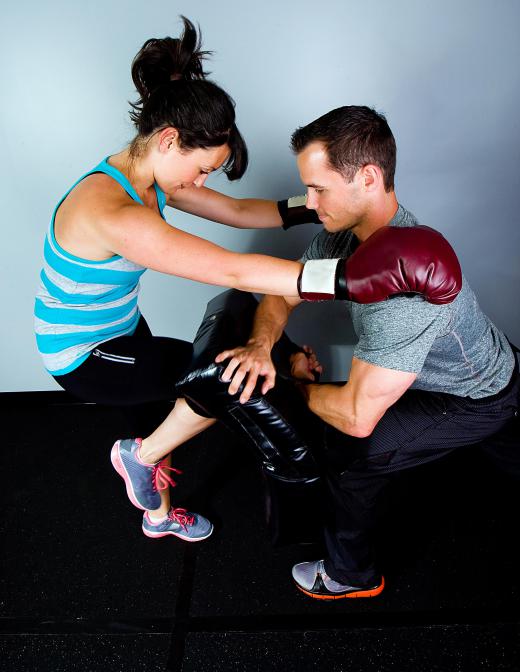
This discipline incorporates weapons, knowledge of nerve points, kicking, throws, joint locks, and hitting techniques into a flowing and beautiful discipline wherein an attacker can be easily neutralized. As a defensive martial art, Hapkido is designed to deflect attack back onto the attacker in a peaceful way. Often, it takes advantage of nerve points in conjunction with joints to immobilize an attacker. This discipline does not require great strength, and as a result, Hapkido is often integrated into self defense classes for weaker individuals.
Hapkido incorporates physical and spiritual discipline to build character as well as self defense skills. The desired end result is a well rounded, peaceful individual who is capable of self defense in situations where it is warranted.
Mary McMahon
Ever since she began contributing to the site several years ago, Mary has embraced the exciting challenge of being a Sports&Hobbies researcher and writer. Mary has a liberal arts degree from Goddard College and spends her free time reading, cooking, and exploring the great outdoors.
Learn more...
Mary McMahon
Ever since she began contributing to the site several years ago, Mary has embraced the exciting challenge of being a Sports&Hobbies researcher and writer. Mary has a liberal arts degree from Goddard College and spends her free time reading, cooking, and exploring the great outdoors.
Learn more...AS FEATURED ON:
AS FEATURED ON:


-
![Hapkido is a defensive martial art.]() By: ericcoteHapkido is a defensive martial art.
By: ericcoteHapkido is a defensive martial art. -
![Hapkido is useful for those desiring to learn self defense.]() By: Felix MizioznikovHapkido is useful for those desiring to learn self defense.
By: Felix MizioznikovHapkido is useful for those desiring to learn self defense. -
![Hapkido is often integrated into self-defense classes.]() By: Mat HaywardHapkido is often integrated into self-defense classes.
By: Mat HaywardHapkido is often integrated into self-defense classes.


Discuss this Article
Post your comments