
At DelightedCooking, we're committed to delivering accurate, trustworthy information. Our expert-authored content is rigorously fact-checked and sourced from credible authorities. Discover how we uphold the highest standards in providing you with reliable knowledge.
What is Guava?
A guava is the sweet fruit of the guava tree, which grows in tropical regions of America and Asia. The genus consists of about 100 small trees and shrubs, with the Psidium guajava species being the most cultivated for food. The fruit can be eaten raw or used to flavor drinks, desserts, and sauces.
The guava is believed to have originated in an area extending from southern Mexico into Central America. Since 1526, it has been common throughout all warm areas of tropical America, the West Indies, the Bahamas, and Bermuda. It was introduced to Florida in 1847 and was brought from there to the East Indies and Guam. It is likely that it spread from those regions to Asia and Africa. It was introduced to Hawaii in the early 19th century and is now common throughout the Pacific islands.

The plant is evergreen, in the form of either shallow-rooted shrubs or trees up to 33 feet (10.05 meters) in height. The tree has a smooth copper-colored bark that flakes off to reveal a green layer underneath and has branches that spread at the top of the tree. The leaves are green and leathery. In addition to fruit, the tree also bears fragrant white flowers with four or five petals.

Guava trees need warm climates. They do best in areas with full sun that receive no frost. They are often grown using vegetative propagation or from root cuttings. These plants are relatively indiscriminate regarding soil, and in general adapt easily. Unlike most tropical fruits, they can be grown to fruiting size in pots indoors.
The fruit may be round, ovoid, or pear shaped and is 2-4 inches (5-10 cm) in diameter. Its thin skin is bright yellow in color, sometimes tinged with red. The flesh is white or orange-pink depending on the variety, and contains many small, hard seeds. The guava is characterized by a strong, sweet odor. Many varieties are grown for their fruit, including the Psidium cattleianum (strawberry guava), Psidium guajava (apple guava), and Psidium friedrichstahlium, the Costa Rica guava.

The guava is rich in vitamins A, B, and C, as well as beta carotene. It can be eaten raw, either out-of-hand or seeded and sliced in desserts or salads, although cooking eliminates the strong smell. The fruit is widely canned and sold for export, as is juice, nectar, and shells, which are stewed and served as a desert in Latin America and Spanish-speaking islands of the West Indies. There are countless recipes for the use of guava in pies, cakes, puddings, jellies, and chutneys, and the fruit may even be dehydrated and powdered to flavor ice cream.
AS FEATURED ON:
AS FEATURED ON:


-
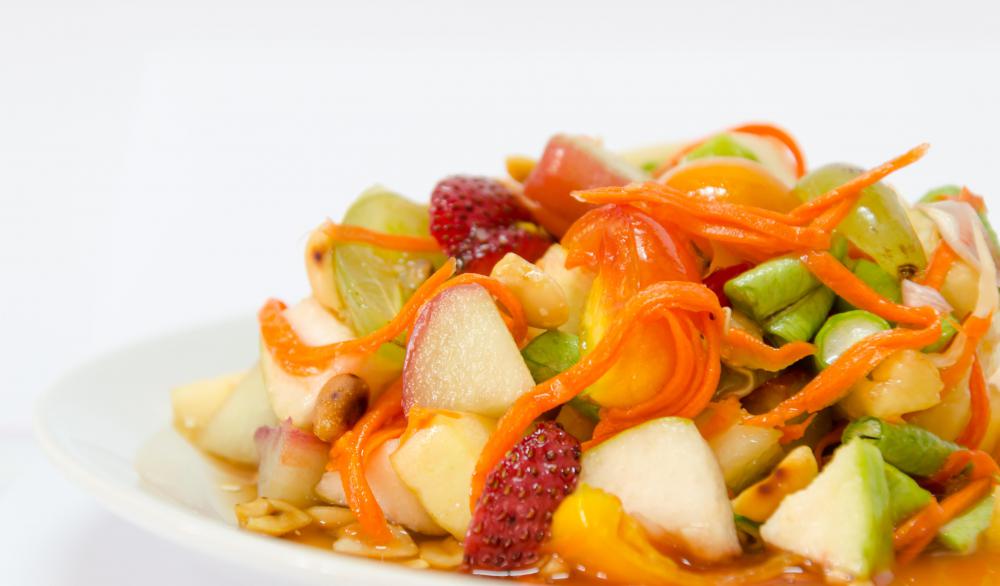
![Guava is delicious added to a salad.]() By: kophotosGuava is delicious added to a salad.
By: kophotosGuava is delicious added to a salad. -
![The evergreen Guava tree flourishes in warm climates.]() By: wuttichokThe evergreen Guava tree flourishes in warm climates.
By: wuttichokThe evergreen Guava tree flourishes in warm climates. -
![The pulp of a guava is pale yellow to pink depending on the variety.]() By: tashka2000The pulp of a guava is pale yellow to pink depending on the variety.
By: tashka2000The pulp of a guava is pale yellow to pink depending on the variety. -
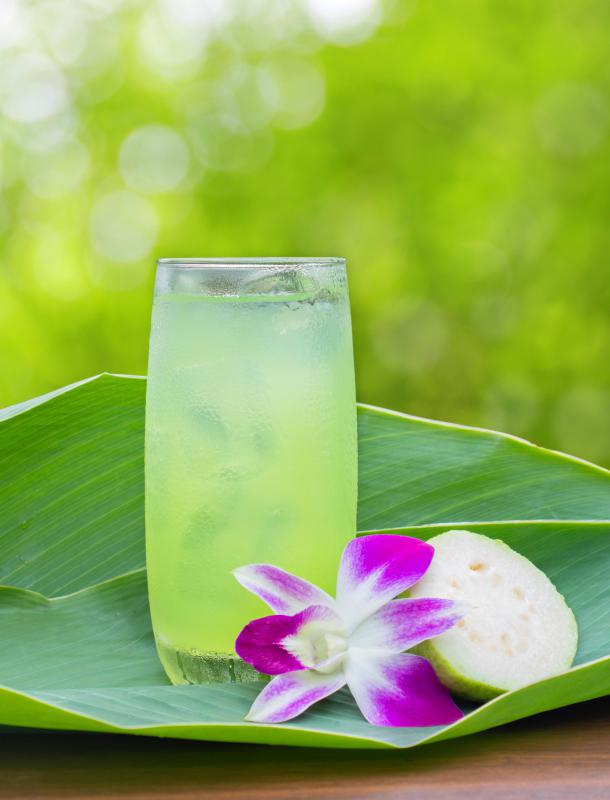
![Naturally sweet, guava makes a refreshing beverage.]() By: nataraNaturally sweet, guava makes a refreshing beverage.
By: nataraNaturally sweet, guava makes a refreshing beverage.


Discussion Comments
Why does guava always have a living worm inside it? Even if you buy it in a shop, the worm is always there. I am in South Africa, eastern cape.
I love fresh guava. I grew up eating it in India. We also make guava chutney back home. It's made with guava pulp, chili, coriander, ginger, lemon juice or vinegar, and salt to taste. We put all the ingredients through a blender and put it in a jar. It keeps for one to two weeks in the fridge.
It's so good with spicy fried snacks. It's also good with kabobs. Yum!
@burcidi-- Some people think that it tastes like a combination of fruits like mango, pear and strawberry. I think it tastes more like pear.
But there are different kinds of guava out there and the taste varies depending on the type.
There are also two fruits with guava in their name. One is pineapple guava and the other is strawberry guava. Strawberry guava doesn't look like or taste like guava. Pineapple guava looks like guava but is more juicy and sweet.
You should try it, it can be found at most groceries.
What does guava fruit taste like? Is it like a mango?
I just got back from visiting family in Santa Barbara California and there are several guava bushes on their property so to the person who wonders if they can grow them in Southern California, I would think that you can. My grandchildren introduced me to eating the flowers. My but they are sweet and I was told that the fruit which matures in the fall is even sweeter.
Guava is one of my all time favorite fruits but they’re so expensive to buy. Reading this has got me thinking about trying to grow it. I live in southern California so the climate is warm (though we do sometimes freeze in winter).
I’m wondering if they can they be grown where I live? Can they be grown from the seeds? I’d love to hear from someone who knows about growing a guava plant.
I love guava almost as much as I love papaya. When I was in India last year, I tried guava with masala and it was delicious. It was a little spicy, but still really good.
Post your comments