
At DelightedCooking, we're committed to delivering accurate, trustworthy information. Our expert-authored content is rigorously fact-checked and sourced from credible authorities. Discover how we uphold the highest standards in providing you with reliable knowledge.
What is Gruyere?
 Mary McMahon
Mary McMahon
Mary McMahon
Gruyere is in the family of Swiss cheeses, a group of semi firm pale cheeses stippled with small holes or air pockets. It also has the distinction of carrying an appellation d'origine controlee, or protected origin designation, which means that only a specific cheese can be labeled and sold with this name. Gruyere is a popular cheese around the world, where it appears in a wide variety of dishes.
Cheeses in other parts of the world, including France, are very similar to Gruyere and considered to be "Gruyere-type" cheeses. Only cheese made in the Gruyere region of Switzerland can be labeled as such, with French relatives going by other names, including Comté and Beaufort. The cheese gained its protected origin designation in 2001, and has hotly defended it since, with some detractors arguing that it is not Swiss alone, but made all over the world. Protected origin designations are designed to protect the culinary heritage of many European countries, and to allow consumers to clearly understand what they are buying. In the case of this product, some critics felt that the Swiss were trying to monopolize the popular cheese.

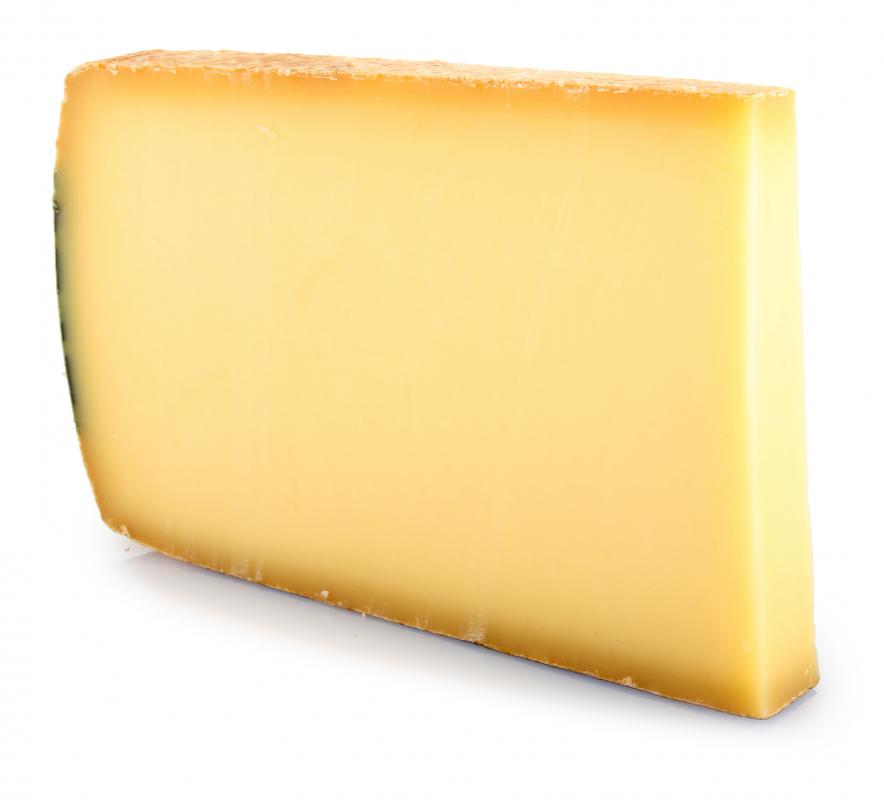
Gruyere is a creamy, pale cheese with small holes and a slightly granular texture. The holes rarely exceed the size of a pea, and are widely dispersed within the cheese. The flavor is rich and somewhat nutty. The cheese is also slightly salty, because it is a brined cheese. Because Gruyere has a distinctive but not overpowering flavor, it is an excellent addition to quiches, soups, salads, and pastas. It can be sliced or grated, depending on the desired effect.

The cheese is made from unpasteurized milk that is heated to 93°F (34°C) before being curdled with liquid rennet. The mixture is stirred until the curd has begun to firm, and then it is quickly cut to release the whey before being heated further, until the curd begins to shrivel slightly. These pieces of curd are pressed into molds to be cured, and then salted in brine for eight days.

After being pulled from the brine, the cheese is ripened for two months at room temperature. Once the cheese has been ripened, it is aged for three months to one year, with more aged cheese having a more developed and intense flavor. It is generally agreed that the more the cheese is aged, the better the flavor will be, with young Gruyere having a slightly sharp raw flavor that will temper with age.
Mary McMahon
Ever since she began contributing to the site several years ago, Mary has embraced the exciting challenge of being a DelightedCooking researcher and writer. Mary has a liberal arts degree from Goddard College and spends her free time reading, cooking, and exploring the great outdoors.
Learn more...
Mary McMahon
Ever since she began contributing to the site several years ago, Mary has embraced the exciting challenge of being a DelightedCooking researcher and writer. Mary has a liberal arts degree from Goddard College and spends her free time reading, cooking, and exploring the great outdoors.
Learn more...AS FEATURED ON:
AS FEATURED ON:


-
![Thick slice of Gruyere cheese.]()
Thick slice of Gruyere cheese. -
![Fontina cheese can be a good substitute for gruyere.]() By: LsantilliFontina cheese can be a good substitute for gruyere.
By: LsantilliFontina cheese can be a good substitute for gruyere. -
![Only cheese made in the Gruyere region of Switzerland can be labeled with this name.]() By: vencavOnly cheese made in the Gruyere region of Switzerland can be labeled with this name.
By: vencavOnly cheese made in the Gruyere region of Switzerland can be labeled with this name. -
![Gruyere is popularly used in quiche recipes.]() By: MIGUEL GARCIA SAAVEDGruyere is popularly used in quiche recipes.
By: MIGUEL GARCIA SAAVEDGruyere is popularly used in quiche recipes. -
![A salt brine gives cheese more flavor and extends its longevity.]() By: OkeaA salt brine gives cheese more flavor and extends its longevity.
By: OkeaA salt brine gives cheese more flavor and extends its longevity.



Discussion Comments
I would use gouda.
It was awfully tasty though, and a classy touch to what was otherwise a pretty disappointing party.
To those who want a substitute to Gruyere try Franche Comte. It has a better flavor profile and melts just as well as Gruyere. Also, stop looking in the supermarket for your cheeses. Invest a little time and shop at your local cheeses shop or gourmet store. You will most likely find what you need there and will be able to speak to someone who can actually help you!
How does Monterey Jack match up with Gruyere?
i thought gruyere was a smoky type of cheese.
i actually wouldn't use provolone in place of gruyere, especially in a mac and cheese dish. Provolone does not melt in the same way gruyere does. Provolone is more appropriate for melting on sandwiches or alone. Use a well aged swiss instead. When used with sharp cheddar it makes an excellent mac and cheese.
Actually Gruyere has a much better flavor than swiss cheese and it is much creamier. I keep it on hand for French Onion Soup because it's very good. Provolone might be your closest match. I'm shocked that I can find Gruyere here in podunk (Marianna, Fl. piddly little town in very N FL) and you can't find it.
I'd try provolone in it's place in recipes. It's not quite as expensive and close to the same flavor and texture.
What can I use if I cannot find Gruyere cheese for my recipes? I want it for mac and cheese and also a potato torte. Would regular swiss cheese be okay? Thank you.
if i cannot find gruyere cheese at my local grocer, what can i use in a mac and cheese dish along with bleu cheese and sharp chedar?
If I cannot find the gruyere cheese, what can I use as a substitute?
what are the 3 Types of Gruyere Cheese produced in Europe? Thanks!
If I cannot find gruyere cheese in any of my local grocers what can i use in place of gruyere on a cheese straw calling for parmesean and gruyere?
Post your comments