
At WiseGEEK, we're committed to delivering accurate, trustworthy information. Our expert-authored content is rigorously fact-checked and sourced from credible authorities. Discover how we uphold the highest standards in providing you with reliable knowledge.
What is Green Tea?
Green tea comes from a tea plant native to Asia called Camellia sinensis, the same plant that is the source of black tea. What makes green tea different, and green, is not the plant used to make the tea, but how it is processed. It is the least processed of commercial teas, and the method used preserves more of the nutrients and health benefits. Green tea has been used for thousands of years in both China and Japan, this type of tea is reputed to provide major health benefits.
To make green tea, the leaves are picked and then immediately fired, a tea processing term which means they are either steamed or heated. The leaves are then dried and prepared for either sale or further processing. Other teas are picked, dried by a process commonly called "withering," rolled or broken to induce oxidation, and then dried. Oxidation removes most of the necessary nutritional values from the tea, and then the leaves are dried to halt the process. Teas that have been oxidized are called black teas, and they include most of the tea people drink in the Western hemisphere. Because of the process used to make this tea, most of the antioxidants that are proven to provide health benefits are removed.
Green tea has a much lighter hue and flavor than black tea, due to the minimal processing. It also still includes most of the plant's antioxidants.

Many people believe that green tea has curative effects. Recent studies indicate that the antioxidants it contains do boost health and the immune system, and the American Cancer Society has studied whether this tea may prevent or treat cancer. Other studies indicate that it may ward off or slow Alzheimer's disease. Many believe that green teas are an effective aid in weight loss and others believe they offer benefits for arthritic patients.

Green teas are available in leaf form, in tea bags, in nutritional supplements, and as prepared beverages. People who are interested in how using this tea may improve their health should check with a medical professional or an herbalist, or look in bookstores for complete information about its proven and perceived benefits.
AS FEATURED ON:
AS FEATURED ON:









-
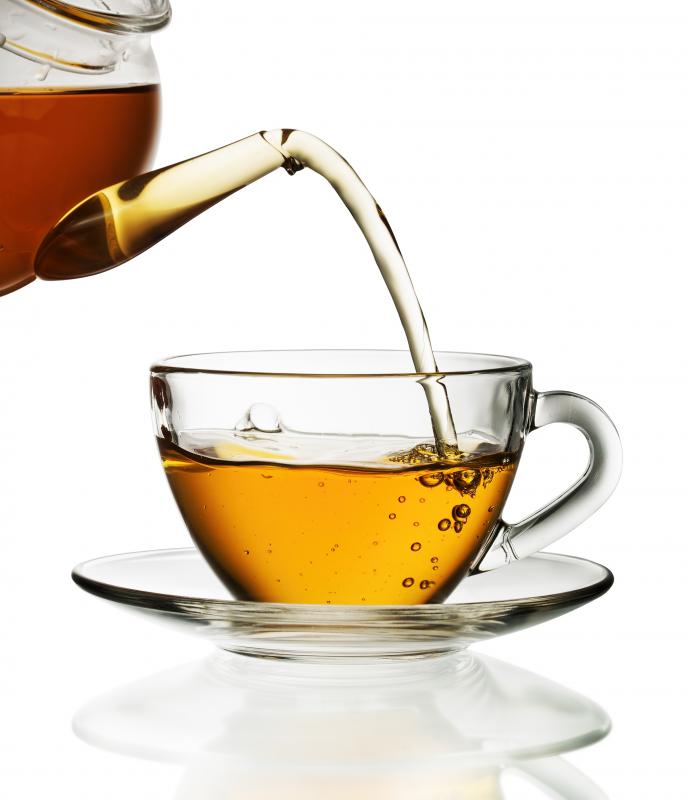
![There are many health benefits associated with drinking green tea.]() By: aleksandra_1981There are many health benefits associated with drinking green tea.
By: aleksandra_1981There are many health benefits associated with drinking green tea. -
![Many people believe drinking green tea has curative effects.]() By: tankist276Many people believe drinking green tea has curative effects.
By: tankist276Many people believe drinking green tea has curative effects. -
![Some studies have shown green tea to be effective in warding off Alzheimer's disease.]() By: chuugoSome studies have shown green tea to be effective in warding off Alzheimer's disease.
By: chuugoSome studies have shown green tea to be effective in warding off Alzheimer's disease. -
![The American Cancer Society has been studying whether green tea may prevent or treat cancer.]() By: DreadlockThe American Cancer Society has been studying whether green tea may prevent or treat cancer.
By: DreadlockThe American Cancer Society has been studying whether green tea may prevent or treat cancer. -
![Green teas may be an effective aid in weight loss.]() By: milanmarkovic78Green teas may be an effective aid in weight loss.
By: milanmarkovic78Green teas may be an effective aid in weight loss.



Discussion Comments
I really like the Bigelow green tea. I tried it at a hotel and liked it so much that I bought a box for my house. My sister also loves it.
Well, green tea might help you, but it won't shed your weight overnight, nor will you lose the weight you want with green tea alone. Problem is, many "green tea" brands are not really selling green tea. I was shocked by it.
great site.
Here's a Chinese folk prescription for green tea that's supposed to help with high cholesterol and diabetes: Pour about 200 ml (6 oz) of hot water over 5 g (0.18 oz) green tea, 10 g (0.35 oz) hawthorne (you can find this in most health food stores), and 5 g (0.18 oz) orange peel. Soak for 5 minutes and enjoy! "They" recommend a cup a day.
you don't have to throw out your used green tea leaves after you've made yourself a great cup of tea. you can use it as a mask! to the wet green tea leaves, just add 1 egg white, 2 drops of honey, and 2 drops of milk. combine well and apply to your face for 20 minutes 2 times a week!
this recipe from the tea growing area of china is said to reduce the signs of aging!
Post your comments