
At TheHealthBoard, we're committed to delivering accurate, trustworthy information. Our expert-authored content is rigorously fact-checked and sourced from credible authorities. Discover how we uphold the highest standards in providing you with reliable knowledge.
What is Granulomatous Mastitis?
 Mary McMahon
Mary McMahon
Mary McMahon
Granulomatous mastitis is a rare condition in which the breast becomes inflamed, developing a mass of tissue that is sometimes mistaken for a cancerous growth. Diagnosis is complicated by the fact that the condition mimics breast cancer, which means that a healthcare professional may require several different tests to confirm a diagnosis and decide on the best treatment plan. This condition most commonly appears after a woman has a child, emerging usually about two years after the pregnancy, although this is not always the case.
A woman with granulomatous mastitis may experience discharge from the breast, along with tenderness and inflammation, which can cause the breast to feel hot to the touch. If the condition is allowed to progress, the breast can become wrinkled and pitted as the mass continues to grow inside.

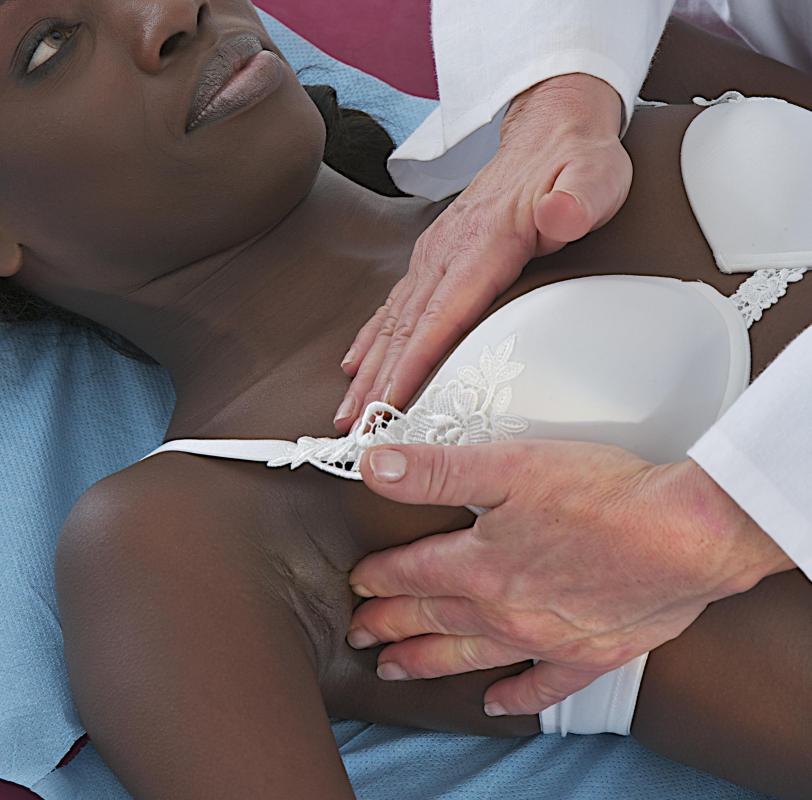
During a breast exam, a medical professional will usually be able to feel a mass inside the breast. This mass is actually a granuloma, a spontaneous collection of immune cells, not a tumor, but it can feel quite similar. Women may also find the mass on a breast self-exam. The healthcare professional may recommend testing, such as an imaging study to look inside the breast and a biopsy to examine cells taken from the mass of tissue. The biopsy result will show that the mass is granulomatous in nature.

Treatment for granulomatous mastitis can include surgery to remove the granuloma and drain the wound. The patient is also given steroids to combat the inflammation. If the condition resolves successfully after treatment, there is a 50% chance that it will recur. One of the major problems with the treatment of this condition is that long-term steroid use can have serious side effects, but the only way to successfully get rid of the issue is to put a patient on a long course of steroids. Treatment must balance the need to resolve the inflammation with a desire to avoid causing complications for the patient.

The cause of granulomatous mastitis is not well understood. Some researchers have suggested that it may be simply a more extreme form of the mastitis or inflammation of the breast that some breastfeeding women experience. Others suggest that it may be connected with the use of hormonal contraception, since it often appears after breastfeeding is concluded and a woman has started taking hormones to prevent an additional pregnancy.
Mary McMahon
Ever since she began contributing to the site several years ago, Mary has embraced the exciting challenge of being a TheHealthBoard researcher and writer. Mary has a liberal arts degree from Goddard College and spends her free time reading, cooking, and exploring the great outdoors.
Learn more...
Mary McMahon
Ever since she began contributing to the site several years ago, Mary has embraced the exciting challenge of being a TheHealthBoard researcher and writer. Mary has a liberal arts degree from Goddard College and spends her free time reading, cooking, and exploring the great outdoors.
Learn more...AS FEATURED ON:
AS FEATURED ON:


-
![A mass of tissue that develops on the breasts is known as granulomatous mastitis.]() By: lenets_tanA mass of tissue that develops on the breasts is known as granulomatous mastitis.
By: lenets_tanA mass of tissue that develops on the breasts is known as granulomatous mastitis. -
![Granulomatous mastitis commonly occurs a few years after a pregnancy.]() By: vasiliystepanovGranulomatous mastitis commonly occurs a few years after a pregnancy.
By: vasiliystepanovGranulomatous mastitis commonly occurs a few years after a pregnancy. -
![An imaging test may be ordered if a clinical exam finds any abnormalities in the breast.]() By: JPC-PRODAn imaging test may be ordered if a clinical exam finds any abnormalities in the breast.
By: JPC-PRODAn imaging test may be ordered if a clinical exam finds any abnormalities in the breast. -
![A woman with granulomatous mastitis may experience tenderness and discharge from the breasts.]() By: ArtoA woman with granulomatous mastitis may experience tenderness and discharge from the breasts.
By: ArtoA woman with granulomatous mastitis may experience tenderness and discharge from the breasts. -
![Graculomatous mastitis may cause a breast to be hot to the touch.]() By: Marin ConicGraculomatous mastitis may cause a breast to be hot to the touch.
By: Marin ConicGraculomatous mastitis may cause a breast to be hot to the touch.




Discussion Comments
I treat many woman with IGM. We use Methotrexate and close monitoring with a slow titration off over a year.
This article is not entirely accurate. Steroids are not a cure. You trade the painful inflammation for a ton of awful side effects, only to have the painful inflammation return when the dosage is tapered. One to two years is an expected duration. It stinks, but that is the reality of the disease. Everyone is different, but we can all relate to the pain and misery that go along with IGM.
My cousin has IGM and is desperately trying to find a doctor to help her. Is there a special doctor to go to? Her insurance is not great and doctors keep turning her down. Please help.
I suffered from IGM for three years. I had daily pain, inflammation four or five times a month on both breasts with major abscesses in the nipples and a weight loss of 17 kilos. I tried a lot of different kind of antibiotics, but nothing helped. Steroids weren't an option. Since the IGM was so severe in both breasts, it would mean a life long recurrence of IGM and the use of steroids with all the side effects.
Last week, I finally got a permanent solution: a double mastectomy with placement of expanders. I feel so much better. No more pain, except for some muscle pain, which is to be expected. I am so much happier and I also look much better, and have started to put on some weight as well.
Some posts say that IGM will disappear with or without treatment of steroids or other medication or in a period of 14 months, but this is not entirely correct, as I know very well from experience. It has put a great strain on my family.
My youngest only knows his mummy having pain. I am very happy with my solution. All the breast tissue has been removed, so the changes of recurrence are nil.
We just found out my wife has granulomatous mastitis. There is not much information regarding the treatment it seems to me that is trial and error since there is a 50 percent chance of it coming back. Well the good news is not cancer.
I got IGM in late October 2007. At the time my last child was six years old. I too, never breastfed nor did I take any type of birth control. Prior to my diagnosis, I was placed on antibiotics and was sent to have a mammogram and biopsy done.
During the biopsy, the tech was insistent that it was a abscess and proceeded to try and remove fluid from the mass with no success. The test came back inconclusive. I was finally sent to a breast specialist, who decided to do surgery that same week, where I was told that the disease grew what they called fingers and imbedded itself into the tissue. They ended up removing over a quarter of my breast tissue. And I was placed on high doses of steroids for over six months.
The surgery itself was horrible, the site was left open and the packing inside had to be changed daily. I to was told that I have a fifty percent chance of a recurrence. Although I have had some symptoms since the surgery, it has never completely come back.
My wife had mastitis while breast feeding of our first baby and now she is seven weeks pregnant again 2 and a half years later. Can the mastitis come back now? We are worried about the new baby and its development. Would mastitis come back after or before the birth?
I was diagnosed with IGM six months ago. I breast-fed seven years ago and I took steroids for six months. Some lumps have vanished but a new one appeared three months ago.
My doctor has changed the medicines to Methotrexate and cyclosporine. But I wonder if surgery is better or stopping all the medicine?
I have granulomatous mastitis for the past nine months. I have completed 19 or 20 weeks on steroids which calmed the swelling and redness. Recently the inflammation has started again. My doctor is also recommending the "wait and see" approach.
My history: one child, breastfed for six months. My child is now 6 years old.
I am open to any recommendations of natural cures for this.
I came down with IGM about a year ago. For the first two months, I sought the advice and treatment of a surgeon, who insisted I had an extreme infection and who treated one of the "bumps" as an abscess and who wanted to take out the milk ducts in that breast completely.
Thankfully, after cancer testing and proper cell testing, I was diagnosed with IGM. The doctor believes in a wait and see approach which has been the most beneficial treatment so far. She did want to drain the growths as they surfaced to to skin, but I found the draining as painful, or more so, than if I just let them drain little by little. Fortunately, today, I feel much better and my breast is almost back to normal.
From all the research, limited as it may be, that I have read, I think most conditions self-correct after an average of 14 months, with or without treatment. If you've been recently diagnosed, please don't rush to surgery, but do get the proper cancer and cell testing and don't hesitate to get a second opinion.
My baby just turned five years old. I didn't breast feed him, but did breast feed my daughter who is now 9. In October of last year my left breast became very sore and by November (a month later) I had several sections that had hard areas. The first thing I thought of was cancer. It turned out to be Granulomatous Mastitis.
Since November, I've had five different surgical biopsies where the doc was wanting to just constantly cut away to make sure it wasn't inflammatory breast cancer.
I changed doctors three months ago and he put me on steroids that took care of the hard, swollen areas. But I still have an area that is infected from surgery about four months ago. I also recently found a knot above the infected area. My doc is now discussing a full mastectomy.
I was diagnosed with granulomatous mastitis and it resolved on its own without any steroids or any medication whatsoever in three months.
I've had surgery on both breasts due to granulomatous mastitis with very barbaric after treatments, and I was not breastfeeding. I've been treated for hyperprolactinemia for nine years and still taking cabergoline. Is there a connection?
I am currently on treatment for IGM, Professor gave me methotrexate and steroids. Breast is so much better.
I had IGM three years ago and had surgery. I recently stopped breast feeding four months ago and i feel like my pain is coming back. Last time i was told by my doctor that in 25 years he has operated on four women for the same reason and none of them has come back after surgery. i see some posts here saying that it can return?
Agree with poster #3. I've never been pregnant either and have recently been diagnosed with granulomatous mastitis. Haven't reviewed treatment with doctor yet. Wonder if others have taken medication that blocks dopamine such as Chantix (to quit smoking), and if there is a connection?
I have just been released from 37 days in hospital with IGM or similar, resulting in very painful surgery and after treatment was barbaric.
Removing the infection from my breast will also not guarantee that it does not come back. I have not breastfed for six years and this basically came from nowhere. I was well one day and very sick the next.
I also suffered from IGM in August 2009 and had to take the steroids. I did not like they way they made me feel so I quickly began to ween (under doctors supervision) and the lump and pain went away. Since then I rely on herbs and other fresh fruits and vegetables to keep it from returning. I have been symptom free for a year now!
This article is not accurate - I have IGM and have never been pregnant - as is the case with other women. Treatment information is also outdated and incomplete. Do not rely on this information. wkzy
This article states that the only treatment for IGM is the use of steroid treatment, however, recent studies have shown that Methotrexate, taken as a monotherapy, can be more effective with less side effects.
Post your comments