
At TheHealthBoard, we're committed to delivering accurate, trustworthy information. Our expert-authored content is rigorously fact-checked and sourced from credible authorities. Discover how we uphold the highest standards in providing you with reliable knowledge.
What is Goiter?
A goiter is the enlarging or swelling of the thyroid, a tiny gland found near the Adam's apple in the neck. The swollen area may be sore and tender or may not be painful at all. In some cases, it can put pressure on the esophagus, which can result in a tight feeling around the throat, causing shortness of breath or a choking sensation. There are different kinds of goiters, with the most common being colloid, toxic nodular, and nontoxic.
Colloid refers to a goiter caused by hypothyroidism, or decreased production of thyroid hormones. In this case, the thyroid gland increases in size because it is attempting to produce a greater amount of hormones. Weight gain or the inability to lose weight may be an issue for people suffering from this condition, because the hormones made by the thyroid are essential to healthy metabolism. Slow metabolism causes people to burn calories at a decreased rate.

A toxic nodular goiter usually refers to hyperthyroidism or the excess production of thyroid hormones, as well as other inconsistencies — including malignancies — in the nodules of the thyroid. People with this condition may have difficulty gaining weight. A nontoxic goiter does not include malignancies.
This type of swelling is thought to be caused by iodine deficiency in many cases, although with the advent of iodized products such as table salt, iodine-related thyroid problems have decreased by large numbers in the United States and many other countries. Other causes include thyroid cancer and non-malignant thyroid cysts. Hormonal changes in the body, like pregnancy or puberty, as well as certain foods, can also cause swellings, but these are usually small and not problematic.

There are many treatment options available, although a very small or non-problematic goiter may simply be observed for some time before treatment is indicated. One that requires medical attention may be treated with hormone replacement therapy, although in some cases, surgery is required. If the swelling causes too much pressure on the windpipe, prevents proper swallowing or breathing, or presents uncertainties regarding a malignant nature, for example, surgery may be advisable.
AS FEATURED ON:
AS FEATURED ON:


-
![There are many treatment options for a person with a goiter.]() By: Gabriel BlajThere are many treatment options for a person with a goiter.
By: Gabriel BlajThere are many treatment options for a person with a goiter. -
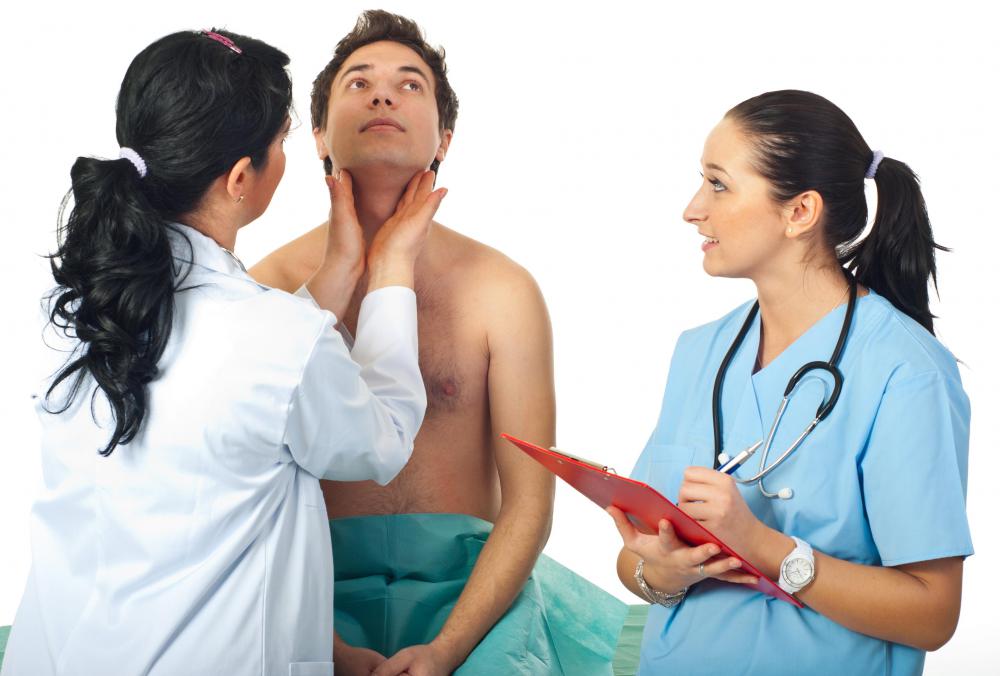
![A goiter is a swollen thyroid gland, seen near the Adam's apple.]() By: Tony AlterA goiter is a swollen thyroid gland, seen near the Adam's apple.
By: Tony AlterA goiter is a swollen thyroid gland, seen near the Adam's apple. -
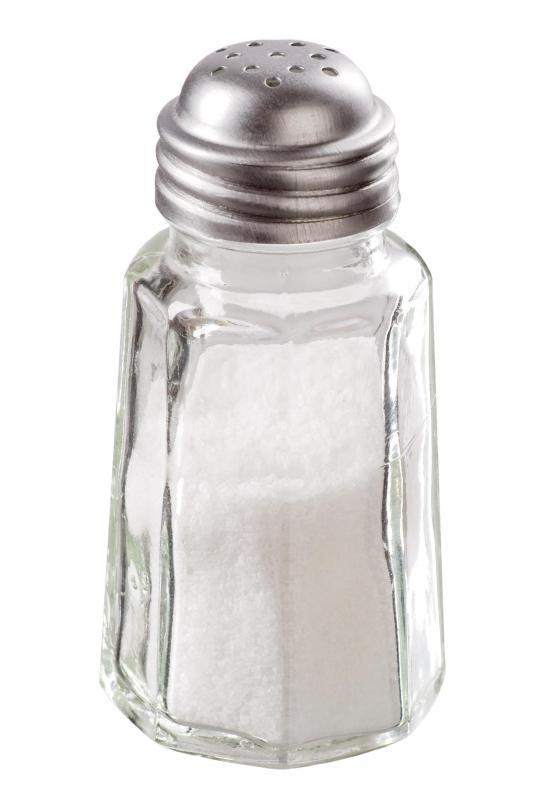
![Iodized salt, which can help prevent goiters.]() By: ViktorIodized salt, which can help prevent goiters.
By: ViktorIodized salt, which can help prevent goiters. -
![Having a goiter may cause weight gain.]() By: KzenonHaving a goiter may cause weight gain.
By: KzenonHaving a goiter may cause weight gain.


Discussion Comments
What are the foods that I should not eat if I have a problem with goiter?
What's the difference between hypothyroidism and hyperthyroidism? Are both curable? how can we treat them? what do the preventive measures usually do? Is there any house care we can do? what are the medications?
what is the difference between a goitre and adam's apple.
what is the difference between a cyst and a goiter?
What is the difference between goiter and thyroid cancer?
Many goiters can be treated homeopathically. The results blew me away. Finding a good homeopath was the hardest part.
Non-toxic goiter. Mostly left side. 56 years, MALE. Family history. Thyroid measures, TSH, T3, T4 absolutely *normal*.
Think goiter was triggered by something else.
Working on shrinking with massage during exercise (biking) and Kelp. May be working.
What is the difference between the toxic and non-toxic goiter, what are the causes of toxic and non-toxic goiter? Are there any food that are allowed to eat if there's presence of toxic and non-toxic goiter? how to prevent this and how to treat?
What kind of food can a patient with non toxic goiter eat? and what kind of food should she not eat? Is it advisable to have an operation to a patient with non toxic goiter?
what kind of food can a patient with toxic goiter eat? and what kind food should he/she not eat?
I have been diagnosed with a colloid nodular goiter and have been on medications and have had many biopsies and nothing seems to work. My goiter is quite large and very noticeable. The last biopsy states that I have a lot of fluid...what ever that means. Nobody can seem to help me but every doctor I see says the same thing- put me on medication and see if it works, but it does not, one doctor even took me off the medication because he said everything was fine. My nodular hurts quite a bit sometimes, and it is hard to sleep at night because I feel like I can't breath when my head is in certain positions. I have had this problem ever since I was little and now in my 40's and still no one can help. Does anyone have any suggestions or help they can provide?
good day. im diagnosed with non toxic goiter nodule with lower left lobe. im undergoing thyroid examination. like thyroid ultrasound, thyroid scan. t3,t4 and irma. in my thyroid scan they told my that is cold nodule, and only t4 is abnormal which is above the normal t3. is it true that only taking medicine will cure with cold nodule? and im having problem because i went to two endocrinologists but different answer to my question. please help me with my problem.
what is the difference between toxic goiter and non-toxic goiter, and what are the causes of toxic and non-toxic goiter? Are there any foods that are not allowed to eat if there is presence of toxic goiter and non-toxic type? how to prevent this and to treat?
Post your comments