
At DelightedCooking, we're committed to delivering accurate, trustworthy information. Our expert-authored content is rigorously fact-checked and sourced from credible authorities. Discover how we uphold the highest standards in providing you with reliable knowledge.
What is Goat Cheese?
 Mary McMahon
Mary McMahon
Mary McMahon
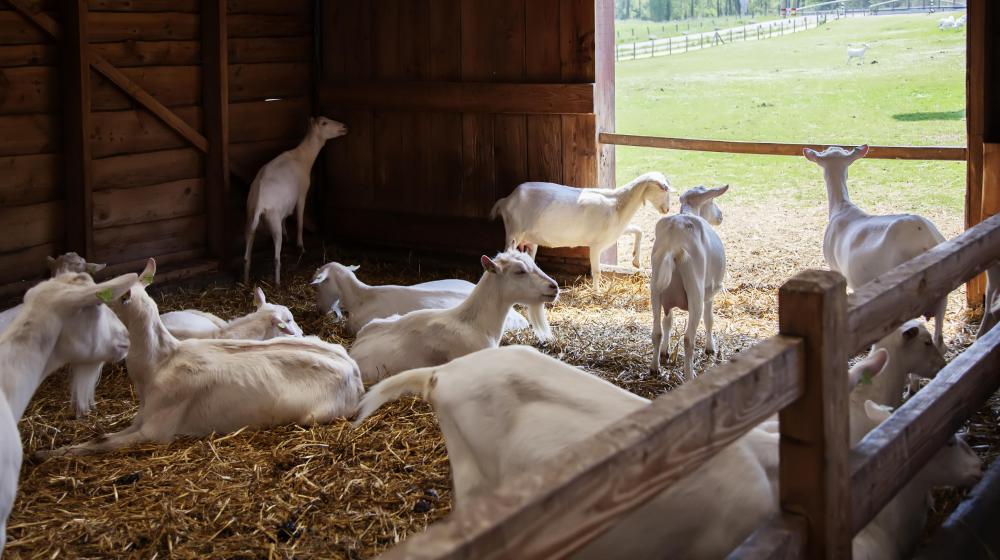
Goat cheese, sometimes called chevre, is a food product made from the coagulated milk of goats. It comes in a wide variety of forms, although the most common is soft and easily spread. This cheese can also be made in hard aged varieties, as well as semi firm cheeses like feta. It is especially common in the Middle East, Africa, and some Mediterranean countries, where the hardy goat survives in areas where cows cannot.
Cheese made from goat's milk is distinctive due to its tangy flavor. The taste can sometimes be very strong, which not all consumers enjoy. In some cases, the flavor is sought after, and some dairies are well known for producing particularly "goaty" cheese. The strong flavor is caused by hormones, which will be reduced if milk producing nanny goats are kept away from male billies. In addition, like all animal products, the milk is heavily influenced by what the goats are eating. Because these animals have hardy digestive systems, they tend to eat many bitter plants that more delicate animals, such as cows and horses, will not.

Goat milk is often used by those who are young, ill, or have a low tolerance to cows milk. It is much more similar to human milk than that of the cow, being thinner, lower in fat, and higher in vitamin A and potassium. Although cows are more common in Western countries, goat milk and cheese are preferred in much of the rest of the world. Because goat cheese is often made in areas where refrigeration is limited, aged cheeses are often heavily treated with salt to prevent them from rotting. As a result, many people associate a salty flavor with this food, especially in the case of the heavily brined feta.

Cheese has been made from goat's milk for thousands of years, and it was probably one of the earliest made dairy products. In its simplest form, goat cheese is made by warming the milk, mixing it with rennet so that it curdles, and then draining and pressing the curds. Soft cheeses are made in kitchens all over the world, with cooks hanging bundles of cheesecloth filled with curds up in the warm kitchen for several days so that they can drain and cure. If the cheese is to be aged, it is often brined so that it will form a rind, and then stored in a cool cheese cave for several months.

Goat milk does not have as much fat as cows's milk, so goat cheese tends not to either. For this reason, many dieters craving cheese will choose this type, crumbling it on salads or melting it on cooked dishes. It softens when exposed to heat, although it does not melt in the same way that many cow cheeses do. Firmer cheeses with rinds are sometimes baked in the oven to until they become gooey and warm; they might then be spread on bread with roasted garlic.
Mary McMahon
Ever since she began contributing to the site several years ago, Mary has embraced the exciting challenge of being a DelightedCooking researcher and writer. Mary has a liberal arts degree from Goddard College and spends her free time reading, cooking, and exploring the great outdoors.
Learn more...
Mary McMahon
Ever since she began contributing to the site several years ago, Mary has embraced the exciting challenge of being a DelightedCooking researcher and writer. Mary has a liberal arts degree from Goddard College and spends her free time reading, cooking, and exploring the great outdoors.
Learn more...AS FEATURED ON:
AS FEATURED ON:


-
![Goat cheese comes in various forms, but it is typically soft and spreadable.]() By: LsantilliGoat cheese comes in various forms, but it is typically soft and spreadable.
By: LsantilliGoat cheese comes in various forms, but it is typically soft and spreadable. -
![Sliced goat cheese.]()
Sliced goat cheese. -
![Goat cheese is common in the Middle East.]() By: TRITOOTHGoat cheese is common in the Middle East.
By: TRITOOTHGoat cheese is common in the Middle East. -
![Goat cheese is made from the coagulated milk of goats.]() By: araraadtGoat cheese is made from the coagulated milk of goats.
By: araraadtGoat cheese is made from the coagulated milk of goats. -
![Greek salad with feta, a crumbly cheese often made from goat's milk.]() By: Denis TablerGreek salad with feta, a crumbly cheese often made from goat's milk.
By: Denis TablerGreek salad with feta, a crumbly cheese often made from goat's milk. -
![Goat's milk is often saltier and sweeter in taste than cow's milk.]() By: Andrey KuzminGoat's milk is often saltier and sweeter in taste than cow's milk.
By: Andrey KuzminGoat's milk is often saltier and sweeter in taste than cow's milk.




Discussion Comments
I'm not a fan of goat cheese, but what is the distinctive flavor of goat cheese in its later age?
For those talking about using feta in place of cow's milk cheese, be aware that most of the feta cheese you find in basic stores (Kroger, Albertsons, Walmart, etc)is made from cow's milk.
You have to go to a specialty store in order to get feta that is actually made from goat's milk.
What is the cholesterol count in Feta vs cow's milk?
You can actually buy great goat cheeses online.
Personally, I hate goat cheese, goats' milk yogurt, cabrito (meat), or anything having to do with goat. It somehow tastes, just a little "pee-like" to me. However, I love even very strong cows' milk cheeses! I absolutely love feta cheese. I also like (young) lamb meat, but not mutton (older sheep) because it's got a tough texture and a strong and unpleasant gamey taste. Odd, because I love venison, which is game meat. My dad, however, wouldn't even come in the house if Mom or I have cooked lamb. Apparently, when he was in the Navy during World War II, the men ate a lot of mutton because it was cheap and readily available.
But goat? No, not my thing -- not at all! However, many people love it. I suppose it's what you've become accustomed to.
Delicious is the word I used to describe goat cheese.
to anon66574, yes, goat cheese can be kept in the freezer. A friend of mine makes goat cheese at home and keeps it in the freezer until she needs it.
Very informative. Thank you! I was wondering if the hormones in feta can cause acne like those in cows milk. My wife stopped dairy and her skin problems cleared up. I wanted her to have salad with feta. Hopefully it would be OK. --otis
Does goat cheese contain casein? I am casein intolerant and what I miss most of all is cheese. I have found substitutes for just about everything dairy except cheese! Thanks.
What about the mucus inducing properties of cow v goat milk? With a view to reducing sinus problems?
Why does goat cheese taste so strong, therefore I hate it, and why is feta cheese so pleasing, and I love, love, love it? Everyone says that they are the exact same thing.
can you please tell me if goat cheese can be put in the freezer?
I own and raise goats (Oberhaslis- a Swiss variety) as well as make cheese. I would definitely not say it is lower in fat than cow's milk (but yes on sheep's milk).
From experience and research, I have found that it can actually be higher in fat. However, goat milk fat molecules are smaller and much easier to digest than cow's as they are smaller and tend to not clump together. Also, on the bright side, this fat is good for you (did you know that they feed pigs skim milk to fatten them up?).
You need the fat in milk in order to properly utilize the other nutrients (vitamins and minerals).
Goat's milk has less milk sugar (lactose) than cow's milk, so yes, some people who are just sensitive- and not severely- lactose intolerant can drink it.
Also, cheese has much less lactose in it than milk anyway, since cheese is made by converting milk sugars to lactic acid.
Also, be careful not to confuse lactose intolerance (milk sugar allergy) with casein intolerance (milk protein allergy).
Enjoy the cheese! It's is awesome when rolled into balls with spices (basil, marjoram, chives, etc.) and marinated in olive oil.
Oh, and P.s.- goat cheese does not have to be "goaty". Mine never is (totally unsure as to why the store-bought stuff is- and so are all of the other home-cheesemakers I have known and heard from!).
very informative. Thanks
Can a person that is lactose intolerant, eat goat cheese and not have the same reaction as to that of cows milk products?
Goat cheese is less calorie dense then cheeses made from milk from cows or sheep. Fats in goat's milk and cheese are easier to process in the digestive system, therefore some individuals who can not have other milk products, might be able to have goat's milk and cheese.
It also seems that the cheese from goat milk does not put strain on the heart, as some other cheeses do specifically because of it's lower fat content, and easy digestibility.
Post your comments