
At AllTheScience, we're committed to delivering accurate, trustworthy information. Our expert-authored content is rigorously fact-checked and sourced from credible authorities. Discover how we uphold the highest standards in providing you with reliable knowledge.
What is Glucose Oxidation?
Glucose oxidation is a chemical process that provides energy for an organism to carry out all of its required activities. During this process, glucose, a simple sugar molecule obtained from food, is broken down into carbon dioxide and water. This reaction releases energy and stores it in a chemical form for the cell to use. There are three separate stages of glucose oxidation: glycolysis, the citric acid cycle, and the electron transport system.
Glucose
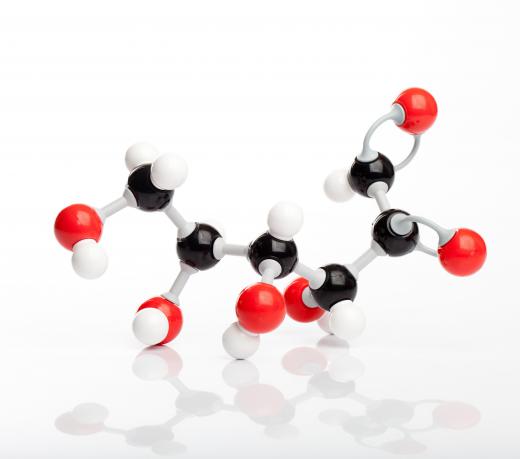
Molecules of glucose are used to build more complex carbohydrates, like starch and cellulose. The chemical formula for this molecule is C6H12O6, meaning that it is made up of six carbon atoms, 12 hydrogen atoms, and six oxygen atoms. Found in plants and many types of food, glucose is absorbed into the bloodstream during digestion.
Oxidation
Glucose oxidation is an aerobic process, a chemical reaction that requires oxygen. The term "oxidation," in fact, refers to any reaction where oxygen is combined with another molecule, which is then said to be oxidized. During the process, one glucose molecule combines with six oxygen molecules to produce six carbon dioxide molecules, six water molecules, and adenosine triphosphate (ATP), a molecule that cells use to store or transfer energy.
Glycolysis
The first step in the oxidation process is glycolysis, which takes place within a cell’s cytoplasm, the gel-like substance that fills the cell and surrounds the other cellular organs. During this stage, the glucose molecule is broken down into two molecules of pyruvate, an organic acid that can supply cells with energy. This breakdown also releases energy, which is used to add a phosphate ion to adenosine diphosphate (ADP) to create ATP. ADP, in turn, is formed with ATP is broken down to release its energy.
Glycolysis of a single glucose molecule consumes two ATP molecules, and produces four in total, leading to a net energy gain of two ATP. The energy from the process is also used to produce two NADH, a form of an enzyme used to transfer electrons to power cellular chemical reactions.
The Citric Acid Cycle
To begin the citric acid cycle, also called the Krebs cycle, pyruvate molecules produced by glycolysis are moved to the mitochondria, a cellular organ involved in metabolic processes. Once there, the molecules are converted into acetyl CoA, the molecule that powers the citric acid cycle. Acetyl CoA is made up of carbon from the pyruvate and coenzyme A, a molecule that assists in biological processes. The conversion process produces one NADH.
Acetyl CoA releases the carbon portion of the molecule into the citric acid cycle, which runs constantly, producing ATP, high energy electrons, and carbon dioxide. Most of the energy produced is stored in the form of high energy electrons, and one turn of the cycle will result in three NADH and one FADH2. Like NADH, FADH2 stores the captured electrons. The cycle also produces two ATP, and gives off the rest of the energy as heat.
The Electron Transport System
The final stage of glucose oxidation also takes place within the mitochondria, where a group of proteins, called the electron transport system, help transform the energy of the electrons captured by NADH and FADH2 into ATP. This process is modeled by chemiosmotic theory, which describes the way these electrons pass along the transport system, releasing energy as they move through.
The released energy is used to move positively charged hydrogen ions back and forth across the membrane separating two parts of the mitochondria. Energy from this movement is stored in ATP. This process is called oxidative phosphorylation, because oxygen is necessary for the final step, accepting electrons and hydrogen atoms to become H2O, or water. The energy yield from this stage is 26 to 28 ATP.
Energy Gained
When a single molecule of glucose is oxidized, the cell gains about 30 to 32 ATP. This number can vary, because often a mitochondrion does not work at full capacity. Some energy may be lost as the NADH molecules formed in glycolysis transfer their electrons through the membrane separating the mitochondria and the cytoplasm.
ATP
ATP is present in all living organisms and plays a critical role in cell metabolism, as it is the main way cells store and transfer energy. Plants produce it by photophosphorylation, a process that converts sunlight to energy. ATP can also be produced in an anaerobic process, a reaction that does not require oxygen. Fermentation, for example, can take place with no oxygen present, but this and other anaerobic metabolic processes tend to be much less efficient ways of making this molecule.
A large number of cellular functions require ATP. The cell breaks down these molecules into ADP and phosphate ions, releasing the stored energy. This energy is then used to do things like move large molecules in and out of the cell or to help create proteins, DNA, and RNA. ATP is also involved in muscle movement and is essential for maintaining the cell’s cytoskeleton, the structure within the cytoplasm that supports the cell and holds it together.
AS FEATURED ON:
AS FEATURED ON:









-
![A molecule of glucose, which is broken down by an organism into carbon dioxide and water in a process called glucose oxidation.]() By: michaeljayberlinA molecule of glucose, which is broken down by an organism into carbon dioxide and water in a process called glucose oxidation.
By: michaeljayberlinA molecule of glucose, which is broken down by an organism into carbon dioxide and water in a process called glucose oxidation. -
![A strand of DNA, which is created by the energy that is produced through glucose oxidation.]() By: eabffA strand of DNA, which is created by the energy that is produced through glucose oxidation.
By: eabffA strand of DNA, which is created by the energy that is produced through glucose oxidation. -
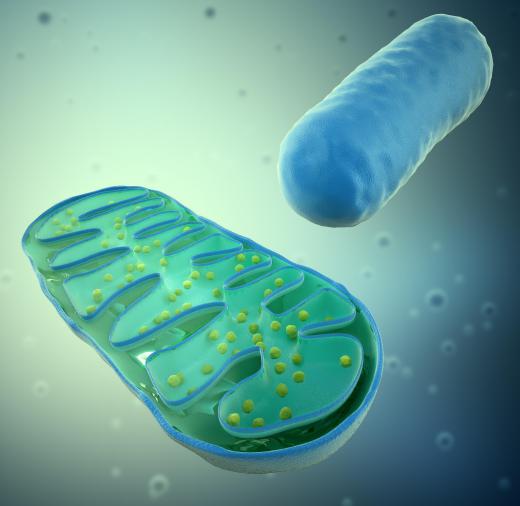
![Mitochondria use the by-products of glucose oxidation to produce ATP.]() By: MopicMitochondria use the by-products of glucose oxidation to produce ATP.
By: MopicMitochondria use the by-products of glucose oxidation to produce ATP. -
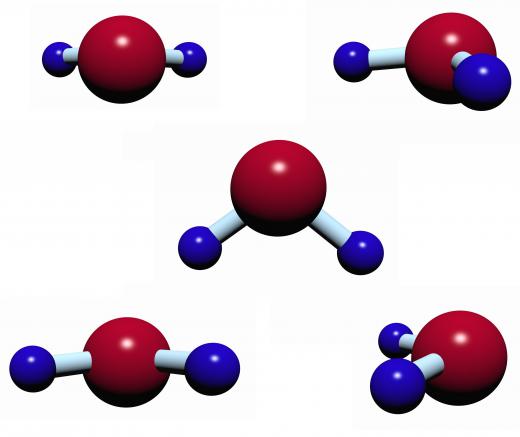
![Water molecules are one product of glucose oxidation.]() By: Ioana Davies (Drutu)Water molecules are one product of glucose oxidation.
By: Ioana Davies (Drutu)Water molecules are one product of glucose oxidation.


Discussion Comments
I was always taught by my professor who is an amazing dietitian that it produces about 36-38 ATP. So yes, that is correct.
The total number of ATP obtained after complete oxidation of one glucose in glycolysis, Krebs cycle, and electron transport is estimated to be between 30 and 38.
The most complete assessment I have seen lately (doi: 10.1074/jbc.X200011200) puts it at 29.85 ATP per glucose molecule, actually.
38 is a usual number given because the most common number seen in textbooks for electron transport is 34, not 32.
(You can get the number of free hydrogen ion equivalents, including the reduced form of NADH and GTP, from glycolysis and the Krebs cycle - the next step is the issue. It's difficult to tell how many ATP are produced by oxidative phosphorylation in mitochondria per hydrogen-equivalent - in fact it is unlikely to be a constant over time even in the same organism.)
I am a little confused on this one. The sum of the ATP molecules produced by this explanation of the three processes, glycolysis, Krebs Cycle, and Electron Transport Chain does add to 38 ATP molecules. I thought though that Glycolysis produces two ATP molecules, Krebs Cycle, two ATP molecules and 32 ATP in Electron Transport chain which equals 36. So would either of these answers (sum of 38 or sum of 36 ATP molecules) be correct? What is the varying factor here that makes the number of ATP molecules different by two ATP molecules?
Post your comments