
At HomeQuestionsAnswered, we're committed to delivering accurate, trustworthy information. Our expert-authored content is rigorously fact-checked and sourced from credible authorities. Discover how we uphold the highest standards in providing you with reliable knowledge.
What is Glitter?
 Michael Pollick
Michael Pollick
Michael Pollick
Glitter is a product used by crafters and designers to create a sparkling or shimmering effect. It is primarily composed of very tiny flecks of glass, stone, paper or plastic, although polyester is perhaps the most common material used in modern production. Coated paper can also be formed into glitter, and some have even used commercial grade diamond dust.
Some may assume that glitter is produced by simply crushing the source material into dust-sized particles, but that is not the case. Commercial manufacturers use various dies to cut out individual pieces in bulk. Even though the pieces can be as small as 50 microns (0.002 inches) in size, each one has been precision-cut in the shape of squares, circles, rectangles or hexagons.

Glitter comes in a vast array of colors and styles, from clear polyester to iridescent metallic. Crafters often purchase a variety in order to enhance particular pieces. Christmas ornaments, for example, may receive a dusting of silver and gold, while holiday candles could be enhanced with red and green glitter. A pattern of white craft glue can be applied to a project and then liberally coated with glitter to make it shimmer or shine.

This product is generally sold in small tubes or specially designed "glitter shakers." These shakers allow the crafter to control the flow of the tiny pieces, which tends to pour out like pepper flakes. Some crafters pour a supply from the original containers into trays for easier access. Working with glitter can be challenging, so it often pays to use smaller batches or have a system in place for recovering any excess.

Glitter is considered to be non-toxic, which makes it suitable for craft projects involving young children. Adult supervision is still advisable, however, since when it's spilled, it can become problematic and some children may confuse glitter with candy. When working with this product around younger crafters, it may help to stress a "less is more" philosophy.

Although a significant amount of glitter is now manufactured overseas, the product itself was invented by an American cattle farmer named Ruschman during the 1930s, although some sources say he invented the product after World War II. His company, Meadowbrook Inventions, is still the world's largest supplier. Customers can order directly from the company, in a wide assortment of shapes, colors, sizes and materials.
Michael Pollick
A regular HomeQuestionsAnswered contributor, Michael enjoys doing research in order to satisfy his wide-ranging curiosity about a variety of arcane topics. Before becoming a professional writer, Michael worked as an English tutor, poet, voice-over artist, and DJ.
Learn more...
Michael Pollick
A regular HomeQuestionsAnswered contributor, Michael enjoys doing research in order to satisfy his wide-ranging curiosity about a variety of arcane topics. Before becoming a professional writer, Michael worked as an English tutor, poet, voice-over artist, and DJ.
Learn more...AS FEATURED ON:
AS FEATURED ON:


-
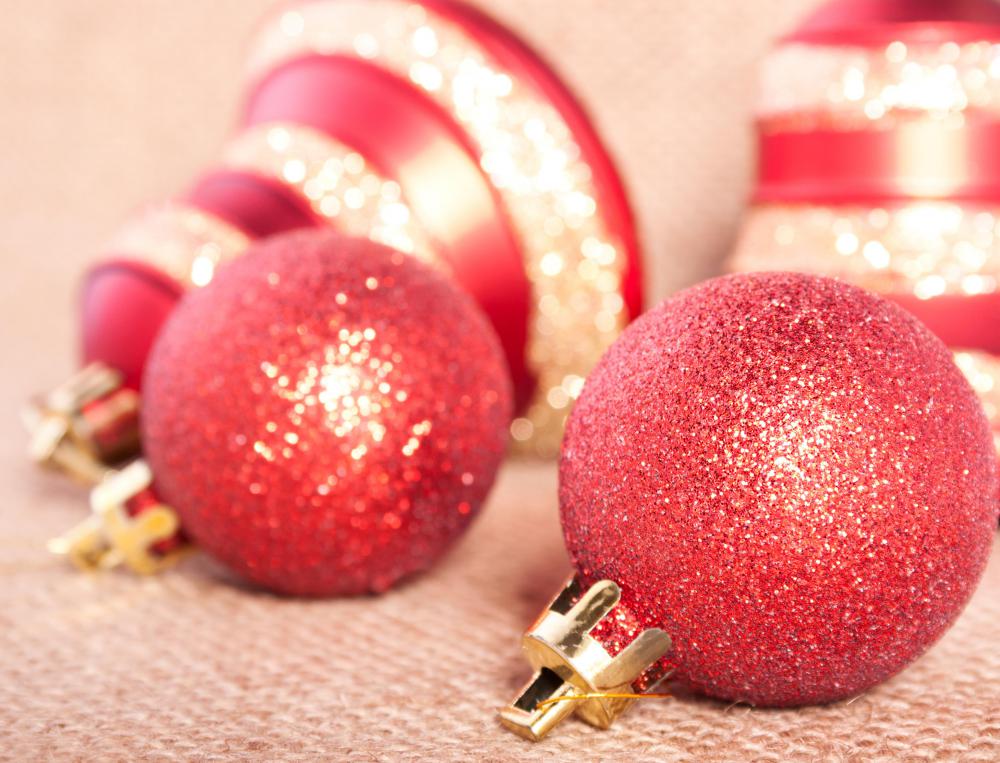
![Christmas ornaments are often liberally coated in glitter.]() By: sheva_uaChristmas ornaments are often liberally coated in glitter.
By: sheva_uaChristmas ornaments are often liberally coated in glitter. -
![Glitter is non-toxic, so it can be utilized by young children doing craft projects.]() By: Gennadiy PoznyakovGlitter is non-toxic, so it can be utilized by young children doing craft projects.
By: Gennadiy PoznyakovGlitter is non-toxic, so it can be utilized by young children doing craft projects. -
![Glitter might be used to highlight items in a scrapbook.]() By: Monkey BusinessGlitter might be used to highlight items in a scrapbook.
By: Monkey BusinessGlitter might be used to highlight items in a scrapbook. -
![Glitter might be used on homemade cards.]() By: Gennadiy PoznyakovGlitter might be used on homemade cards.
By: Gennadiy PoznyakovGlitter might be used on homemade cards.



Discussion Comments
@golf07 – I agree that glitter on the face can be a bit overpowering. That's why I prefer to have glitter in my nail polish.
You can find various kinds, from frosts to dark colors, with glitter in them. The frosts generally have only a few flecks of glitter here and there, while the more intense shades are loaded with it.
I have a spring green glitter frost that looks good as a top coat over darker green polish. I also have a dark blue polish with so many large flecks that it changes the texture of my nails. It's a little weird to run my finger across my nails and feel rough spots, but it looks so cool.
I bought some spray glitter to wear in my hair on Halloween, and it stuck to my locks very well. It actually took several shampoos to get the stuff out, so I had to go to work with slightly sparkly hair for a few days.
It smelled and felt like hair spray, but it contained tons of tiny flecks of glitter. When it dried, it really locked in place. The sections of my hair that received the spray could not be tossed around, and they felt weirdly stiff.
From now on, I'm going to use glitter only in crafts projects. I'm never putting it on my hair again.
@Perdido – I know what you mean! I never outgrew my fascination with glitter, and I still buy clothing that sparkles with it.
As a child, I had several t-shirts with glitter in certain spots. Now, I buy more grown-up versions of glitter garments. I have several blouses with glitter doused upon the tops of flowers, and they look formal enough for work or parties.
I even have a purple velvet dress with lavender and silver glitter on it. Twisting vines of roses cascade down the dress, and the blooms are composed of glitter. My dance partner does not appreciate this, though, because he ends up covered in glitter after a trip out onto the floor with me!
If someone has never seen glitter, words cannot do it justice. I tried describing it to my young daughter before showing her some, and nothing I could have said could have prepared her for its awesomeness.
There is something so magical about glitter. It captures the light in a way that is out of this world, and it is the stuff of fairy tales.
It's amazing that all that awe and wonder can be brought about by little shards of shiny polyester. I was intrigued by it as a young girl, just like my daughter is now, so I allow her to have all the glitter she wants on her clothes, toys, and school supplies.
I work at a high school and have seen several young girls wearing makeup with a little bit of glitter in it. This is usually seen in eye makeup or some kind of lip gloss.
I think this is appropriate for younger people, but don't think it looks real sophisticated on someone who is older.
For the young girls it adds a little bit of shine that might accent certain features. A little bit goes a long way though.
I saw one girl with some heavy eye makeup with a lot of glitter, and it was way too much. She would have looked much nicer with less eye shadow and just a hint of glittery shine.
I agree that glitter can add sparkle, shine and make something look pretty, but I don't think it is worth the mess.
It seems like a lot of Christmas cards are made with glitter, and one card can leave a lot of glitter everywhere. The card sure looks pretty, but I would prefer one that doesn't have glitter on it. Because of this, I never send out Christmas cards that have glitter on them.
The same thing goes with the Christmas decorations. I think you can find beautiful decorations that don't leave such a mess behind.
@andee - Have you ever tried the glitter sticks? These come in just about every color you could want, and I have found them to be much easier to work with.
They are flexible sticks similar to a pipe cleaner except they are fuzzy and look like glitter.
Some people don't like them nearly as well as glitter because they don't give quite the same effect. Depending on the type of project you are working on, they can be easier to work with and not leave the mess.
You can still get a glittery look and not have to worry about using glue or spilling glitter all over the place.
Glitter is sometimes referred to as the herpes of the crafting world, because once you get it, you'll never be able to get rid of it. I've heard horror stories about performers using the old fashioned glass-based glitter and getting infections in places they really didn't want to get infected.
Personally, I'm over the idea of using glitter on most craft projects, since there are so many other choices when it comes to adding sparkle or shimmer. I'd rather use a metallic ribbon to frame a paper card, for example. Glitter falls off too easily and too often.
I had never given any thought to how glitter was made. I just know it is something that most kids love to use in different craft projects.
While glitter can add some sparkle and shine, it can also be a mess to clean up. It seems like no matter how careful you try to be, it ends up getting all over the place.
It is amazing how one tiny speck of glitter can be hard to pick up. There have been times when the top of the shaker bottle comes off and then half of the glitter spills out of the bottle.
Even with all the mess that goes along with it, I still keep glitter around for a fun craft project every now and then. There is nothing that can give that extra sparkle quite like glitter can.
Post your comments