
At DelightedCooking, we're committed to delivering accurate, trustworthy information. Our expert-authored content is rigorously fact-checked and sourced from credible authorities. Discover how we uphold the highest standards in providing you with reliable knowledge.
What is Gin?
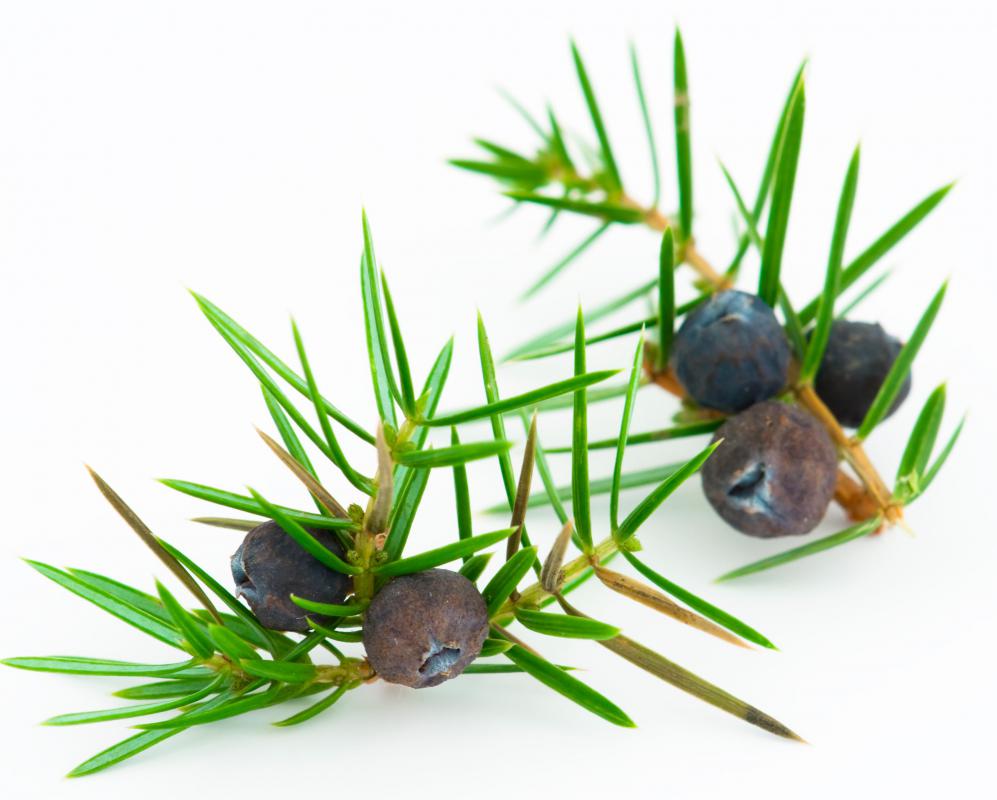
Gin is a hard alcohol flavored with the seeds of the juniper bush. It is a rather dry alcohol and is rarely drunk on its own, but used instead as a base for many different types of drinks. Good gin is very smooth, with a strong juniper flavor exciting the senses.
The name is most likely a derivation of the Dutch word genever, which simply means "juniper." This word comes from the Latin juniperus via Old French genevre. Others hold that the name is a shortening of the city name Geneva in Switzerland.

The invention of gin is usually attributed to a Dutch physician in the 17th century, though there is some contention in this area, with many claiming that the Italians had been drinking a nearly identical liquor for some time before this. Whatever the case may be, it was in Holland that it first achieved real popularity, being widely sold as a tonic to treat gallstones, rheumatism, and stomach aches. Juniper was added not only for flavor, but because the berries have a number of healing properties, including acting as a diuretic and helping with arthritis.

From the Netherlands, gin spread to England, where it quickly achieved mass appeal. The flavor was simplified somewhat from the Dutch version, which was often aged in wooden casks and took on more complex flavors. When, in the early 18th century, the British government allowed gin to be stilled without a license, the market truly took off. By the middle of the 18th century, substantially more of the spirit was being produced and consumed in England than beer, and more than half of the bars in London specialized in gin at the time.
In the 19th century, the most popular modern style, the London dry gin, was perfected. The majority produced these days is in this style — no matter where it is produced — though some companies still produce a more traditional Dutch or Old Tom gin.

Throughout the 19th century, gin was used in colonies such as India and Southeast Asia as a way of hiding the distasteful quinine used as a protection against malaria. Quinine, in turn, was diluted in tonic water, and it was this practicality that gave birth to the ever-popular gin and tonic. Later, gin began to be used in a number of signature alcoholic drinks, including the martini, the gimlet, the salty dog, and the Tom Collins.

Modern gins may remain very simple — such as the Beefeater, which is more-or-less the same recipe used when they opened shop in the early 19th century — or they may incorporate other flavoring agents or improved distillation for a crisper taste. Bombay Sapphire, for example, includes many different flavors, such as almonds, angelica, coriander, liquorice, and lemon zest, among others. Tanqueray Ten is an extremely popular high-end spirit — building of the success of the already high-end Tanqueray gin — which was first produced in 2000 and has won a dazzling array of awards. This ultra-premium spirit is made in small batches and produced exclusively from whole fruits, giving it a balance of taste that makes it ideal for gourmet martinis.
AS FEATURED ON:
AS FEATURED ON:


-
![Seeds of the juniper bush are used to flavor gin.]() By: Dani VincekSeeds of the juniper bush are used to flavor gin.
By: Dani VincekSeeds of the juniper bush are used to flavor gin. -
![Blueberry gin is a flavored variety of the spirit.]() By: leighboardman84Blueberry gin is a flavored variety of the spirit.
By: leighboardman84Blueberry gin is a flavored variety of the spirit. -
![A lime in a gin and tonic.]() By: IrochkaA lime in a gin and tonic.
By: IrochkaA lime in a gin and tonic. -
![A traditional martini is made with gin and vermouth.]() By: dondesignsA traditional martini is made with gin and vermouth.
By: dondesignsA traditional martini is made with gin and vermouth. -
![Gin is commonly mixed with tonic water.]() By: alexlukinGin is commonly mixed with tonic water.
By: alexlukinGin is commonly mixed with tonic water.


Discussion Comments
I think gin means spirit or ghost more.
@boathugger: Here is the recipe for a Bermuda Cocktail.
You will need 1 ¾ oz. gin, ¾ oz. peach brandy, 1 tsp. grenadine, and 2 dashes of orange juice. Pour the ingredients in a shaker with ice. Shake very well and then strain into a glass.
Has anyone ever heard of the drink called "Bermuda Cocktail"? I know that it has gin in it but I don't have the other ingredients.
@googie98: Gin rummy was created in 1909 by Elwood T. Baker and his son, C. Graham Baker. It used to be referred to as just “gin”. The game evolved from a game called “whiskey poker”. From that came gin poker and then gin rummy.
Where did the name "gin rummy" come from?
Post your comments