
At WiseGEEK, we're committed to delivering accurate, trustworthy information. Our expert-authored content is rigorously fact-checked and sourced from credible authorities. Discover how we uphold the highest standards in providing you with reliable knowledge.
What is Giftedness?
Giftedness is a term that is often met with much confusion by the public, as well as by educational and mental health professionals. A widely accepted, though broad, definition denotes a person who excels or has the potential to excel in critical or creative thinking, or in athletic or artistic endeavors. The term may also refer to a person who possesses an above average capacity for empathy, which is also called emotional giftedness.
Most people assume that this term describes an extremely intelligent person, such as a genius or a prodigy in some area of the arts, such as a gifted pianist. This assumption fails to recognize gifted people who have not exhibited any great or unusual achievements. In fact, many such people are labeled as being lazy, underachieving and unsuccessful. This is often due to the person’s own confusion about his or her above average abilities. The assumption also tends to include extremely intelligent people that do not, however, fall under the definition.

There is a marked difference between intelligence and giftedness. An intelligent person excels in education and knows the answers to questions, compared with a gifted person, who instead asks the questions. A person with a high intelligence has great ideas, whereas a person who is gifted has crazy, wild ideas. One is alert, while the other is sharply observant. An intelligent person learns easily, and the other already knows based on his or her intuition. IQ tests may indicate a highly intelligent person, whereas gifted people may do poorly.

Giftedness is an inborn trait that can be recognized in early childhood. Apart from obvious indications of it, as in a musical prodigy, a gifted child may also understand abstract concepts at an early age; enjoy collecting peculiar things, such as rocks, insects, and bottle caps; be intensely curious and attentive to detail; make connections between seemingly obscure things; and exhibit high creativity. These children also tend to prefer older companions, question authority, and seem mature for their age.

This trait is not often recognized in childhood. Sadly, gifted children are sometimes misdiagnosed as having attention deficit disorder (ADD), oppositional defiant disorder (ODD) or other behavioral problems, and mental illnesses. Depression, anxiety disorders and obsessive compulsive disorder (OCD) are also often present. When these difficulties are unrecognized as coexisting with giftedness, the result is sometimes unnecessary or inappropriate medical interventions, as well as the pain and insecurity of being misunderstood by others.
AS FEATURED ON:
AS FEATURED ON:









-
![The term "gifted" denotes a person who excels or has the potential to excel in critical or creative thinking, or in athletic or artistic endeavors.]() By: Varina PatelThe term "gifted" denotes a person who excels or has the potential to excel in critical or creative thinking, or in athletic or artistic endeavors.
By: Varina PatelThe term "gifted" denotes a person who excels or has the potential to excel in critical or creative thinking, or in athletic or artistic endeavors. -
![One can be gifted in music.]() By: Stuart MonkOne can be gifted in music.
By: Stuart MonkOne can be gifted in music. -
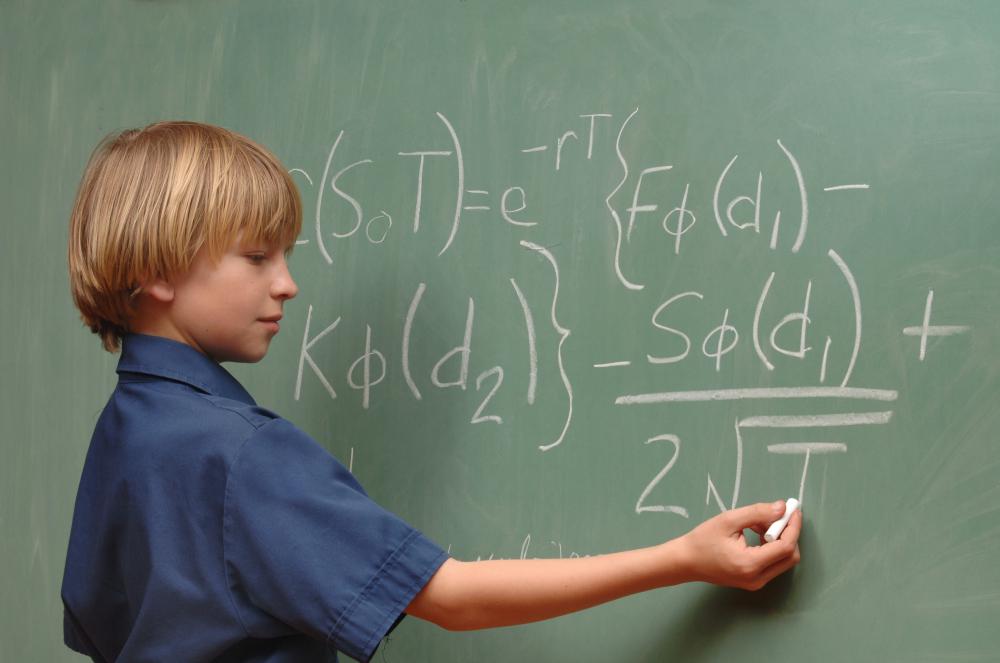
![An individual may be considered gifted if he or she shows particular capabilities in the field of math.]() By: James SteidlAn individual may be considered gifted if he or she shows particular capabilities in the field of math.
By: James SteidlAn individual may be considered gifted if he or she shows particular capabilities in the field of math.


Discussion Comments
Child giftedness annoys some teachers. They feel undermined and become intimidated when the student seems to know more than they do.
I knew a kid in elementary school who was unbelievably sharp and observant. He would call the teacher out on things, and he would ask her questions that would disprove what she just said.
She hated being corrected, and she didn't feel like it was his place to do this. He just didn't belong in that classroom, because he was far too advanced in this thinking for us.
@lighth0se33 – I hate those tests! They don't account for the less common characteristics of giftedness, like artistic ability and musical prowess.
My child got tested, too, and he didn't pass. However, his piano teacher says that he is a musical prodigy.
That wasn't something that his school was concerned with, though, because the educational system doesn't put much value into music and art these days. As budgets get cut, art and music programs are the first to go, so what use are students who are gifted in these to them?
I must have exhibited some giftedness characteristics as a child, because I got tested for acceptance into the gifted class on three separate occasions. Unfortunately, I didn't meet the standards.
The test involved things like solving puzzles that did not seem to fit together. I never could get the pieces to fit, and I didn't measure up to some of their other expectations, either.
My teachers recognized something special in me, but it didn't fall in line with what the academic program viewed as giftedness. They learned to accept that I was just a smart kid.
Yes and those having the habit of parodying it should not do it anymore. It's god's gift.
What i presume is the talented ones are here to help those who are slow learners. Much heart giving and more help to these people is mostly required.
Giftedness is definitely inborn, it isn't/can't be a product of learning. This is from much research and personal experience.
Is Giftedness inborn? or is it a product of learning?
Post your comments