
At WiseGEEK, we're committed to delivering accurate, trustworthy information. Our expert-authored content is rigorously fact-checked and sourced from credible authorities. Discover how we uphold the highest standards in providing you with reliable knowledge.
What is GERD?
Gastroesophageal Reflux Disease (GERD) is the excessive flow of stomach acid into the esophagus, which can damage the esophagus and other parts of the body. Severe and/or frequent heartburn is the main symptom of this condition. GERD can create harmful complications in the body if left untreated.
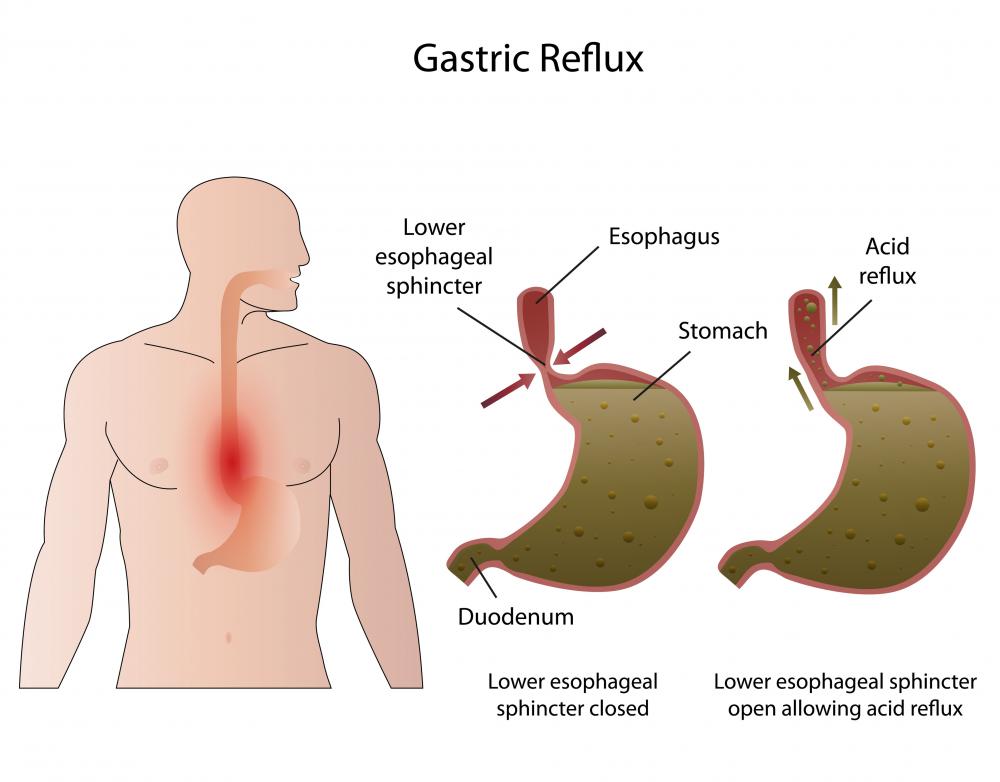
The esophagus is used for swallowing, and GERD sufferers experience heartburn as the main symptom, often right after a meal. Food aggravates this condition, but not necessarily spicy food — although spicy food can make symptoms worse in some patients. Food fills up the stomach and the stomach produces more stomach acid. The esophageal sphincter, which is gate-like and located at the lower section of the esophagus, is supposed to remain closed and only open when liquids or foods are being swallowed. However, in many GERD patients, the esophageal sphincter is "relaxing" more than it should and is letting in excess stomach acid.

Stomach acid easily escapes from the relaxed esophageal sphincter; this escaping or flowing is called "refluxing." Heartburn occurs when the stomach acid creates a burning sensation. Some people with GERD also experience coughing, wheezing, or asthma due to stomach acid connecting with the lungs. Inflammation of the vocal chords resulting in hoarseness can also be a symptom. Stomach acid is very strong and can erode tooth enamel as some sufferers experience reflux of stomach acid into the mouth.

The United States Department of Health and Human Services estimates that seven million Americans have GERD. Anyone can develop this condition, but it is most common in those between 40 and 64 years of age. Almost everyone will or has experienced heartburn, but not all heartburn is related to GERD. The term has been used for 20 years, but still is not commonly known even by some doctors.

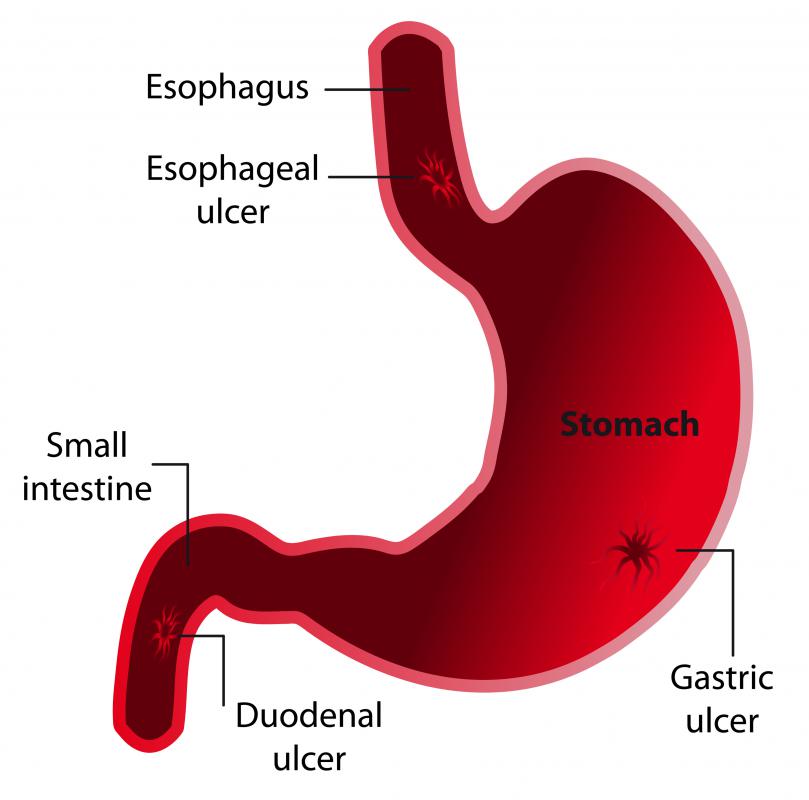
A hiatus hernia is sometimes confused with GERD, but is not the same thing. A hiatus hernia is a dislocated stomach. GERD patients may also have a hiatus hernia if they have complications from the condition, such as erosive esophagitis. Erosive esophagitis is a broken esophageal lining. Other complications include esophageal stricture, or narrowing of the esophagus, and esophageal ulcer.
AS FEATURED ON:
AS FEATURED ON:









-
![Eating large or spicy meals may trigger GERD symptoms in some people.]() By: rafer76Eating large or spicy meals may trigger GERD symptoms in some people.
By: rafer76Eating large or spicy meals may trigger GERD symptoms in some people. -
![Surgery may be necessary for GERD patients if other treatment options have proved unsuccessful.]() By: deregeSurgery may be necessary for GERD patients if other treatment options have proved unsuccessful.
By: deregeSurgery may be necessary for GERD patients if other treatment options have proved unsuccessful. -
![GERD causes excessive amounts of acid to flow into the esophagus, resulting in heartburn.]() By: nebariGERD causes excessive amounts of acid to flow into the esophagus, resulting in heartburn.
By: nebariGERD causes excessive amounts of acid to flow into the esophagus, resulting in heartburn. -
![An esophageal ulcer at the point where the stomach and esophagus connect is one potential complication of GERD.]() By: p6m5An esophageal ulcer at the point where the stomach and esophagus connect is one potential complication of GERD.
By: p6m5An esophageal ulcer at the point where the stomach and esophagus connect is one potential complication of GERD. -
![The lower esophageal sphincter is supposed to remain closed except when food is swallowed, but in GERD patients it relaxes more than it should.]() By: bilderzwergThe lower esophageal sphincter is supposed to remain closed except when food is swallowed, but in GERD patients it relaxes more than it should.
By: bilderzwergThe lower esophageal sphincter is supposed to remain closed except when food is swallowed, but in GERD patients it relaxes more than it should.


Discussion Comments
Foods which interact badly with the stomach and can lead to this issue include greasy foods such as hamburgers and manufactured meats. Big meat companies are recognizing the importance of changing their practices for the sake of a changing demand for junk foods and higher expectations in terms of how they handle and process animals.
Focusing on keeping a healthy diet and seeking to fully understand exactly what you are ingesting on a daily basis are two helpful steps toward avoiding or dealing with GERD. This will not only affect your intestines and digestive tract positively, but will enable you to feel better on a regular basis, improving your brain and vitality.
GERD can cause bad breath and upsets the normal functioning of a social life and business. It is essential to catch this issue early and adjust diet and exercise accordingly. If you spend the entire day sitting and/or eating junk food and drinking beer, than you may need to adjust these habits since they can be a very direct cause of GERD.
Post your comments