
At TheHealthBoard, we're committed to delivering accurate, trustworthy information. Our expert-authored content is rigorously fact-checked and sourced from credible authorities. Discover how we uphold the highest standards in providing you with reliable knowledge.
What is Fascia?
 Mary McMahon
Mary McMahon
Mary McMahon
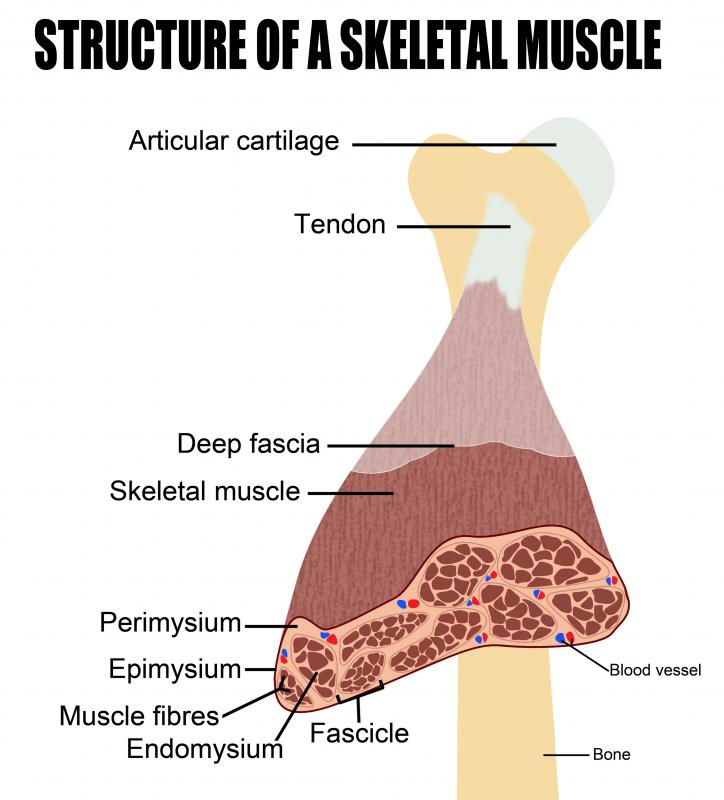
Fascia is strong connective tissue which performs a number of functions, including enveloping and isolating the muscles of the body, providing structural support and protection. It is a product of mesenchyme, a type of connective tissue which develops in embryos before differentiating into numerous other structures in the body. Mesechyme also forms the foundation for bone, cartilage, and important components of the circulatory and lymphatic systems. Fascia is a very important part of the body, and it has three layers, starting with the superficial directly under the skin and ending with subserous, deep inside the body.
Fascia is thin, but very fibrous and strong. Anyone who has skinned chicken breasts or trimmed meat has encountered it, the whitish colored thin sheets of tissue between the skin and muscle of the meat. This tissue forms directly under the skin and serves as a strong layer of connective tissue between the skin and muscles underneath it.

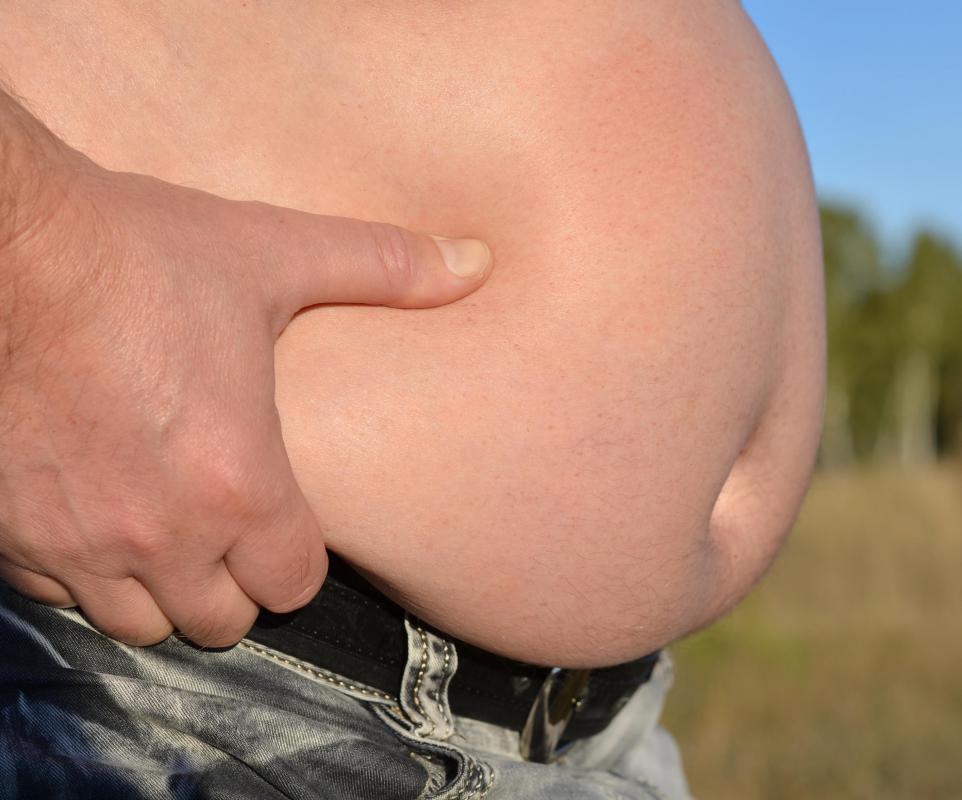
The top layer is superficial fascia, which may be mixed with varying amounts of fat, depending on where it is on the body. The skull and hands have a particularly noticeable superficial layer that connects the skin to the tissues and bone underneath it. By wriggling your scalp, you can see that superficial fascia is strong but flexible, keeping the skin firmly anchored while allowing its owner to move freely.

Underneath lies deep fascia, a much more densely packed and strong layer. Deep fascia covers the muscles in connective tissue aggregations which help to keep the muscles divided and protected. On occasion, it can create tight knots or connective adhesions which act as trigger points which can cause pain. A variety of treatments including myofascial release and stretching are used to treat this condition, which can be debilitating and extremely painful. If a patient is diagnosed with a condition like myofascial pain syndrome, it may be useful to know that the term means “fascia related to the muscles,” and that these conditions do not necessarily involve the superficial and subserous fascia.

The subserous fascia lies between the deep layer and major organs of the body. It is more flexible than deep fascia, and the body leaves space around it so that the organs can move freely. Like that layer, the subserous tissue can also form fibrous knots and adhesions which can be painful unless they are addressed.
Mary McMahon
Ever since she began contributing to the site several years ago, Mary has embraced the exciting challenge of being a TheHealthBoard researcher and writer. Mary has a liberal arts degree from Goddard College and spends her free time reading, cooking, and exploring the great outdoors.
Learn more...
Mary McMahon
Ever since she began contributing to the site several years ago, Mary has embraced the exciting challenge of being a TheHealthBoard researcher and writer. Mary has a liberal arts degree from Goddard College and spends her free time reading, cooking, and exploring the great outdoors.
Learn more...AS FEATURED ON:
AS FEATURED ON:


-
![Muscles are enveloped by connective tissue called fascia, which provides structural support and protection.]() By: Igor MojzesMuscles are enveloped by connective tissue called fascia, which provides structural support and protection.
By: Igor MojzesMuscles are enveloped by connective tissue called fascia, which provides structural support and protection. -
![The various types of fascia are all thought to provide a similar function, which is to transmit the tension in muscles throughout the body with a minimal amount of friction.]() By: Balint RaduThe various types of fascia are all thought to provide a similar function, which is to transmit the tension in muscles throughout the body with a minimal amount of friction.
By: Balint RaduThe various types of fascia are all thought to provide a similar function, which is to transmit the tension in muscles throughout the body with a minimal amount of friction. -
![The superficial fascia often contains large deposits of fatty adipose tissue.]() By: elizalebedewaThe superficial fascia often contains large deposits of fatty adipose tissue.
By: elizalebedewaThe superficial fascia often contains large deposits of fatty adipose tissue.

Discussion Comments
What is the function of fascia during fitness activities?
I have a question for the board. I had a car accident and am suffering from fascia damage in my shoulder blade. With PT, how long is it to be expected before I heal? Thank you!
In newer models of understanding, doctors don't even think about superficial fascia, as fascia, but only the deep and subserous as fascia, but the superficial fascia blends into the reticular layer of the dermis. Let me put in layman's terms for you: it keeps the skin on. And another thing: not all massage therapist are equal. And while I think many shouldn't diagnose initially, those with training in some kind of myofascial release can be beneficial for many, especially with negative pressure message cupping.
To those with bad restrictions, try gua sha/ graston technique/ astym soft tissue treatments to loosen adhesions and break up excess scar tissue. Acupuncture and dry needling can be very effective in pain management.
Physical therapy is important, but serious massage therapy can be extremely beneficial by itself or in conjunction with physical therapy. To those with old soft tissue injuries, please consider other treatments for soft tissue issues that are noninvasive first.
While I'm glad people have found relief from compartment syndrome, that in no way means the fascia has no importance.
My brother had prune belly syndrome and was missing muscles and fascia in his abdomen wall and wasn't expected to live as long as he did. Those like me, who have Ehlers Danlos Syndrome -- a connective tissue disease -- struggle in great part because our fascia doesn't hold up as much as a normal person's would, and is subject to easy injury for many. Not everyone has it severely, but obviously, the condition is degenerative, and so the possibility of going downhill is there for many with this disease.
Many of my community are also misdiagnosed with fibromyalgia. Typically, fibromyalgia patients note bumps and lumps under their skin in the subcutis. Some doctors attribute this to adhesions and restrictions in the superficial fascia; go figure. In the horrible flesh eating disease necrotizing fascitis if it penetrates too much beyond the fascia with even little to no skin and/or muscle involvement, it may still necessitate removal of the entire extremity beyond partial tissue debridement.
Doctors today simply have no understanding beyond of the true importance of fascia and believe muscles are the key when that is outdated and ever more clearly untrue. Muscles are simply given a shape due to the external presence of fascia and the intramuscular fascial fibers running in between muscles binding them together. Without a fascia, a body simply cannot be. Fascia keeps the body interconnected superficial to deep. Your organs don't hang in the balance for no damn reason. Fascia retains their position and protects them. Saying you can do without it is like saying a sausage can hold itself together without its wrapping. Your body is just mush without it. There is a science to fascia's importance and function and it's useless to argue why you need it.
1) Cipro saved my life without destroying my fascia.
2) You can do without fascia. I suffered from compartment syndrome for a decade. Finally, the doctors properly diagnosed me, filleted my fascia open by means of a bilateral fasciotomy and now my life is changed.
Stick to science and not conjecture.
And @anon88437: Absolutely.
My abdominal fascia was destroyed by Lupron, a horribly toxic drug manufactured by Abbott Labs. Just one shot of Lupron left me with permanent, severe abdominal distention, which surgeons say is probably not fixable. I have had one unsuccessful major surgery already. My abdominal wall reconstruction is not covered by insurance so my medical bills are huge.
Fascia is made of collagen. Lupron lowers your estrogen level to zero and your body cannot make collagen, and the fascia becomes severely dehydrated. Your vagina could atrophy, or your abdominal wall. Hernias are a known injury caused by Lupron but my doctor, Serena Chen, MD, denies everything. She is married to a drug company executive.
Nobody should take Lupron for any reason; it destroys bones as well as connective tissue. Lupron was FDA approved based on falsified data. However, Lupron is NOT FDA approved for fertility treatments. Abbott Labs has a long history of compensating doctors to prescribe drugs.
I have had fasciitis in my shoulder blades, for four months now, and I'm getting circulation back into the area by brushing and also using inflammatory herbs and flexeril to help with the pain.
I use a tennis ball when the pain gets so bad to help break down the muscle.
My fascia is destroyed thanks to Cipro (a horrifically-poisonous antibiotic manufactured by Bayer). I took it for only six days way back in 2009 and have been unable to walk since. I have fascia tears all throughout my body that do not heal.
Once the fascia tears, all the involved muscles become traumatized and I am now bedridden. I was just 30 years old when this happened to me.
I highly recommend none of you ever take Cipro. It is by far the biggest regret of my entire existence.
Yes, it is possible to damage a layer of fascia. It is also possible to repair fascia. Not all massage therapists are trained in this area. Mine is however. So is my physical therapist and chiropractor. Look for the rare individual who has specialized in this area. Not all practitioners are alike.
For example, my massage therapist specializes in lymph drainage. This is needed if you have ever had Hodgkins lymphoma or breast cancer. Both cancers as well as Castleman's disease can disrupt the lymphatic system.
I know from personal experience. I had two kinds of cancer, surgery under my left armpit, and more. I am in recovery and have found so much help from a specialized physical therapist and massage therapist. Remember, not all practitioners are alike. Interview your healers.
I have to reply to a couple of above posts. I have a degree in kinesiology in the athletic therapy field (much like physio) and also am a certified massage therapist. In my opinion, massage therapy schools are not created equal. My school, however, did spend two years teaching us the exact same assessment techniques that I learned for years in my athletic therapy training, so indeed massage therapists who are trained should be able to assess and treat injuries, with the focus obviously being on the manual therapy aspect of it (including muscle energy work in the case of my school).
Do not make the mistake of thinking that a trained RMT is the same as a person who performs spa massage. I have noticed also that many massage therapists, as with many physiotherapists, become somewhat lazy in their assessments over time. Keep looking until you find someone who is professional and does not fall back on relaxation style spa massage because it is easier.
@Anon49500: I have the same thing, but it's in my legs. I was very active in high school, but now that I am in college I have a "bump" on the side of my leg. My doctor said it was a tear in the fascia tissue. He said there is no way for it to be repaired. The only thing they could do is cut the tissue in more places to evenly distribute the pain somewhere else. I am wondering what they name of this procedure is called to look more into it.
This is in reply to the last post of (Anon49500) as to your question if anyone knows what you have. I do. I have had it since I turned 13 years old and now I'm 22 years old. I just found a doctor here in my hometown who knows what it is. I will be having surgery here soon to fix it.
I was in the same dilemma that you are in that none of the doctors had ever seen anything like it and didn't know what it was. But Dr. Andrew Scott Martin here in Las Vegas, NV told me what it was and now I'm going to have surgery for him to fix it. I have it in both of my legs.
I have a bulge of fascia all in my abdominal area, all due to my pregnancy that ruined my body! Now I think I need plastic surgery to get rid of all that excess fascia above, and around and under my bellybutton!
I've worked in the manual therapy field for over thirty years and have observed that there are many techniques for addressing fascia problems. Various posts on this page recommend different techniques as the best. As in any given field of practice, be it bodywork, car mechanics or plumbing, the experience, skill and knowledge base of the therapist is what truly matters, be they massage therapist, osteopath or whatever.
If you suffer from any malady, try different therapies and therapists within specific therapies. Your situation is unique to you. Never give up on your quest for relief. There is someone with the knowledge and skills to help you.
Has anyone here who is suffering from fascia pain looked into "rolfing"? I have been active throughout my life, but am constantly suffering from herniated discs, muscle spasms, knee and hip pain, etc.
I was told I had lupus in my mid twenties, so I decided to live a very healthy lifestyle, yet, every few months, something hurts. Recently, my doc said that I do not have lupus and the blood tests are often misread or misinterpreted, but obviously something is "off" in my body.
My husband read an article in the NYTimes on the benefits of rolfing. It is a deep form of massage and moving within the fascia (connective tissue) in the body. Since the treatments, I am feeling less pain, and have noticed that I have more movement/mobility. My posture is also improving. I feel like this procedure can help others, which is why I am posting. If you look up "rolfing", you can find the website for a certified tech in your area. Good luck to you all, and I hope everyone feels better.
It is possible to repair fascia. Type III collagen is laid down after an injury or surgery and binds the area for approximately 21 days before Type 1 collagen, the stronger collagen, is laid down.
Compression techniques used on the fascia both superficial and dense create a piezoelectric effect in the fascia, which is a negative charge which attracts the positive water molecules to attach to the GAGS and PGS, which helps with the hydrostatic pressure that helps to support the body with its weight bearing capabilities.
I learned an enormous amount about the special properties of fascia by studying Bowen therapy with the school called Fascial Kinetics which have been teaching the special properties of fascia for over 18 years.
I don't know who it is who wrote the comment about massage therapists working outside their scope of practice. Duh! We don't diagnose or prescribe treatment - we actually fix people instead.
Wouldn't want someone who had over 1000 hours of muscle training to actually work on the problem would you? Get hurt yourself and have a PT who had 30 hours of actual muscle training fix you! Ha.
I have PTs ask me for advice. Around the world, massage therapists have more respect than in the US - where strong lobbyists stop us from doing our work. The person who wrote that has no clue about the benefits of a good massage therapist.
Those of you who are hurt and are going to massage - you're on the right track. Sorry about the rant - just tired of the idiots out there.
All you massage therapists are practicing outside your scope. You don't have the education to diagnose disease or prescribe treatments.
Has anyone heard of, or been diagnosed with fasciitis? Inflamed fascia.
I have suffered dreadfully with tight fascia - Myofascial Pain Syndrome - all over my body for the past ten years causing misalignment and constant pain and have tried many therapies from different practitioners and specialists.
I have found that an infrared heat lamp softens and releases the tight and hardened fascia making it more pliable and benefits massage which in turns eases the pain. Hope this is helpful.
Fascial Kinetics is the specific treatment for the fascia. No other treatment is more effective. Look for a person who does Fascial kinetics.
The difference between a good surgeon and an average surgeon is their respect for the fascia and its importance. After any surgery the surgeon should reconnect the fascia back together as well when they are closing to help to support the smooth recovery of the wound. Fascia will eventually recover if it is healthy and well hydrated but people today just don't drink enough water to keep healthy fascia.
The best way to treat any type of facial problem is to see a massage therapist that knows myofascial techniques.
The most efficient and effective response to all of your posts above is to find someone in your area that practices Hellerwork Structural Integration.
The practitioners are trained to work with fascia and also have knowledge of the whole body and structure.
Density, adhesions, pollutants, emotional memory, scar tissue, viruses are released with the proper kind of touch and attention. Hope this helps.
I was in a car crash recently and I have tingling pain in my lower legs, front and back. it's not so bad if I don't touch it but its extremely painful if touched.
I didn't break any bones in my legs, but it's definitely soft tissue damage. Obviously this 'fascia' damage includes nerve damage, no?
Any suggestions for treatment as this pain kind of got side-tracked because of other injuries, and there was no proper investigation into the legs. Thanks so much!!! :)
I tore the fascia in my forearm years ago and the muscle protrudes from the four-inch tear. I was in severe pain at first but it slowly went away after a month. I have no pain and most people cannot even see it eight years later.
Ihave a fascia tear on my left shoulder. As a result, I have a very noticeable bulge. The bulge is the shoulder muscle pertruding through the fascia tear. Has anyone heard of an injury such as mine? If so, was it repairable? All the doctors that I have seen have never seen an injury like mine.
I am in remission from Non-Hodkins Lymphoma. I have severe pain in the groin area and down the front of my thigh. Since there are so many lymph nodes in the groin area, could it be that I have fascia restrictions due to the lymphoma?
I'm seeing a chiropractor right now that is highly certified in Active Release Technique. I have been having symptoms of ulnar nerve entrapment, with tingling ring and pinky fingers (which now feel stiff instead of tingling) and a feeling of dull pain in my elbow. After the first A.R.T. treatment (which was all done on my upper back and shoulder, *not* my elbow) the pain in my elbow actually disappeared. Now I'm continuing treatment in order to correct the feeling in my fingers, so we'll see where that goes.
It has been fascinating. This type of treatment is all about breaking up scar tissue, wherever it may be, including in the fascia. It is often successful in treating carpal tunnel syndrome as well as a lot of various injuries. I highly recommend looking up a practitioner in your area for these types of problems. It's way more than massage. My doc works *hard* on my back and arm every time. I'm impressed!
Go and see a Registered Massage Therapist, they have excellent techniques for aiding and helping fascia tissue. ( I'm a massage student)
OK i was in a car accident 9 years ago and im in worst shape now then i was then, i was hit head on and the steering wheel and airbag broke my jaw and cracked part of my sternum, I'm in pain all the time, so after tons of tests and xrays with no answers, I'm now seeing an Osteopath last month and she said that the fascia all around my chest wall, heart and lungs is very tight and causing my pain, i am short of breath, pain under my left breast and get sharp sharp pains right through to my back, does this FASCIA thing make any sense? please tell me your opinion.....
I just had a second surgery due to complication of my first surgery i april of 08. The fascia had to be redone. What are complications after a second surgery? I had a tram flap for my first surgery
It could very well be fascia restrictions, but also scar tissue build up. After any surgery scar tissue is laid down which, if not coaxed in the right direction could cause a mesh like pattern causing limited range of motion. An osteopath, massage therapist or other health professionals dealing with soft tissue manipulation will know how to test for and treat this condition.
Fascia does not respond to deep tissue work like muscle does. Fascial techniques are done slowly and held for a longer duration, this allows the ground substance in the fascia to rehydrate and become more pliable. I would suggest an osteopath, rolfer or someone trained in myofascial release.
you should go to an osteopath. they have techniques about fascia.
you could have structural damage to your fascia. you need to find a specialist - not a PT - that will help you with stretching the fascia.
I'm wondering about whether the fascia can be damaged as well. I had a partial knee replacement 5 months ago, and I have a great feeling of constriction around my knee, as if it's in a vise which restricts movement. My physical therapist has been doing some deep tissue massage because she thinks that perhaps the fascia is not lying smoothly and is sort of bunched up, which is causing the constriction. Has anyone had a similar experience, or does anyone have information about this?
Is it possible to damage the a layer of fascia? And if so is there anyway to repair it?
Post your comments