
At EasyTechJunkie, we're committed to delivering accurate, trustworthy information. Our expert-authored content is rigorously fact-checked and sourced from credible authorities. Discover how we uphold the highest standards in providing you with reliable knowledge.
What is Ethernet?
Ethernet is a standard communications protocol embedded in software and hardware devices, intended for building a local area network (LAN). It was designed by Bob Metcalfe in 1973, and through the efforts of Digital, Intel and Xerox (for which Metcalfe worked), "DIX" Ethernet became the standard model for LANs worldwide.
A basic hard-wired LAN consists of the following components:
- Two or more computers to be linked together, or networked.
- A network interface card (NIC) in each computer.
- Ethernet cable to connect to each computer.
- A networking switch or networking hub to direct network traffic.
- Networking software.

A NIC is installed in each computer and is assigned a unique address. An Ethernet cable runs from each NIC to the central switch or hub. The switch or hub will act as a relay (though they have significant differences in how they handle network traffic), receiving and directing packets of data across the LAN. This type of networking, therefore, creates a communications system that allows the sharing of data and resources, including printers, fax machines and scanners.

These networks can also be wireless. Rather than using a cable to connect the computers, wireless NICs use radio waves for two-way communication with a wireless switch or hub. In lieu of Ethernet ports, wireless NICs, switches, and hubs each feature a small antenna. Wireless networks can be more flexible to use, but also require extra care in configuring security.

Alternate technologies include the passe "Token Ring" protocol designed by IBM, and the far newer asynchronous transfer mode (ATM) technology. ATM allows devices to be connected over very wide distances to create WANs (wide area networks) that behave like LANs. For an inexpensive network located in a single building, however, Ethernet is a well-established standard with a solid record, boasting over three decades of providing reliable networking environments.

The formal designation for standardization of the Ethernet protocol is sometimes referred to as IEEE 802.3. The IEEE (Institute of Electrical and Electronics Engineers) proposed a working group in February 1980 — accounting for the designation [19]80 2[nd month] — to standardize network protocols. The third subcommittee worked on a flavor essentially identical to Ethernet, though there are insignificant variances. Consequently, generic use of the term might refer to IEEE 802.3 or DIX.
AS FEATURED ON:
AS FEATURED ON:









-
![Ethernet cables plugged into an internet switch.]() By: tr3giEthernet cables plugged into an internet switch.
By: tr3giEthernet cables plugged into an internet switch. -
![four ethernet jacks on the back of a router.]() By: Leonid Smirnovfour ethernet jacks on the back of a router.
By: Leonid Smirnovfour ethernet jacks on the back of a router. -
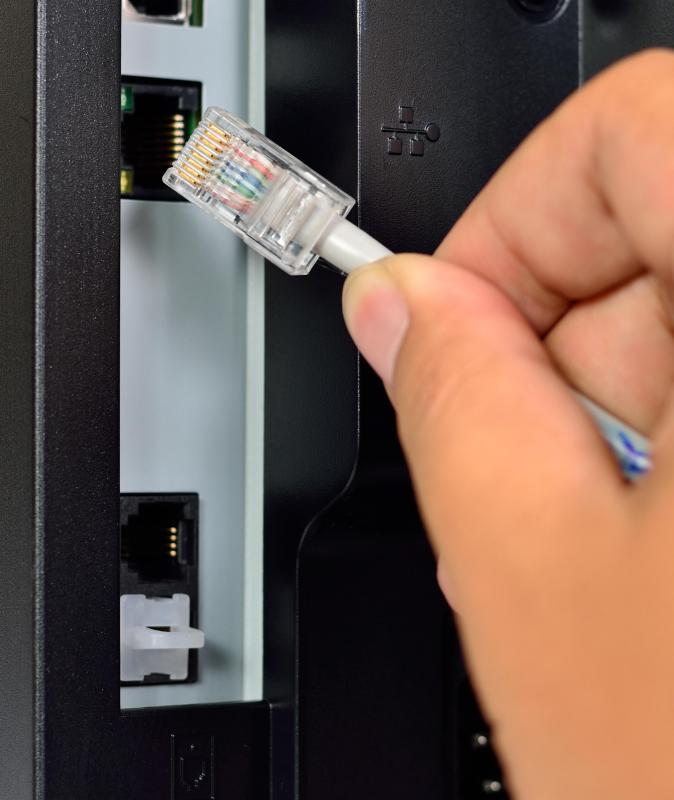
![An Ethernet cable.]()
An Ethernet cable. -
![A network hub with an Ethernet cable.]() By: sergey makarenkoA network hub with an Ethernet cable.
By: sergey makarenkoA network hub with an Ethernet cable. -
![Many computers are equipped with Ethernet ports.]() By: singkhamMany computers are equipped with Ethernet ports.
By: singkhamMany computers are equipped with Ethernet ports.


Discussion Comments
I have a satellite receiver which will show certain programs from the internet via an ethernet connection,
so I have set up the laptop connected to the internet by wifi, and joined it to the satellite receiver by an ethernet cable and the indicator lights come up on both devices. The satellite receiver says not connected. why? and is there anything to be done?
I have a Hp intel pentium 4 server now the previous owners have installed broadcom Netxtreme Ethernet management on here, I would like to upgrade to windows 7, I have checked on the windows upgrade advisor, and that's the only thing that needs to be removed. everything else is compatible. How do i uninstall the broadcom ethernet without disrupting any files? --clueless
You can also include some matter about Ethernet crossover Cable. Yet, well done. -Shini S.
information in this article are very much helpful, not only for the students but also for the people who are interested in knowing more about dealing with computers! Good job! -TMC//BSIT-3
To Joe: I think it is an RJ48, possibly an RJ48C, for a T1 it is wired White/Blue receive one/two skip 3 and White/Orange Transmit four and five.
written very clearly. Nice article. Keep it up.
excellent and simple information. easy to understand
short and sweet explanation that helped me to understand.
simple information which beginners can understand. nice one.
knowledgeable information. thank you.
nice article. thanks for such good information.
can nets/vsta telephone line connect to adsl?
good article. gives a lot information. thank you.
The end of an ethernet cable has a jack that looks much like a phone jack only it is a little wider - more like a rectangle than a phone jack's sort of square shape.
Post your comments