
At WiseGEEK, we're committed to delivering accurate, trustworthy information. Our expert-authored content is rigorously fact-checked and sourced from credible authorities. Discover how we uphold the highest standards in providing you with reliable knowledge.
What Is Endolymph?
Endolymph is a potassium-rich fluid found within the human inner ear’s membranous labyrinth. It is sometimes also known as Scarpa's fluid after Antonio Scarpa, the 18th century Italian anatomist who first discovered that the inner ear was filled with fluid. It's usually one of two main fluids found in the inner ear that are known collectively as "cochlear fluids." Endolymph has a composition very different from that of extracellular fluids found elsewhere in the body, including perilymph which is the other cochlear fluid. It also has two unique roles: it helps with hearing by absorbing and directing sound waves, and also aids in balance by promoting electrochemical stability that is relayed almost immediately to the brain. Even small shifts in composition and volume cause big changes in a person’s balance, coordination, and hearing.
Understanding the Inner Ear Generally

Though human ears are small, they are filled with many highly complex and specialized regions that can have significant impact on a person’s quality of life. The area known as the “inner ear” is often though of as the most specialized and sensitive, so it perhaps comes as no surprise that this is where the important endolymphatic fluid is stored.
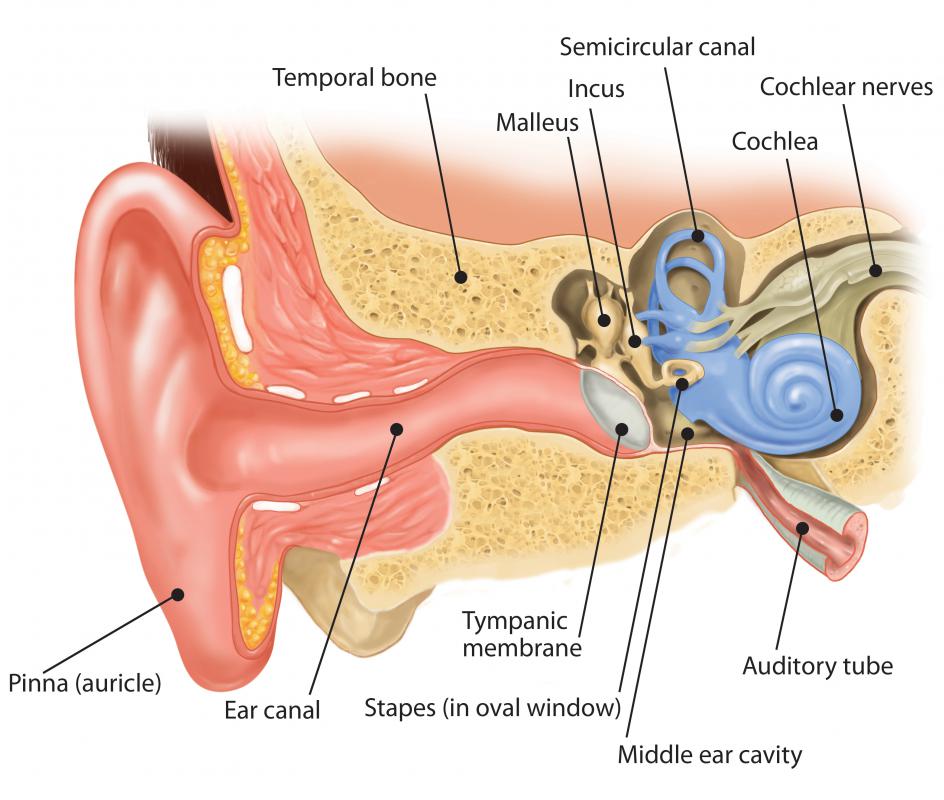
In a process known as transduction, the inner ear converts sounds that enter the ear canal into the electrical signals that are carried to the brain. The inner ear contains a series of fluid-filled spaces. A structure called the bony labyrinth consists of a central vestibule, three semicircular canals, and the spiral-shaped cochlea, and each substructure contains a corresponding portion of what’s known as membranous labyrinth. It is this labyrinth that is filled with fluid.

The utricle and saccule in the vestibule and the semicircular ducts in the semicircular canals are involved in maintaining balance, and the scala media in the cochlea is involved in hearing. Meanwhile, watery perilymph, a typical extracellular fluid comparable to plasma or cerebrospinal fluid, fills the space in the bony labyrinth surrounding the membranous membrane.
Fluid Function and Main Role

In healthy people, the fluid courses through the chambers of the inner ear almost constantly. This movement stimulates nerve cells, particularly receptor cells, in response to sound waves, and this is a big part of how the brain interprets sound both when it comes to overall volume as well as things like tone and pitch. The fluid also relays important signals about the head and larger body’s position in space, which is instrumental in providing balance. As a person tilts and bends, the fluid moves, too; changes are reported to the brain to allow calibration and prevent dizziness, vertigo, and other related problems.
Secretion

Potassium in the fluid is secreted from the stria vascularis. The high potassium content means that it is that element, rather than sodium, that maintains the electrical gradient in the cells in the fluid more generally. Other significant features include the fluid’s low calcium content and high positive charge, known as the endocochlear potential.

The perilymph and endolymph do not flow between regions as once was thought by early anatomists. Rather, they are maintained by local ion transport processes. Endolymphatic fluid has a unique high-potassium, low-sodium composition and a much higher total ion content than that of perilymph. Unlike many other body fluids, these two are not secreted and reabsorbed.
Common Problems and Imbalances
Meniere's disease is a disorder related specifically to this fluid with symptoms including low-frequency hearing loss, ringing in the ears, dizziness and a feeling of pressure in the ear. In patients who have Meniere's disease, fluid levels are much higher than they should be, creating a condition known as endolymphatic hydrops. As a result, some part of the membrane surrounding the fluid ruptures or develops a leak. The release of endolymph into perilymph is toxic and disturbs the normal chemical composition of the inner ear, leading to hearing loss. Also, rapid motion or spinning can cause false triggers of the fluid as it moves, resulting in dizziness and possible motion sickness.
AS FEATURED ON:
AS FEATURED ON:









-
![The inner ear contains a series of fluid-filled spaces.]() By: kocakayaaliThe inner ear contains a series of fluid-filled spaces.
By: kocakayaaliThe inner ear contains a series of fluid-filled spaces. -
![The movement of endolymph can cause motion sickness.]() By: carla9The movement of endolymph can cause motion sickness.
By: carla9The movement of endolymph can cause motion sickness. -
![Small changes in endolymph composition can make a person sensitive to sound.]() By: Syda ProductionsSmall changes in endolymph composition can make a person sensitive to sound.
By: Syda ProductionsSmall changes in endolymph composition can make a person sensitive to sound. -
![Inner ear disorders sometimes cause dizziness and a loss of balance.]() By: elizalebedewaInner ear disorders sometimes cause dizziness and a loss of balance.
By: elizalebedewaInner ear disorders sometimes cause dizziness and a loss of balance. -
![The release of endolymph into perilymph can cause hearing loss.]() By: slasnyiThe release of endolymph into perilymph can cause hearing loss.
By: slasnyiThe release of endolymph into perilymph can cause hearing loss.


Discussion Comments
If you have ever had Meniere's disease you know how frustrating this can be. Mine started out with this ringing in the ears that just wouldn't go away.
I also noticed that when I laid down or sat up quickly I got very dizzy. This is when I found out I had Meniere's.
While it is not anything terminal, it can really have a big effect on how you go about your day. When your endolymph and inner ear are messed up, you feel so out of balance. I had a big fear that I would get so dizzy and fall over or not be able to drive my car.
It did make a big difference once I began treatment, but it still took several months before I began to feel right again.
Post your comments