
At WiseGEEK, we're committed to delivering accurate, trustworthy information. Our expert-authored content is rigorously fact-checked and sourced from credible authorities. Discover how we uphold the highest standards in providing you with reliable knowledge.
What is E-Publishing?
E-publishing is short for electronic publishing, referring to a type of publishing that does not include printed books. Instead, it takes the format of works published online, on a compact disk, emailed, or provided in a file format compatible with handheld electronic readers. This is an alternate form of publication especially attractive to new writers, and it has both advantages and disadvantages over traditional printed books.
Some of the advantages of e-publishing include the following:
- Negligible investment by the publisher translates to a greater willingness to take on untried writers and non-traditional characters, story lines, and manuscript lengths.
- Faster publishing time for accepted manuscripts. Rather than waiting up to two years for a manuscript to see print, this method generally publishes work within a few weeks to a few months after acceptance.
- Greater flexibility within the writer/publisher relationship. E-publishing affords more say to writers in preparing works for publication. A paper publisher might ask a writer to change a character, plot line, or other features of a story to make it more marketable. An e-publisher might also make suggestions, but the writer will generally have more say. The writer might also be instrumental in providing graphics for the work, such as an electronic jacket.
- Writers have the ability to update the text often and easily at virtually no cost. This is particularly handy for works related to fast-moving industries, such as computer technology. Since the publisher does not have an investment in printed books already lining shelves, text can be electronically updated in seconds.
- E-publishing offers greater longevity for works with slower sales. While paper publishers will remove slow movers from active status (print), electronic storage affords unlimited archiving. This gives new writers time to build a following by having their entire catalog available over extended periods of time.
- Works published electronically have an ISBN number, just like printed books. This means anyone can walk into a storefront bookstore and order an electronic copy of the book.
- Writers often get a higher percentage of royalties through this method because the initial financial layout for the publisher is so much less than for a paper publisher. Some writers receive as much as 70% of the profits in royalties.
- With e-publishing, writers normally retain all other rights to the work, such as the option to go to a paper publisher later, adapt a screenplay, or use the work in some other capacity. Paper publishers, on the other hand, tend to covet as many rights as possible from the writer in the initial boilerplate contract.
If this all sounds a little too rosy, this form of publishing does have a number of disadvantages:
- Electronic works generally sell far fewer copies than paper books. Many people aren’t aware of e-publishing and others prefer reading a book from print rather than electronically. Good sales, according to one e-publisher, amount to 500 copies for a successful manuscript.
- Writers are typically responsible for providing their own ongoing marketing for e-published work. A book might be great, but if nobody knows about it, it won’t sell. Authors also can’t count on the public seeing their books on shelves or in store windows.
- E-published works do not always carry the same weight as traditional paper publishers. The sense is that the bar is somehow lower for these works than for printed works. This may change with time, however, as the industry becomes more established.
- Writers do not receive an advance. This is not just a financial disadvantage, but might disqualify e-published authors from participating in certain organizations where membership requirements include works paid by advance. That said, sales royalties are often paid more frequently by e-publishers, such as quarterly rather than annually.
- Piracy is another concern in the industry. It is a fairly simple thing, technically speaking, for a recipient of an e-work to edit the file, make several copies, and sell the work out from under the nose of the e-publisher and author. Some e-publishers counter that the relatively small market for e-works provides little impetus for this.
- Prices are not always significantly cheaper for e-works, despite the lower overhead. This might be a deterrent to sales.

Despite the disadvantages, e-publishing can be a good way for a new writer to gain a following. Romance, science fiction, murder mystery, and fantasy are all popular electronic genres. It is also ideal for How-To books that must be updated frequently. Businesses can also save money on employee manuals and training materials by providing them electronically. An added advantage here is that works can be clickable — the table of contents and indexes can all make navigating through technical e-books a breeze.
AS FEATURED ON:
AS FEATURED ON:









-
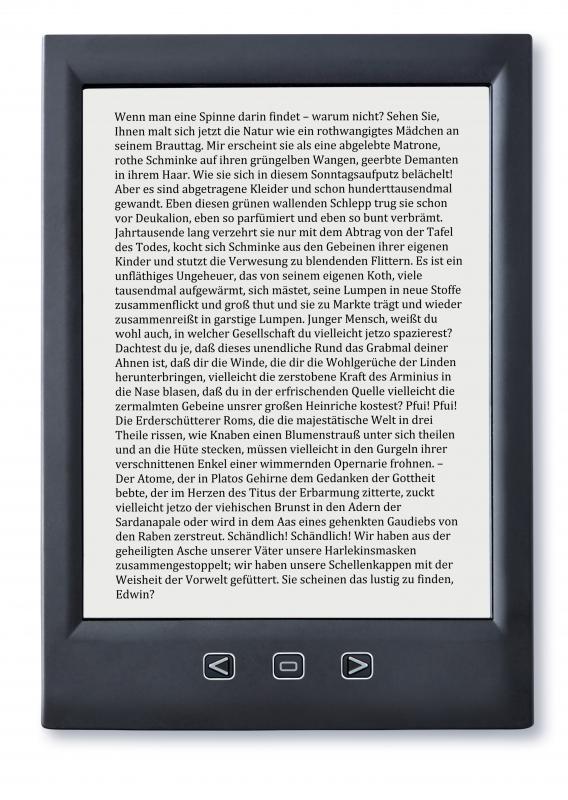
![A tablet e-book displaying e-published content.]() By: TaffiA tablet e-book displaying e-published content.
By: TaffiA tablet e-book displaying e-published content. -
![Murder mysteries are popular electronic genres.]() By: stokketeMurder mysteries are popular electronic genres.
By: stokketeMurder mysteries are popular electronic genres. -
![Due to its convenience, e-publishing has the potential to reach a greater audience than traditional printed books.]() By: Aleksei PotovDue to its convenience, e-publishing has the potential to reach a greater audience than traditional printed books.
By: Aleksei PotovDue to its convenience, e-publishing has the potential to reach a greater audience than traditional printed books. -
![E-published materials may not go through a strict editing process like printed works.]() By: PixsoozE-published materials may not go through a strict editing process like printed works.
By: PixsoozE-published materials may not go through a strict editing process like printed works. -
![Writers are typically responsible for providing their own ongoing marketing for e-published work.]() By: Gandolfo CannatellaWriters are typically responsible for providing their own ongoing marketing for e-published work.
By: Gandolfo CannatellaWriters are typically responsible for providing their own ongoing marketing for e-published work.


Discussion Comments
Trust me! I was stuck to the page. This is an amazing write-up on the future scope of electronic publishing services. And, this gives an exact picture of how the electronic publishing services evolved and how did it lead to the popularity of pre-print and indexing services.
Thus, it may be any printed format that you need, it’s quite possible to get the typesetting services done in a short while using technology in this digital era.
But at the same time, we must also be cautious and pick a reputed and Apple-approved ebook conversion house to work with typesetting services and create books in EPUB format. Choose those who could provide people across the world with required top-notch services like pre-pressing, typesetting, and bespoke solutions at a price comparatively less than the rest in the market.
Once again, Thanks a lot for this astounding piece of writing. It makes readers realize that getting your writing digitIzed is now sung as a bug in a rug.
In the future, will e-publishing studies be considered important and which sectors will provide job careers? Will the courses take a long time to finish?
Thanks a lot, but what i want to know is how does someone maintain the E-publishing for it not to fade and lose market?
i would like to publish with e-publishing. how do i do that?
I have learned e publishing. Can anybody give me a job.
I want to start an e-publishing company. what are the steps i have to follow? what do i need?
I want to start an e-publishing company. What are the steps I have to follow? and what do I need?
I want to know more about e-publishing.
now i am looking for the e publishing job and i want to know which kinds of technologies are used?
What is the future of e publishing?
i wish to start an e-publishing company. what are the steps i need to take? --angsems
In the next 10, maybe 15 years e-publishing will come to the forefront as the way most of today’s printed material will be offered. The majority of novels will be read on more sophisticated e-readers. Most magazines and newspapers will be offered as e-subscription downloadable formats and many will only be available in electronic form. Printers will slowly become cross media one stop shopping for publishers. Innovative web design firms will make this transition more quickly. All-in-all, if you can imagine it, it will probably be possible. Just my thoughts. Kurt Kubitz
I want to start an e-publishing company. What are the steps I have to follow? and what do I need?
good evening i read this article about e- publishing amd i just want to know is there a career future in e-publishing and what are the studies we have to take in learning this job?
PREM
good evening. i read this article but i want to know if what the problems are in e publishing, how we can find solutions for them, or if e publishing for the first time, show any problems and their solutions, what the objectives are for e publishing and what methods to use to solve this problem. I'd like to see an article about research, reporting of problems in e publishing and how to solve them.
i have an idea to start a company with e-publishing.
what is the procedure to start the project and how to get that project?
I want to start an e-publishing company. What are the steps I have to follow? and what do I need?
I want to start an e-publishing company. What are the steps I have to follow? and what do I need?
good evening i read this article about e publishing i just want to know is there career future in e publishing and what are the studies we have to take learning this job.
Post your comments