
At TheHealthBoard, we're committed to delivering accurate, trustworthy information. Our expert-authored content is rigorously fact-checked and sourced from credible authorities. Discover how we uphold the highest standards in providing you with reliable knowledge.
What Is Dense Irregular Connective Tissue?
Dense irregular connective tissue, which is made up of elastic fibers and a type of protein fiber called collagen, provides protection to the tissues or organs it surrounds. The collagenous fibers are irregularly arranged in interwoven sheets that makes the tissue very strong. This type of tissue is particularly common in areas of the body where multi-directional force is frequently exerted, such as muscles, for example.
Connective tissue provides support to the organs and tissues of the body and is separated into two types: loose connective tissue, which is more abundant, and dense connective tissue. The latter is sub-divided into two categories — regular and irregular — that are classified based on the arrangement of the tissue's fibers. The fibers of dense regular connective tissue are arranged in parallel to each other unlike dense irregular connective tissue, which has an irregular pattern of fibers. The different arrangement of fibers serves different functions. Dense regular connective tissue can withstand tension only in the direction that its fibers run, whereas the irregular tissue can withstand multi-directional tension.

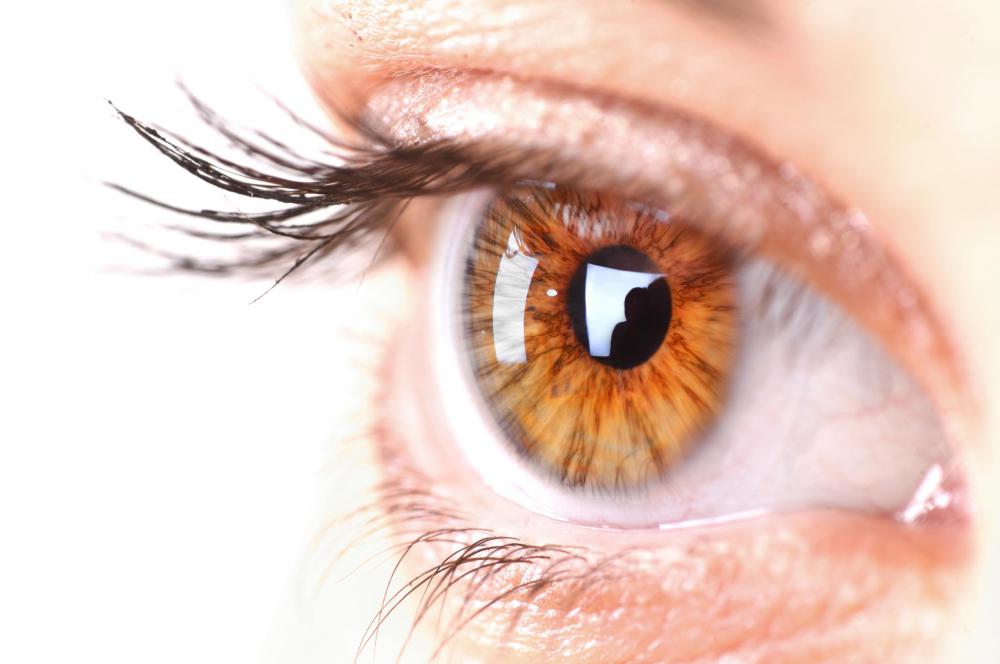
The fibrous and protective white part of the eye, or the sclera, contains dense irregular connective tissue, as does the part of the gastrointestinal tract called the submucosa. Its function is to support the mucous membranes. It also makes up a large part of the skin; the top outer layer is the epidermis, which is made up of four to five layers of this tissue, depending on what part of the body it's covering.

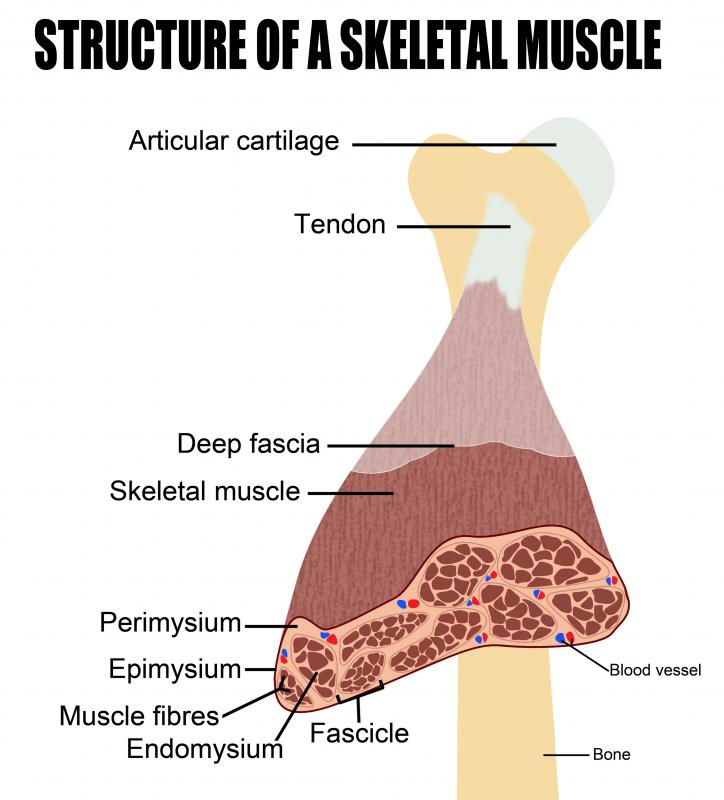
Between the epidermis and the deep subcutaneous tissue lies a thick layer of dense irregular connective tissue. This type of connective tissue also makes up fibrous capsules, which are protective sacs or membranes that surround internal organs, glands, and bones. It's called the periosteum when it forms a membrane the lines the outer surface of bones, and when it forms a protective layer around the cartilage of developing bones, it's called the perichondrium. The tissue also forms some types of fascia, which are supportive and protective membranes that surround muscles, muscle groupings, nerves, and blood vessels. The type of fascia that envelopes individual muscles, holds muscles together, and separates muscles into functional groups is called deep fascia, which is located under a layer called the superficial fascia.
AS FEATURED ON:
AS FEATURED ON:


-
![Dense irregular connective tissue can be found in the white of the eye.]() By: Péter MácsDense irregular connective tissue can be found in the white of the eye.
By: Péter MácsDense irregular connective tissue can be found in the white of the eye. -
![A large part of the dermis is made up of dense irregular connective tissue.]() By: LoloStockA large part of the dermis is made up of dense irregular connective tissue.
By: LoloStockA large part of the dermis is made up of dense irregular connective tissue. -
![The type of fascia that envelopes individual muscles, holds muscles together, and separates muscles into functional groups is called deep fascia.]() By: Balint RaduThe type of fascia that envelopes individual muscles, holds muscles together, and separates muscles into functional groups is called deep fascia.
By: Balint RaduThe type of fascia that envelopes individual muscles, holds muscles together, and separates muscles into functional groups is called deep fascia. -
![Dense irregular connective tissue called the periosteum when it forms a membrane the lines the outer surface of bones.]() By: designuaDense irregular connective tissue called the periosteum when it forms a membrane the lines the outer surface of bones.
By: designuaDense irregular connective tissue called the periosteum when it forms a membrane the lines the outer surface of bones.


Discussion Comments
@giddion – I do a lot of resistance exercise, and I can tell you that it is good for the connective tissue, as well as for building muscles. As my muscles grow, the dense irregular connective tissue becomes stronger.
I have read that this adds extra protection to the muscles. Also, if I ever find myself in need of physical therapy, it could help me recover more quickly.
When I first started doing resistance training, I had no idea that my connective tissue would benefit. This is just something I learned when I became more interested in the science behind it.
I imagine that bodybuilders make good use of their dense irregular connective tissue. All that weightlifting surely places a lot of strain on the muscles from all directions.
I work out a few times a week, but I do mostly light weightlifting. However, I also benefit from this tissue, I'm sure. I would imagine that it might be a bit more well-developed or thicker on the muscles of bodybuilders, though.
The existence of dense irregular connective tissue is just one of many reasons that I believe in a Creator. The human body is so well designed and well thought out!
Every little cell has a purpose, and the fact that we have cushions in the form of tissue surrounding all our important organs is astounding to me. Everything just falls into place too perfectly to have occurred randomly.
Post your comments