
At WiseGEEK, we're committed to delivering accurate, trustworthy information. Our expert-authored content is rigorously fact-checked and sourced from credible authorities. Discover how we uphold the highest standards in providing you with reliable knowledge.
What is Cystic Acne?
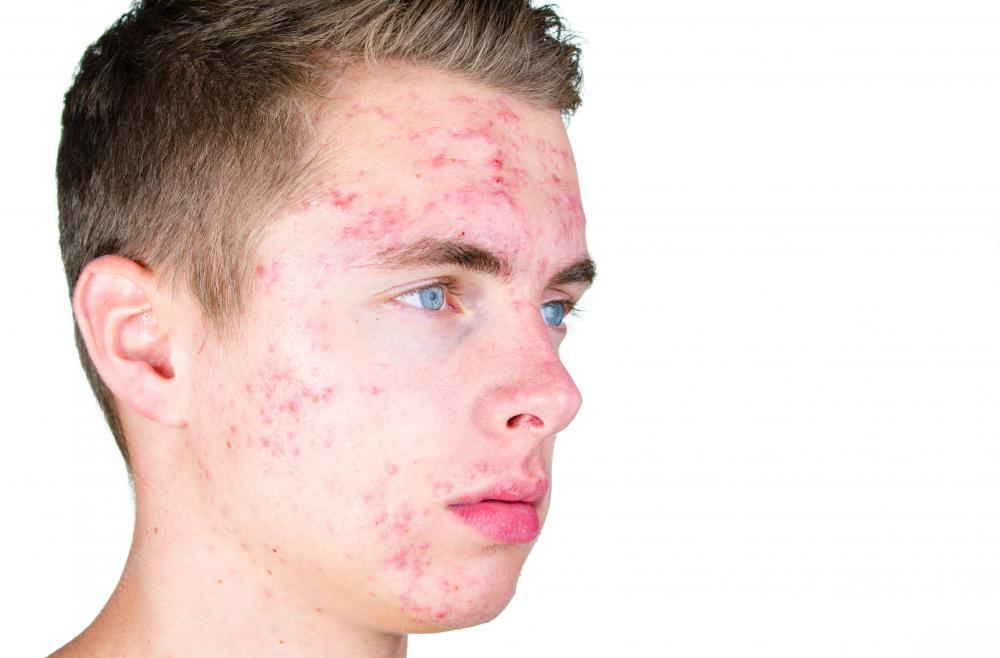
Considered the most severe type of acne, nodulocystic acne, or cystic acne, is painful and leaves permanent disfiguring scars on its victims. It is an inflamed breakout that develops on the face and other areas of the body that leaves behind large blemishes measuring up to several centimeters across. The name derives from the cyst that develops deep within the skin following infection. The cyst is filled with puss and is found under the swollen pustule.
Not all severely inflamed acne can be considered cystic. The existence of a cyst distinguishes this form from the common acne known as acne vulgaris. A person suffering from nodulocystic acne not only develops cysts but also nodules. Unlike cysts, which feel soft, nodules are hard lumps under the skin's surface, and they can also be painful. Since nodules form deep within the skin, they take a long time to heal. The term "nodular acne" refers to a particular type of acne that develops nodules but does not have cystic lesions.

Teenage boys and young men are more prone to cystic acne generally, although women are likely to suffer from it during their menstrual cycle or post pregnancy. Nodulocystic acne can actually occur at any age, but it is more common during teenage years when various hormonal changes take place in the body. Experts believe that the main cause is overactivity of the sebaceous glands. Extra oil is secreted by these glands and clogs the pores on the skin surface, and it then combines with external bacteria to form an infection in the clogged pores. When left unchecked, the infection could affect the deepest tissue of the skin, causing the painful nodulocystic acne. The presence of dead skin cells within the pores causes cystic acne as well.

The likelihood of developing scars following nodulocystic breakouts is extremely high because of the severe damage to surrounding skin tissues. In order to prevent the development of permanent scars, pricking and scratching the affected portions of the skin should be avoided.
Those who are suffering from cystic acne are advised to seek professional medical help. This type of acne requires systematic medication that only healthcare professional can provide. Unlike common acne that can easily be treated with topical bactericidal, nodulocystic acne requires a combination of more aggressive treatments that include oral antibiotics, intralesional corticosteroid injections, and possible surgical excision and drainage.
AS FEATURED ON:
AS FEATURED ON:









-
![Cysts develop underneath the skin's surface and become inflamed making cystic acne painful.]() By: Ocskay BenceCysts develop underneath the skin's surface and become inflamed making cystic acne painful.
By: Ocskay BenceCysts develop underneath the skin's surface and become inflamed making cystic acne painful. -
![Cystic acne can lead to scarring if not treated properly.]() By: Budimir JevticCystic acne can lead to scarring if not treated properly.
By: Budimir JevticCystic acne can lead to scarring if not treated properly. -
![Cystic acne should be treated by a doctor.]() By: Picture-FactoryCystic acne should be treated by a doctor.
By: Picture-FactoryCystic acne should be treated by a doctor. -
![Oral antibiotics may be an effective treatment for cystic acne.]() By: Syda ProductionsOral antibiotics may be an effective treatment for cystic acne.
By: Syda ProductionsOral antibiotics may be an effective treatment for cystic acne. -
![In most cases, acne can be treated with over-the-counter cleansers and does not require prescription gels.]() By: ipagIn most cases, acne can be treated with over-the-counter cleansers and does not require prescription gels.
By: ipagIn most cases, acne can be treated with over-the-counter cleansers and does not require prescription gels.




Discussion Comments
I am 40 and up until now I've had little or no acne breakouts. Only during my period. Recently, I've getting huge cystic bumps on my face. I tried everything, even crushing and putting aspirin on my skin. This left me with dark scarring on my face and the cysts came back.
I recently started taking vitamin c 1000 mgs lypo spheric, one pack a day. In addition I also take pantothenic acid 500mgs. I take two daily. I also wash my face using neutrogena acne wash and red indian clay. Also for any cysts that pop up suddenly, I use acne free severe terminator 10. This stuff works while you sleep. For a moisturizer I use tea tree oil. For the first time in six months my face is finally clearing up and my skin is glowing. The scars are disappearing and I feel great.
I have a history of acne and have gone through many rounds of antibiotics to keep my face clear. I thought I was too old to get bad acne, but have had a recent flare up.
There has been some major stress in my life recently and I am almost positive that is part of my problem.
The worst breakouts are cystic acne on my chin. When I am working at my desk, I have a habit of resting my chin in the palm of my hand. I wonder if this has anything to do with getting more acne on my chin than anywhere else.
@SarahSon - If you have insurance, this is something that I would definitely look into for your acne scars.
I went to my dermatologist to get rid of some acne scars on my face, and have been very pleased with the results.
You might want to check to make sure your insurance company covers it. Mine did and all I had to pay was my co-payment.
It really is amazing what they can treat today. This is a quick procedure, almost painless, and the results are well worth it.
I had some acne when I was in high school, but it got really bad when I was in college. This is something that is hard to deal with no matter what your age is. It is really hard to feel confident about yourself when you have bad acne.
I don't know if this was ever considered cystic acne, but know that I had to end up taking some very powerful medication to treat it. I had taken oral antibiotics for years, but that wasn't helping any more.
I still have some scars on my face from this. This is something that makeup may cover up a little bit, but the scars are still noticeable.
I am thinking about getting some laser treatment done. Has anyone had good results with laser treatment for acne scars?
@burcidi - In addition to changing your diet, you might want to consider some natural remedies. I've never had cystic acne, but I've used tea tree oil on various blemishes with really good results.
I did a little bit of searching, and it looks like tea tree oil can be used for cystic acne, too. I'm not sure if it will work as well as the antibiotics, but it might be worth a try. Especially if you combine it with some dietary changes, it really could work!
Also, if you've been on antibiotics for a long time, I would suggest taking some probiotics to get your good bacteria back to where it needs to be. I'm sure you're doctor has already suggested that though!
From reading some of these responses, it sounds like therapy should also be part of treating cystic acne, at least in teenagers. When I was in high school, most of my friends were fairly insecure about their looks. I also had a friend that had trouble with acne (luckily just the regular kind) and I remember it made her feel extra-insecure.
Cystic acne looks so much worse than regular acne, I can understand why a teenager would suffer from low self-esteem from having it. And we all know high school kids can be pretty cruel. I think teenage cystic acne sufferers could definitely benefit from some kind of therapy to help them deal with these issues.
@seag47 - Great information! A friend of mine is looking into reducing her cystic acne scars, so I'm going to let her know what you said about those treatments.
Anyway, from what my friend told me, cystic acne treatment can consist of various things. Other people have mentioned antibiotics, but doctors also treat cystic acne with various creams, as well as hormonal treatment. As someone else mentioned below, cystic acne can be caused by hormonal imbalances, so it stands to reason that people might take different hormones to get rid of the root problem, and by extension the cystic acne.
@orangey03 – There are several techniques that a dermatologist can use to remove cystic acne scars. When I went in for a consultation about getting rid of my scars, he told me that he could either do a series of chemical peels, microdermabrasion, or laser resurfacing.
The last two involve actual grating of the skin to promote new cell growth. They were more on the pricey side, so I decided to go with the chemical peels.
I went in for a peel every two weeks for six months. The dermatologist wiped some sort of across my face, and it made the top layer of my skin peel away.
My face was dry, red, and flaky for awhile, but I got great results from it. If your brother's acne scars run very deep, though, he might want to try one of the other techniques. Chemical peels can only peel so far down, and the results from the other methods are more drastic.
@Oceana – It is sad that teenagers are affected with such intense acne, because we all know how cruel peers can be at that age. My brother endured so much teasing because of his cystic acne that my mother started home-schooling him.
She was afraid that his classmates were doing irreparable damage to his self-esteem, so she removed him from that environment. He got a good education at home and scored high on a college entrance exam.
By the time he went to college, the cystic acne had gone away. He still had scars from it, but he looked a lot better.
The scars are still with him today. I know he would like to erase them completely, but I don't know if that's possible. Does anyone know how you can get rid of acne scars?
I had a close friend in high school who suffered from cystic acne. He was a great guy, but his acne made him super shy.
I think he learned to trust me once he saw that I wasn't going to tease him about his appearance. His parents couldn't afford to take him to a doctor, so he just had to live with it.
He never picked at the acne or squeezed it, because he knew this would be bad. He just washed his face three times a day and left it alone.
By the time he turned seventeen, I suppose his hormones had shifted, because the acne went away. When it did, he got the confidence to finally ask me out. He didn't know it, but I would have gone out with him in spite of the cysts.
I had cystic acne at age 26. I had just started a new job, and I was under a lot of stress. My hormones were also all out of whack.
The nodules were very sore to the touch. Sometimes at night, when I would roll over on my cheek, I would awaken in pain.
I tried to cover them with a thick makeup, but I think this only aggravated my condition. I eventually had to go see a dermatologist.
I remember him sticking a needle deep into my skin and pressing hard on the sides of the bumps to drain the pus out. This left my skin extra red and irritated for awhile.
This excision, combined with tetracycline, helped me recover from cystic acne in about six months. I really thought at one point that even the dermatologist couldn't make it go away, but he did.
@burcidi-- I think there are a lot of factors that have to do with cystic acne and diet is one. I've seen an improvement in my cystic acne when I avoid milk in particular and when I eat a lot of foods with vitamins, antioxidants and fiber but that's not all. Working out regularly and specifically sweating is really great for cystic acne. I feel like it cleans out my system and releases toxins.
Aside from these external factors, there may also be a hereditary component causing cystic acne. I heard once that people with thick skin tend to suffer from cystic acne more because it's harder to exfoliate and clean the pores and more chances of an infection.
My sister has beautiful skin that's very thin. It's enough for her if she exfoliates once in every two weeks. But I need to exfoliate several times a week to clean my pores.
I think it would be wrong to look for one single cause or one single cystic acne remedy. The solution is lots of things together I think. I don't know if others would agree.
@burcidi-- Honestly, I've heard it both ways. Some people say that their cystic acne improved after changing their diet. Others said that it makes no difference.
I think the treatment for cystic acne depends on what exactly is causing it. For example, if yours is caused by hormones, then I doubt that things like diet will provide any long-term treatment. You would need to have hormonal tests done and treat any hormonal imbalances.
But if your cystic acne is caused by an unhealthy diet or an allergy to certain foods then most definitely avoiding those foods and eating healthier would help.
So you need to find out why you have cystic acne before you decide on a treatment. Until you do, I think oral antibiotics and antibiotic creams is a good option.
Hi, I've been suffering from severe cystic acne for the past five years. My doctor has put me on antibiotics several times during which my acne has mostly cleared up. But only to return when I stop the medication.
I cannot keep taking antibiotics and would really like to find an alternative treatment. I've heard that avoiding certain foods like milk and meat products helps this condition a lot.
Has anyone seen an improvement in their cystic acne after changing their diet in any way? Please let me know.
Post your comments