
At WiseGEEK, we're committed to delivering accurate, trustworthy information. Our expert-authored content is rigorously fact-checked and sourced from credible authorities. Discover how we uphold the highest standards in providing you with reliable knowledge.
What is Cross Stitch?
Cross stitching is a form of decorative embroidery. Designs are composed of many x-shaped stitches, much as digital images are composed of many square pixels. There are two primary forms of this craft: stamped and counted cross stitch. Stamped versions follow patterns that are printed directly onto fabric; counted cross stitching follows a separate pattern design and typically uses a a special woven fabric called Aida cloth.
Cross stitching is the simplest form of embroidery because designs are created by combining multiple x-shaped stitches. The counted type is typically easier than the stamped kind because Aida cloth automatically standardizes the stitch size.

In stamped cross stitch, the embroidery pattern is printed directly onto the fabric. The dye usually disappears after the first wash, so it's important not to wash the item until the entire design is finished. Different colored x shapes represent different colored threads. Stamped cross stitch is the most common form since most embroidered items, such as pillows, bibs, and tablecloths, are not made of Aida cloth.

Counted cross stitch patterns are typically printed onto a grid on a sheet of paper or in an electronic document. Different icons, such as clovers or blue circles, represent different thread colors. The printed guide can be followed by stitching x shapes into the grid-like Aida cloth. The term "counted" comes into play because, unlike a stamped pattern, one must count out the correct position and number of stitches.
Most embroidery floss is actually six strands of thread woven together into one strand. This is typically too thick for cross stitching, as the thread thickness may obscure the x-shaped stitches and make it difficult to tie off stitches in the back of the fabric. Pattern directions typically specify thread thickness, such as three strands. The specified number of strands from the floss can be isolated and gently separated. To create visual depth, certain parts of the pattern may use more strands than others.
All x-shaped stitches should be done in the same direction. For example, if the x is shaped by pulling thread through from the bottom-left across to the upper-right part, making a forward slash, and then pulled from the bottom-right corner across to the upper-left corner, all x's should be formed this way. For a row of stitches of the same color, all of the forward slashes can be completed first, then the x can be shaped by reversing direction to form the other slashes.
AS FEATURED ON:
AS FEATURED ON:









-
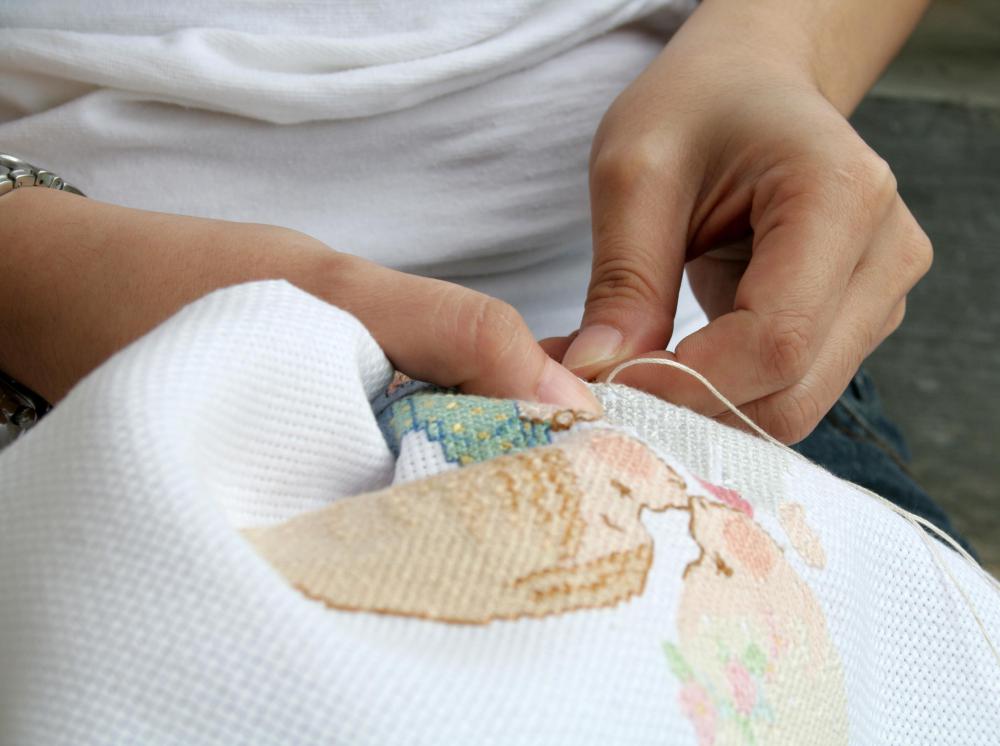
![Multiple x-shaped stitches are combined to form cross stitching designs.]() By: Lorelyn MedinaMultiple x-shaped stitches are combined to form cross stitching designs.
By: Lorelyn MedinaMultiple x-shaped stitches are combined to form cross stitching designs. -
![Embroidery floss must be separated for cross stitching.]() By: Andreja DonkoEmbroidery floss must be separated for cross stitching.
By: Andreja DonkoEmbroidery floss must be separated for cross stitching.

Discussion Comments
My grandmother decorated her house with her own cross stitch art. She kept the cross stitch fabric framed inside the hoops and just bought new ones for each piece.
She stitched a lot of country scenes and slogans that remind me of home. Whenever I see cross stitch embroidery in catalogs now, I think of her house and I feel nostalgic.
It seems like the stamped kind would be easier to use than the separate cross stitch patterns. I can't imagine having to count over every hole to make sure I put the stitches in the right place! That would get old fast.
I'm the kind of person who needs to follow an outline directly. I think it wouldn't matter too much if the stitches wound up being not all the same size, as long as the overall result looked good.
Besides, that Aida cloth is kind of rough. It reminds me of canvas, and I wouldn't want to use that on a pillow or garment.
@giddion – It's not hard at all. The strands are fairly loose already, so pulling a few apart is no big deal.
I bought a cross stitch kit when I was twelve, and I loved it. It came with a hoop for holding the fabric in place, a diagram of the pattern, and the colors of thread I needed to stitch it.
A friend showed me the technique, and I really took off from there. It's a great hobby for kids who like crafts.
How hard is it to separate the strands of embroidery floss if you only need a couple of them? I'm thinking of trying my hand at cross stitching, but I don't want to get stressed out dealing with unruly thread.
Post your comments