
At TheHealthBoard, we're committed to delivering accurate, trustworthy information. Our expert-authored content is rigorously fact-checked and sourced from credible authorities. Discover how we uphold the highest standards in providing you with reliable knowledge.
What is Cortisone Cream?
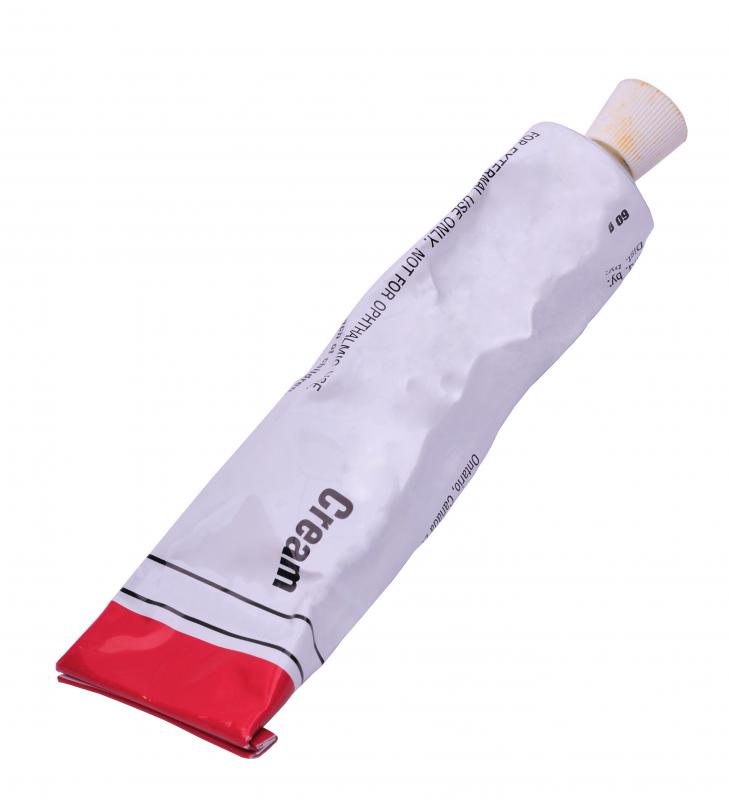
Cortisone cream is a topical corticosteroid ointment that reduces inflammation to areas where applied. It is often used to topically treat arthritis pain from inflammation of the joints, as well as inflammation of the skin caused by various skin disorders and conditions. Available in over-the-counter strength, it is usually sold as hydrocortisone.
Hydrocortisone is a water-soluble, synthetic steroid sold under various names as a cream to relieve itching and minor skin irritation. It is also a primary ingredient in over-the-counter hemorrhoid medication. In prescription strength, cortisone cream may be prescribed to treat skin conditions that are unresponsive to over-the-counter products.

Cortisone cream may be prescribed for other reasons not related to skin conditions, as determined by a doctor. A person should only treat a condition, such as rash, itching, or other skin irritation, with over-the-counter ointment under the advice of a medical professional or pharmacist unless he or she has successfully treated similar conditions with hydrocortisone before. If the condition does not improve within seven days, the patient should consult with a healthcare professional.

Common uses for this cream include the treatment of eczema, psoriasis, dandruff, diaper rash, insect bites, and itching and rash from poison ivy, oak, or sumac. The ointment may cause further skin irritation in some people and should not be used for long periods of time. Other side effects that may occur include thinning of the skin, dryness, and allergic reactions such as hives.

Cortisone cream does not treat bacterial or fungal skin infections. Signs of skin infection, including localized redness, raised bumps, or hives should be checked by a medical professional before applying any over-the-counter treatment. The cream is applied topically and absorbed into the skin, but generally not into the blood stream, but patients should still tell their doctor or pharmacist about any medications they take as well as any history of allergic reaction to corticosteroids.
AS FEATURED ON:
AS FEATURED ON:


-
![Common uses for cortisone cream include treating eczema, diaper rash and psoriasis.]() By: TingaCommon uses for cortisone cream include treating eczema, diaper rash and psoriasis.
By: TingaCommon uses for cortisone cream include treating eczema, diaper rash and psoriasis. -
![Corticosteroid cream is commonly used to treat eczema.]() By: quaysideCorticosteroid cream is commonly used to treat eczema.
By: quaysideCorticosteroid cream is commonly used to treat eczema. -
![Cortisone cream reduces the inflammation of the areas it is applied to.]() By: Africa StudioCortisone cream reduces the inflammation of the areas it is applied to.
By: Africa StudioCortisone cream reduces the inflammation of the areas it is applied to. -
![Cortisone cream can be used to provide relief from itchy hives.]() By: Jürgen FälchleCortisone cream can be used to provide relief from itchy hives.
By: Jürgen FälchleCortisone cream can be used to provide relief from itchy hives. -
![Cream that contains cortisone might help with inflammation.]() By: FentonCream that contains cortisone might help with inflammation.
By: FentonCream that contains cortisone might help with inflammation. -
![Cortisone is the primary ingredient in over-the-counter hemorrhoid creams.]() By: carroteaterCortisone is the primary ingredient in over-the-counter hemorrhoid creams.
By: carroteaterCortisone is the primary ingredient in over-the-counter hemorrhoid creams. -
![Cortisone cream is considered safe when used in accordance with the manufacturer's directions.]() By: robert mobleyCortisone cream is considered safe when used in accordance with the manufacturer's directions.
By: robert mobleyCortisone cream is considered safe when used in accordance with the manufacturer's directions. -
![Cortisone cream can be used to treat poison ivy rashes.]() By: librakvCortisone cream can be used to treat poison ivy rashes.
By: librakvCortisone cream can be used to treat poison ivy rashes.




Discussion Comments
What are the best brands of Cortisone cream?
My husband has a skin yeast infection. Nothing works for him. except cortizone 10 to stop itching and he is on warfarin. Are there any side effects?
Is cortisone cream harmful if swallowed?
elomet cream vs cortisone cream -- which one better?
different doctors advised different creams. i am confused.
Get more rest. That will help the body cure most anything, if it isn't already too far gone.
I have noticed that my hair is thinning around the sides. My hair dresser said that applying cortisone cream to that area daily will open the hair particles which will allow my hair to grow. Before i use it, i want to make sure this is correct. Also, my family does not have a history of baldness and i don't know why my hair is thinning, my is freaking me out.
is the cortisone cream safe to use for hair growth?
I have a pimple. Does cortisone cream cure this?
i shaved my pubic hair and now i have a really bad rash. do you know if this would help? also any other cream?
twila995: treatments for granuloma anulares usually involve steroid treatments prescribed by your doctor.
anon27996: Your hair actually changes several times throughout your life, particularly when hormones are going crazy in your body. if you've been pregnant, you probably noticed that your hair was shinier and healthier looking that it ever was before. same principle. as you age, your hormones change naturally. this could actually make your hair wavy/curly.
but no, the cortisone cream more than likely would have nothing to do with your hair.
Do you think the cream will help itching skin when I run?
I’ve had eczema for the past four years and i used a lot of medicines which was recommended by doctors and a dermatologist, but nothing worked. Each day the eczema was jumping to another part of my body. i got Cortizone 10 Maximum Strength Ointment and used it only two times, i swear only two times and it was gone. It was impossible. I couldn’t believe it and now i know my ointment for eczema, skin irritation, rashes, redness, poison ivy, etc. .thank you cortizone10, and thanks for reading. hope you all get well soon. --newyork filiz
I have granuloma anulare. Does anyone know of any treatment?
I have a skin condition called Lichen Planus. I have been using a cortisone cream when it gets really itchy. I use moisture creams all the time. Over the past year that I have been using this treatment my hair has become very wavy. Now I am 78 years old and this is no joke. Everyone wants to know if I have gotten a perm! Could the cortisone cream cause this? Needless to say after a life of straight hair this is really weird!!!!
Post your comments