
At WiseGEEK, we're committed to delivering accurate, trustworthy information. Our expert-authored content is rigorously fact-checked and sourced from credible authorities. Discover how we uphold the highest standards in providing you with reliable knowledge.
What is Contact Dermatitis?
 Michael Pollick
Michael Pollick
Michael Pollick
Many of us experience contact dermatitis after encountering one of the unholy trinity of plants — poison ivy, poison oak or poison sumac. Oils from these plants make direct contact with the skin and cause a chemical irritation. Medical professionals call this Irritant Contact Dermatitis, or ICD. Other causes of ICD can be soaps, detergents, hair dyes, foods, cleaning agents or pesticides. This condition accounts for up to 80% of reported cases.
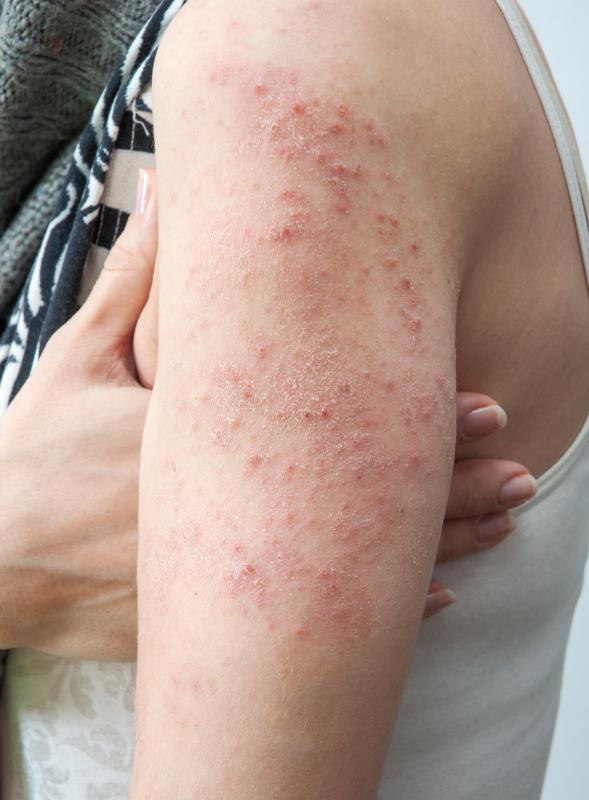
The other 20% of contact dermatitis cases stem from allergic reactions, especially ones developed over time. Accordingly, this form of the disease is called Allergic Contact Dermatitis, or ACD. Instead of an external irritant causing a direct reaction with the skin, ACD is caused by the body's own immune system. If a person is considered hypersensitive to nickel, for example, a rash may form directly under a nickel-plated bracelet. A hairdresser may form a sensitivity to certain hair dyes, causing a patch of red, scaly skin to form on the areas of contact.

In the case of ICD, the effect can be immediate or cumulative. Exposure to poison ivy oils may create a localized rash within 24 hours, but it may take weeks or months for a harsh laundry detergent to create a noticeable injury. Incidents of this type of dermatitis are among the most commonly reported workplace injuries. This has lead many companies to provide protective gloves, emergency wash areas and protective barrier creams for workers exposed to harsh chemicals daily.

Diagnosing ACD can be a time-consuming project. Many people perform self-examinations, eliminating all possible irritants from their lives and then methodically restoring them one by one. Any negative reaction during the process should narrow down the list of possible allergens. Both irritant and allergic dermatitis can be controlled by totally eliminating the offending substances. A dermatologist can also perform a skin test in which samples of common chemicals and plants are placed on patches of healthy skin. Any negative reaction is noted for future reference and treatment.

Chronic contact dermatitis conditions such as eczema can rarely be cured. Instead, dermatologists often prescribe topical anesthetics to reduce itching and steroids such as prednisone. Scratching affected areas can cause the irritation to become worse, so experts suggest using wet compresses to ease itching and peripheral swelling. The recommended treatment for most cases of contact dermatitis is no treatment at all. The inflamed skin should be given time to heal on its own, which it usually does within 2 months. The long-term course of treatment is generally a change in lifestyle to reduce exposure to potential irritants and allergens.
Michael Pollick
A regular WiseGEEK contributor, Michael enjoys doing research in order to satisfy his wide-ranging curiosity about a variety of arcane topics. Before becoming a professional writer, Michael worked as an English tutor, poet, voice-over artist, and DJ.
Learn more...
Michael Pollick
A regular WiseGEEK contributor, Michael enjoys doing research in order to satisfy his wide-ranging curiosity about a variety of arcane topics. Before becoming a professional writer, Michael worked as an English tutor, poet, voice-over artist, and DJ.
Learn more...AS FEATURED ON:
AS FEATURED ON:









-
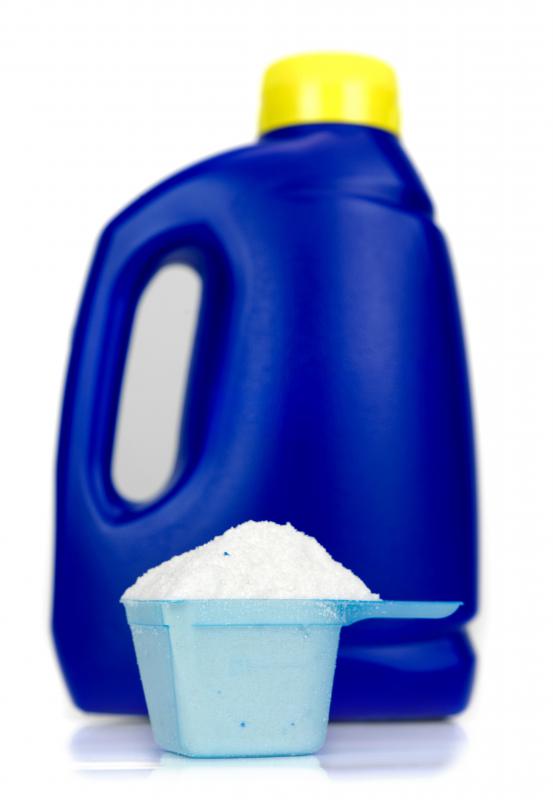
![Some laundry detergents can cause skin reactions.]() By: Kitch BainSome laundry detergents can cause skin reactions.
By: Kitch BainSome laundry detergents can cause skin reactions. -
![Poison oak causes contact dermatitis.]() By: fabfotosPoison oak causes contact dermatitis.
By: fabfotosPoison oak causes contact dermatitis. -
![Using some hair dyes might cause sensitivity and dermatitis in hairdressers.]() By: JackFUsing some hair dyes might cause sensitivity and dermatitis in hairdressers.
By: JackFUsing some hair dyes might cause sensitivity and dermatitis in hairdressers. -
![Exposure to pesticides can cause contact dermatitis.]() By: tuayaiExposure to pesticides can cause contact dermatitis.
By: tuayaiExposure to pesticides can cause contact dermatitis. -
![Prednisone is a steroid that can help relieve itching.]() By: Thirteen Of ClubsPrednisone is a steroid that can help relieve itching.
By: Thirteen Of ClubsPrednisone is a steroid that can help relieve itching. -
![Exposure to poison ivy oils may create a localized rash within 24 hours.]() By: librakvExposure to poison ivy oils may create a localized rash within 24 hours.
By: librakvExposure to poison ivy oils may create a localized rash within 24 hours.


Discussion Comments
My contact dermatitis strikes on my hands for the most part. I mostly use gloves and barrier creams like Tape Relief. Someone definitely needs to come up with an allergy cure!
While it's difficult to root out the cause of contact dermatitis, it can be even harder to root out the cause of noncontact dermatitis. If the allergy-causing substance doesn't even come into contact with the infected area, it can be even harder to find out what is causing the problem!
Post your comments