
At TheHealthBoard, we're committed to delivering accurate, trustworthy information. Our expert-authored content is rigorously fact-checked and sourced from credible authorities. Discover how we uphold the highest standards in providing you with reliable knowledge.
What is Considered a High Fever?
 Tricia Christensen
Tricia Christensen
Tricia Christensen
A high fever can accompany viruses, infections, or reactions to immunizations. It is the body’s way of attempting to rid itself of infection, and it can be effective. However, most people are curious to know when the fever begins to be dangerous, and in most cases, it isn’t that dangerous on its own. Very high fever can be dangerous for those with extremely suppressed immune systems, and for very young children. In general, a slightly elevated body temperature isn’t of great concern, unless it lasts for a lengthy period of time.
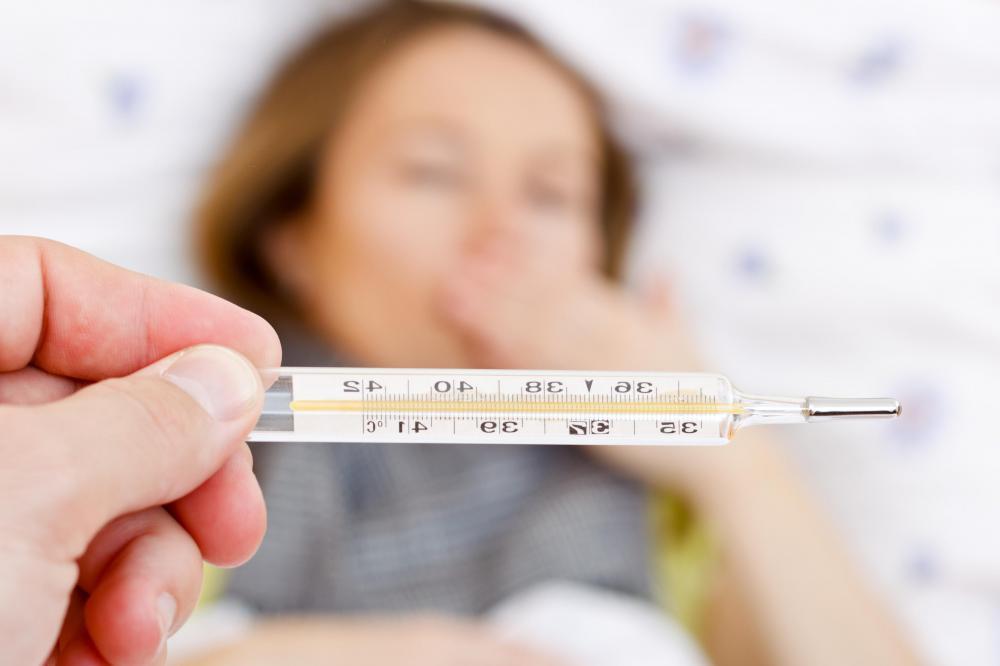
There are guidelines for determining what is considered a really elevated fever and when to call a doctor about presence of fever. These vary depending upon age. It should first be understood what normal body temperature is. This is typically 98.6 degrees F (37 degrees C), as taken orally, rectally or with ear thermometers. Readings under the arm, or axillary temperatures, are usually about one degree F lower, or about 36.5 degrees C.

In infants three months or younger, any fever is cause for concern and any rectal reading above 100.4 degrees F (38 C) is indication to call a doctor. This is because infants may quickly succumb to illness and they can dehydrate in a hurry. It is very dangerous to ignore evidence of fever in an infant, and people might look for fever if they note extra irritability, sleepiness, or if a baby seems very warm. It’s also important to notify doctors if an infant’s temperature drops below 97 degrees F (36.11 C).

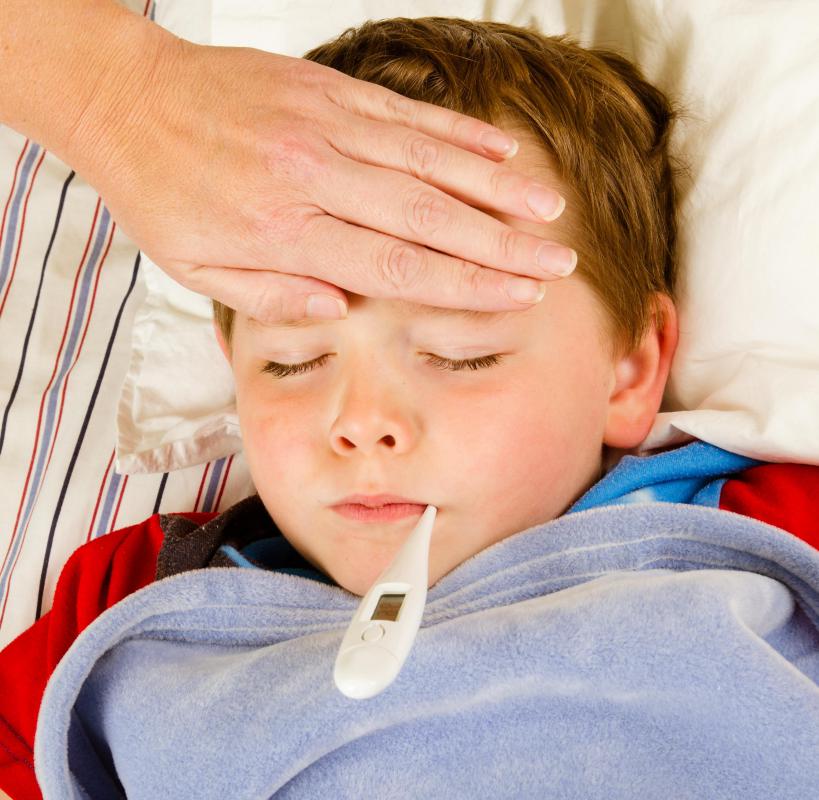
Once a child is over three months old, a high fever is considered 102 degrees F (38.88 C). This should always mean that a doctor should be called to determine if the child should be seen. A lower fever could be an emergency condition if a child is not responding and is very sleepy. This could signal the child has a condition like meningitis, and the child should be taken to an emergency room right away.

Children under 5 are also more vulnerable to a type of seizure caused by fever. These are called febrile seizures. Most of these will not permanently harm a child, but if one occurs, it is a medical emergency and a child should see a doctor immediately. Febrile seizures are not particularly common in older kids or in adults.
In adults, a high fever is usually considered 103 degrees F (39.44 degrees C). When such a fever occurs, particularly if it doesn’t go down within a day, contact a doctor. Also, any person of any age who sustains a fever for several days, even if it’s lower than the high fever range, could have an infection and should contact a physician.
Tricia Christensen
Tricia has a Literature degree from Sonoma State University and has been a frequent TheHealthBoard contributor for many years. She is especially passionate about reading and writing, although her other interests include medicine, art, film, history, politics, ethics, and religion. Tricia lives in Northern California and is currently working on her first novel.
Learn more...
Tricia Christensen
Tricia has a Literature degree from Sonoma State University and has been a frequent TheHealthBoard contributor for many years. She is especially passionate about reading and writing, although her other interests include medicine, art, film, history, politics, ethics, and religion. Tricia lives in Northern California and is currently working on her first novel.
Learn more...AS FEATURED ON:
AS FEATURED ON:


-
![Oral thermometer.]() By: drhansonOral thermometer.
By: drhansonOral thermometer. -
![A fever indicates a body is fighting a virus.]() By: Ocskay BenceA fever indicates a body is fighting a virus.
By: Ocskay BenceA fever indicates a body is fighting a virus. -
![Ear thermometer.]() By: morelia1983Ear thermometer.
By: morelia1983Ear thermometer. -
![It is important to monitor temperature when sick.]() By: Szabolcs SzekeresIt is important to monitor temperature when sick.
By: Szabolcs SzekeresIt is important to monitor temperature when sick. -
![A temperature of 102 degrees F is considered a high fever for a child over 3 months old.]() By: Thomas PerkinsA temperature of 102 degrees F is considered a high fever for a child over 3 months old.
By: Thomas PerkinsA temperature of 102 degrees F is considered a high fever for a child over 3 months old. -
![There are guidelines for determining what is considered a high fever and when to call a doctor about the presence of a fever.]() By: robhainerThere are guidelines for determining what is considered a high fever and when to call a doctor about the presence of a fever.
By: robhainerThere are guidelines for determining what is considered a high fever and when to call a doctor about the presence of a fever. -
![Adults who experience a persistent high fever should consult a physician.]() By: emde71Adults who experience a persistent high fever should consult a physician.
By: emde71Adults who experience a persistent high fever should consult a physician.




Discussion Comments
Once when I was really sick, I ended up with a fever of 40.2 degrees. Even after taking a cool/lukewarm bath, taking medicine and lying in bed with damp cloths on my forehead, neck and chest, my fever would not decrease. I was sweating horribly and shivering violently. Mum wanted me to take off my clothes (and sleep in my underwear) but I said I felt too cold.
I would wake up screaming and crying hysterically from nightmares and hallucinations. I barely remember anything. I was so out of it. My mum ended up having to ring and ambulance, as she was worried I'd have a seizure. I ended up being rushed to hospital at 1:30 a.m. and had to spend about two nights there. Horrible, horrible, horrible. High fevers are no laughing matter. They can be seriously dangerous.
@feasting – Acetaminophen is great for lowering fever. It sure beats some of the other remedies for high fever I've heard, like bathing in cold water, which could cause shock!
I know it's strange, but I actually enjoy the feeling I get when I have fever! I feel loopy and out of my head, and I can't tell the difference between dreams and reality. My mother has to force me to take acetaminophen to get rid of the fever!
This doesn't sound right to me. All colds are viral, and they usually don't come with high fever.
She went to a couple of other doctors and went through a period of recovery before becoming sick again with a fever of 102. This time, a doctor said she had bronchitis. It sounds like this developed because her original illness wasn't treated properly.
People with chronic illnesses should always seek treatment for a persistent high fever. I have a kidney disease, so my kidneys are more vulnerable to the effects of an infection with fever than those of most people.
I am also at a greater risk of developing a kidney infection. So, if I have a fever and I'm not sure why, I have to go to the doctor and get some antibiotics.
A fever is a sign that war is waging within the body, and anything the doctor can give me to aid my immune system is good. Sometimes, this is steroids, and sometimes, it's antibiotics.
I always take acetaminophen to lower my fever. If it reaches 102, though, I get worried and go to my doctor.
Usually, when I'm sick with something that causes fever, it is relatively low, like around 99 or 100 degrees. I usually burn this off sweating overnight.
I just started a new medication: fluconazole. I took my first dose around 12:45 this afternoon. Since then I have had a fever of about 102F. While on this medication I cannot take any fever reducer with NSAID or Ibuprofen(which I am allergic to). I called my doctor, but still haven't received a call back yet. What should I do?
I just want to know ehich medicine is safer for fever: Paracetamol or Nimesulide? Are there any side effects if one takes 3000 to 4000 mg paracetamol (in repeated doses of 650 mg every four to six hours) daily for 8 to 10 days continuously.
My mother feels better when she takes Nimesulide 100 mg once or twice instead of paracetamol. But we are confused about whether Nimesulide is safer than Paracetamol or if it has worse side effects than the Paracetamol. If one feels fever 102-104 then for immediate treatment before getting a doctor, which medicine must be taken for first aid: paracetamol or Nimesulide? Which is safer for prolonged use?
@win199 - Yes! There are a ton of possibilities when it comes to high fevers: hallucinations, seizures, and even brain damage. As previously stated by another commenter, it's wise to just break down and call the doctor to find out how to properly medicate you or your child and whether or not a trip to the emergency room is in order.
@win199 - The best thing to do when you or your child has a fever is to get them to a doctor! Some doctors have 24 hour call lines where you can just call them.
Generally they will give you medical advice on medicating yourself or your child and ask you to report back to them at a later time. As for risks associated with a high fever, if a small child has a fever over about 105 or 106 F, then there is a risk of seizure involved - very scary!
It's important to remember that having a fever is a good thing. I know this might sound crazy, but having a fever means your body is doing its job and combating the alien virus or infection within your body. Although it's explained here in the article what is considered high, can complications occur if you just let the high fever go?
I was diagnosed with a popliteal abscess on my left popliteal in August this year. Since then, I always had high fever where my body temperature was only once or twice under 38 degrees C.
The abscess was drained several days later, and after about two days, my high fever was finally gone. - Just sharing, :)
Post your comments