
At Sports&Hobbies, we're committed to delivering accurate, trustworthy information. Our expert-authored content is rigorously fact-checked and sourced from credible authorities. Discover how we uphold the highest standards in providing you with reliable knowledge.
What is Climbing Chalk?
Climbing chalk is used by rock climbers to improve their grip. When climbing on warm days, a climber's hands can become sweaty, causing him to lose his grip. Chalk, made of magnesium carbonate, absorbs the moisture from the skin, therefore strengthening his hold on the rock. Climbing chalk can be found in the form of loose powder, or a chalk ball. The chalk is stored in a bag around the climber's waist for easy access.
Most climbing chalk bags are sold with a drawstring closure at the top. The climber can place a chalk ball in the bag and leave it open when climbing, making it easily accessible. If the rock climber is using loose powder, she can pour it in the chalk bag and cinch it closed. It must remain closed throughout the climb, to prevent the chalk from spilling.
When a climber's hands become sweaty, he chalks them to absorb the moisture. If he is using a chalk ball, he just has to touch the ball with the part of his hand that grips the rock. This removes the sweat and applies a light coating of chalk. If the climber is using loose powder, he has to open the chalk bag slightly, dip in his fingers and re-close the bag. When he rubs his fingertips together, the moisture and loose powder are removed.

When using climbing chalk, it is recommended to use a chalk ball if possible. In the form of loose powder, climbing chalk can spill on the rocks when it is being used. This poses a risk to the climber; although it improves the hand grip, chalk can make the footholds slippery. When the climber places his foot in the foothold, there won't be any traction, resulting in him slipping. Chalk balls are safer, as the chalk is contained in a mesh bag and can't spill out.
There are a couple of downfalls to using climbing chalk. Chalk leaves a trail on the rocks, which can be visually displeasing. This also makes the route noticeable to other climbers and removes the challenge of the climb. When large amounts of moisture from the air combines with the chalk, it can build up on the handholds and could cause other climbers to slip.
Challenging routes often require a climber to use climbing chalk or an alternative drying agent. It should be used as sparingly as possible, though. Many experts recommend using a chalk ball to minimize the danger to the climber and others. It will keep the chalk contained and help minimize any damage to the environment.
AS FEATURED ON:
AS FEATURED ON:


-
![Climbing chalk is used to absorb sweat from the palms of climbers.]() By: Christian SchwierClimbing chalk is used to absorb sweat from the palms of climbers.
By: Christian SchwierClimbing chalk is used to absorb sweat from the palms of climbers. -
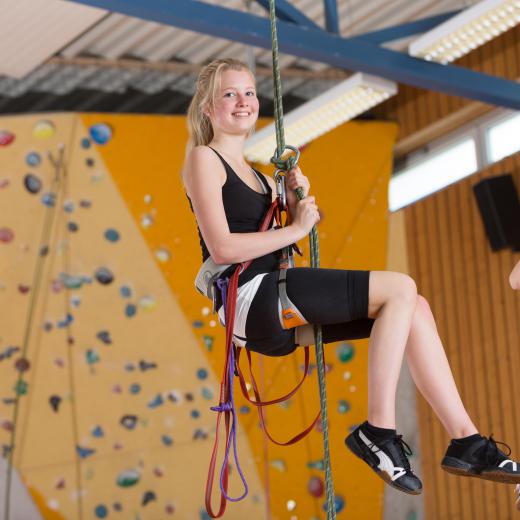
![Climbing chalk is used by rock climbers to improve their grip.]() By: Mike-FotografieClimbing chalk is used by rock climbers to improve their grip.
By: Mike-FotografieClimbing chalk is used by rock climbers to improve their grip.


Discussion Comments
If I were ever forced to climb a cliff, I know that I would carry along a climbing chalk ball. I have a fear of heights, and though I would never ascend a mountain on purpose, it would be nice to have chalk along if I had to, for some reason.
Whenever I watch a movie in which the characters are in danger of slipping from a high point, my hands start to sweat. This is from the comfort of my own home, so I imagine my hands would be soaked with sweat if I were really there.
It wouldn't even have to be warm. I could work up a nervous palm sweat in the dead of winter!
It actually makes me feel a little better knowing that professional climbers use climbing chalk. Maybe I won't get so nervous when I watch rock climbers on television, now.
Post your comments