
At DelightedCooking, we're committed to delivering accurate, trustworthy information. Our expert-authored content is rigorously fact-checked and sourced from credible authorities. Discover how we uphold the highest standards in providing you with reliable knowledge.
What is Champagne?
Champagne is a wine-producing region in the far north of France, near Paris, where the signature sparkling white wine is produced. Though the term is sometimes used as a generic description of sparkling white wines in the style of the wines of Champagne, this is an incorrect usage, and the term sparkling white should be used instead. To produce the bubbles in this wine, a technique referred to as the methode traditionnelle or traditional method is used. In this method, the base wine which will become Champagne is bottled with a small amount of yeast and sugar to trigger a second stage of fermentation in the wine. This fermentation gives off some gas within the bottle, which acts as carbonation.
Since this process leaves a bit of sediment in the bottle, and Champagne is traditionally a clear wine, the sediment is shaken into the neck of the bottle, frozen, and removed in a lump. This extra bit is then replaced with a bit of wine, and often some sugar — collectively known as the dosage. Champagne is made drier by not adding sugar during this process, in which case it is labeled extra Brut.

Champagne is produced as a blend between the Pinot Noir, Pinot Meunier, and Chardonnay grapes. The amount of each of these grapes differs from shipper to shipper, and some wines — such as blanc de blancs or blanc de noir — use only Chardonnay grapes or only Pinot Noir grapes. There are three primary levels of quality within any given Champagne shipper. Non-vintage uses grapes blended from a number of years, vintage uses all grapes from one specific year, and prestige cuvée uses all grapes from one specific year, from the first pressing, and has aged for a longer period of time. Not every year produces either vintage or prestige varieties, though recently about one-in-three years have done so.

Champagne is designed be drunk upon purchase, and in nearly all cases is not meant to be collectible. A non-vintage variety will begin losing quality within only three or four years, while prestige may last up to 15 years without degrading. This wine is normally drunk from either a flute or tulip glass, both of which are skinny and tall. This shape allows the scents of the wine to reach their full potential, and helps the bubbles last for longer than in flatter, larger-bowled glasses.

The bubbles offer a wonderful opportunity to evaluate the wine by sight. A good Champagne should have the tiniest bubbles possible, and they should last for longer than seems possible. Sparkling wines from other parts of the world — especially those which artificially add carbonation or use tank methods to create bubbling — have much larger bubbles, and the wine will go flat much more quickly than true varieties.

Champagne can range in texture and style greatly, depending on the mix of grapes used, the dosage, and the shipper who produced it. There are extremely light Champagnes, such as those produced by Lanson, and those which are as full as one could wish for, most notably those of Krug and Bollinger. There are over 100 different producers in France, and each produces its own unique style of wine, ensuring that for nearly any occasion or dish, there is an ideal match.
AS FEATURED ON:
AS FEATURED ON:


-
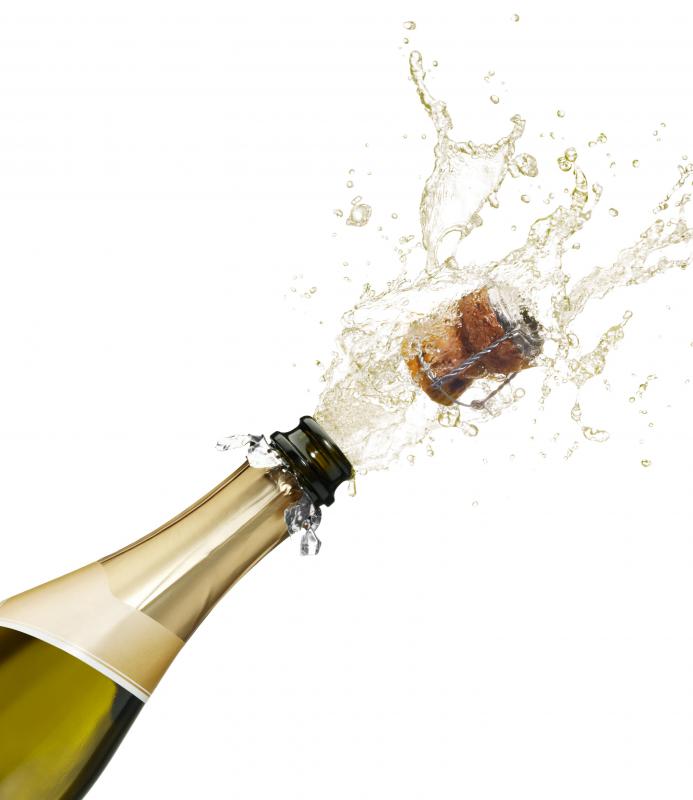
![A bottle of champagne.]() By: Rob StarkA bottle of champagne.
By: Rob StarkA bottle of champagne. -
![Champagne can be assessed based off the carbonation inside.]() By: OkeaChampagne can be assessed based off the carbonation inside.
By: OkeaChampagne can be assessed based off the carbonation inside. -
![Fermentation gives off gas in champagne, producing bubbles.]() By: Igor NormannFermentation gives off gas in champagne, producing bubbles.
By: Igor NormannFermentation gives off gas in champagne, producing bubbles. -
![Glass of champagne.]() By: S.WhiteGlass of champagne.
By: S.WhiteGlass of champagne. -
![Champagne is a specific type of sparkling wine, produced in a particular way, in a certain region of French known as Champagne.]() By: benkenogyChampagne is a specific type of sparkling wine, produced in a particular way, in a certain region of French known as Champagne.
By: benkenogyChampagne is a specific type of sparkling wine, produced in a particular way, in a certain region of French known as Champagne.



Discussion Comments
If you're set on real champagne though, I'd say just ask a wine merchant or read up about it online -- there's lots of info. Or just get a few mid-priced ones and see which one you like the best.
First of all, champagne usually has a really dry taste and although it does not taste really bad, it does not have a taste that will not allow it to be drunk in any amount of excess, like other alcohols, such as beer.
Another reason is that champagne is seen as more of a classy drink that is only drunk on special occasions and is usually costly, which does not allow it to be something that is to be used at a party, as opposed to maybe a toast or other tradition based purposes.
I love the tiny bubbles in vintage Champagne. This is what we had at our wedding.
Even though I had Champagne in my glass for hours, the bubbles didn't disappear. This just amazed me.
@shell4life – I will admit that I don't buy real Champagne. I drink the cheap kind available at my supermarket on New Year's Eve, and so does everyone else at the party.
However, I did get to try genuine Champagne once. The difference between it and the other kinds was unbelievable. You haven't really experienced good sparkling white wine until you have tried the real thing.
However, I have had many cheaper sparkling white wines on special occasions. I like the fizz and the taste, so I have no need of paying high prices for something that is viewed as superior.
Is Dom Perignon ruined if placed in the freezer for 3 hours to cool? When I removed it, there were ice chunks. we did not drink it that night.
can i use it as a cosmetic? and how?
Post your comments