
At WiseGEEK, we're committed to delivering accurate, trustworthy information. Our expert-authored content is rigorously fact-checked and sourced from credible authorities. Discover how we uphold the highest standards in providing you with reliable knowledge.
What is Chainsaw Carving?
Chainsaw carving is the art of using a chainsaw to carve people, animals, and other designs into wood. It began as a backwoods novelty, something lumberjacks did to impress and amuse each other. Today, successful chainsaw carvers can be found in suburbs and cities as well as the forest. That's because wood sculptors have discovered that using a chainsaw — especially for initial cuts on a large piece of wood — can carve hours and even days off a major project.
Old school chainsaw carvers, like Ken Kaiser and Ray Murphy, believe that it isn't a true chainsaw carving unless every detail was carved out by a saw. The more modern approach is to add detail to the saw cuts by using chisels, small saws, or other more traditional hand tools.

As chainsaw carving has developed as an art form, specially designed guide bars, tips and chains have come onto the market to aid in adding detail and minimize the "kickback" that sometimes comes with chainsaw operation. The first thing any chainsaw carver needs is a healthy respect for the saw.
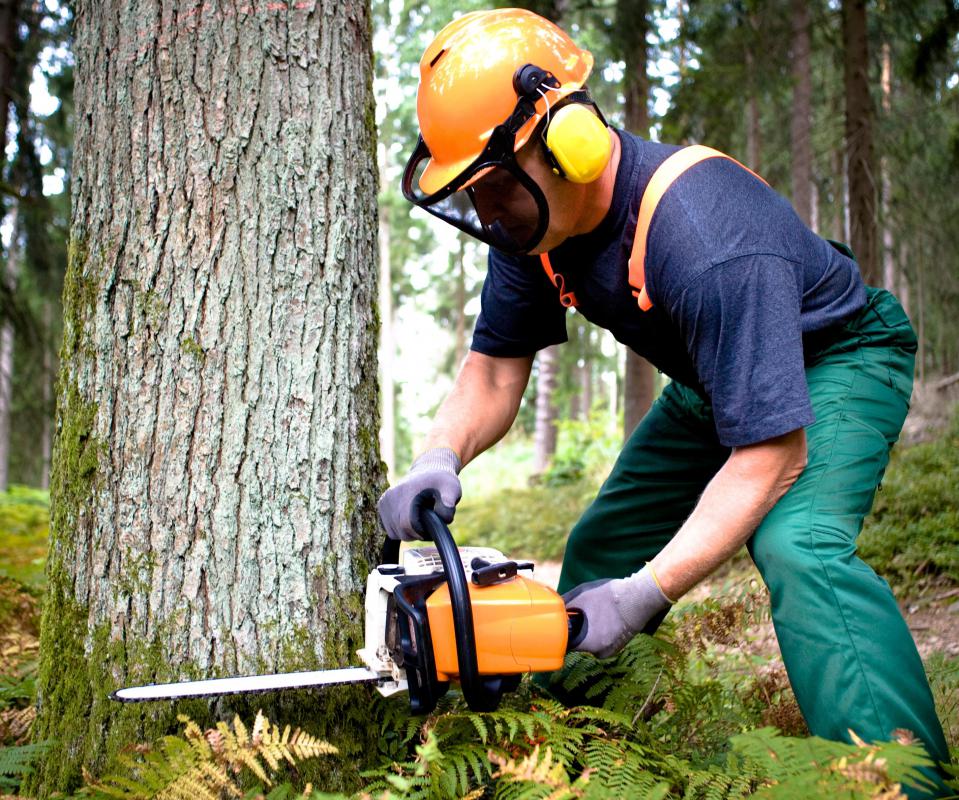
According to one insurance agency that specializes in insuring lumberjacks, the average chainsaw cut requires 100 stitches. It is recommended, then, that a full array of protective gear be donned before any chainsaw carving is attempted. This includes a helmet, goggles, steel-toed boots, and thick pants.

Beyond that, carving is carving. Many chainsaw carvers use two saws: a heavy-duty model for the initial cuts, and a smaller saw for the second level of detail. Another consideration is the hardness of the wood that is being used. Pine, cedar, and fir are often recommended as good wood choices for carving. In addition, the log should be free of major defects, including cracks that could cause problems on the finished piece.
Chainsaw carving often involves large, spectacular pieces, so the best carvers often get thousands of dollars for a commissioned work. Many sculptors use their skill at this art form to amaze onlookers at public performances. There are several professional carvers guilds, and many artists offer their carvings online.
AS FEATURED ON:
AS FEATURED ON:









-
![Trees used in a chainsaw carving competition.]() By: KacpuraTrees used in a chainsaw carving competition.
By: KacpuraTrees used in a chainsaw carving competition. -
![A man using a chainsaw.]() By: Val ThoermerA man using a chainsaw.
By: Val ThoermerA man using a chainsaw.

Discussion Comments
I am told that chainsaw carving has become very popular. There are competitive competitions and thousands, maybe tens of thousands of people around the world who do chainsaw carvings at some level. As this article says, there are special attachments that can be added to a standard chainsaw to make the machine safer for carving, so maybe the activity isn't that dangerous.
I went online the other day and saw a website where they sold nothing but items carved by people using chainsaws. Some of the pieces were so detailed that you wouldn't think they could be carved by anything as large as a chainsaw. I have enough trouble cutting through branches with them. I can't imagine trying to make designs and shapes.
One of the most popular subjects of the chainsaw carvings are bears. I'd say that at least twenty percent of the items on the site were of a bear doing something.
Chainsaw carving? There is no limit to the ways we can find to waste our time. As the article points out, chainsaws are dangerous machines when they are not handled with caution and respect. They were designed for work, not making carvings. For those who want to make carvings, there are already tools for that. Try using something that won't kill you or at least injury you really badly.
Post your comments