
At TheHealthBoard, we're committed to delivering accurate, trustworthy information. Our expert-authored content is rigorously fact-checked and sourced from credible authorities. Discover how we uphold the highest standards in providing you with reliable knowledge.
What is Cartilage?
 Niki Foster
Niki Foster
Niki Foster
Cartilage is a type of connective tissue in the body. It is made of cells called chondrocytes embedded in a matrix, strengthened with fibers of collagen and sometimes elastin, depending on the type. There are three different types: hyaline cartilage, elastic cartilage, and fibrocartilage. This tissue serves to provide structure and support to the body's other tissues without being as hard or rigid as bone. It can also provide a cushioning effect in joints.
This type of tissue is avascular, meaning that it is not supplied by blood vessels; instead, nutrients diffuse through the matrix. Cartilage is usually flexible, again depending on the type. Some of the bodily structures that include it are the ears, nose, ribcage, and intervertebral discs.
Hyaline cartilage makes up the majority of that found in the human body. It lines the bones in joints, helping them to articulate smoothly. This type contains mostly type II collagen fibers.

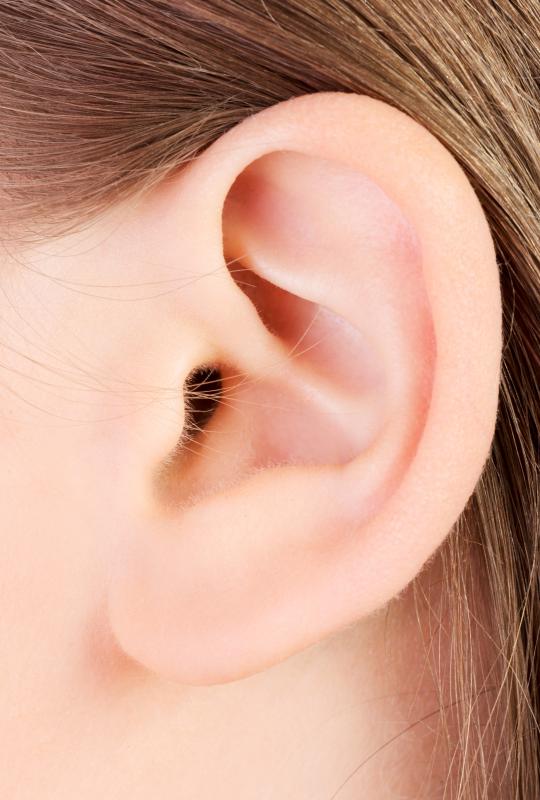
Elastic cartilage is more flexible than the other types because of the elastin fibers it contains. It is found in the outer ear, the larynx, and the Eustachian tubes, for example. This type provides the perfect balance of structure and flexibility and helps keep tubular structures open.
Fibrocartilage is the strongest and most rigid type of cartilage. It contains more collagen than hyaline, including more type I collagen, which is tougher than type II. Fibrocartilage makes up the intervertebral discs, connects tendons and ligaments to bones, and appears in other high-stress areas. Damaged hyaline cartilage is often replaced with fibrocartilage, which unfortunately does not bear weight as well due to its rigidity.

There are a few disorders associated with cartilage. Chondrodystrophies are a group of disorders in which it is ossified, or transformed into bone. Arthritis is characterized by the degradation of cartilage in the joints, leading to limited movement and pain. Achondroplasia is a disorder resulting in dwarfism. Benign tumors called chondroma can also arise in this tissue.
Niki Foster
In addition to her role as a TheHealthBoard editor, Niki enjoys educating herself about interesting and unusual topics in order to get ideas for her own articles. She is a graduate of UCLA, where she majored in Linguistics and Anthropology.
Learn more...
Niki Foster
In addition to her role as a TheHealthBoard editor, Niki enjoys educating herself about interesting and unusual topics in order to get ideas for her own articles. She is a graduate of UCLA, where she majored in Linguistics and Anthropology.
Learn more...AS FEATURED ON:
AS FEATURED ON:


-
![Elbow joint with cartilage shown in light-violet.]() By: AlilaElbow joint with cartilage shown in light-violet.
By: AlilaElbow joint with cartilage shown in light-violet. -
![Hyaline cartilage connects the ribs to the sternum.]() By: JaeehoHyaline cartilage connects the ribs to the sternum.
By: JaeehoHyaline cartilage connects the ribs to the sternum. -
![Elastic cartilage is found in the larynx.]() By: Alila Medical MediaElastic cartilage is found in the larynx.
By: Alila Medical MediaElastic cartilage is found in the larynx. -
![The outer ear contains elastic cartilage.]() By: Piotr MarcinskiThe outer ear contains elastic cartilage.
By: Piotr MarcinskiThe outer ear contains elastic cartilage. -
![Achondroplasia is a disorder associated with cartilage that typically results in dwarfism.]() By: Nolte LourensAchondroplasia is a disorder associated with cartilage that typically results in dwarfism.
By: Nolte LourensAchondroplasia is a disorder associated with cartilage that typically results in dwarfism.



Discussion Comments
Which foods contain Glucosamine?
The hyaline cartilage has pericondium and other types don't. Of what importance is this pericondium and why is it only found on hyaline cartilage?
What is cartilage's main importance?
what is the name of the cell type that makes cartilage?
is cartilage soft and can it be squeezed like in your nose and make your nose smaller?
What are the major causes of cartilage injuries?
where does the name come from?
how does cartilage get nourishment?
My head has a two-inch lump on it. Is this dangerous?
what can be done for torn cartilage?
Can you do a cartilage transplant?
Or can the collagen that is found in the different types of cartilage be found naturally anywhere else?
Would there be any hope for replacing, I think Hyaline cartilage from one part of the body to the other, like putting it in the knees, so people could run more.
What does Cartilage form?
what does cartilage look like?
My third rib on the left hand side has decided to grow more cartilage so there is now a lump under my skin, why would this happen?
can the body grow more cartilage, or repair damaged cartilage?
Post your comments