
At WiseGEEK, we're committed to delivering accurate, trustworthy information. Our expert-authored content is rigorously fact-checked and sourced from credible authorities. Discover how we uphold the highest standards in providing you with reliable knowledge.
What is Butternut Squash?
 Diane Goettel
Diane Goettel
Diane Goettel
Butternut squash is a type of edible plant with slightly sweet, bright orange flesh and an inedible, thick and tan skin. Native to Mexico and the surrounding areas, the flesh of the squash can be used in many dishes, and is a good source of vitamins. A popular winter squash, butternut squash can last as long as three months if kept in a cool place.
The labels "summer squash" and "winter squash" have very little bearing on their availability and usage today. Both classifications of squash are generally available in markets year round. A summer squash is a squash with a thin skin that will perish within a few days to a week, such as zucchini. Butternut squash is classified as a winter squash because it has a very thick skin and therefore, a long shelf life.

Butternut squash is grown on a vine and is best harvested when the fruit is fully mature. Complete maturation usually takes at least three months. When the squash is ready for picking, it will be between 8 and 12 inches long (20.3 and 30.5 cm) and weigh between 2 and 3 pounds (0.97 and 1.36 kg). When the fruit is fully mature, it has a nutty, sweet taste. Many people liken the taste of butternut squash to that of a sweet potato or pumpkin.

Although the squash is native to Mexico and the surrounding areas, the most popular butternut squash is the Waltham Butternut, which was originally grown in Massachusetts. Squash has actually been an important part of many different cuisines for centuries. Some historians and archaeologists believe that peoples of the land that is now Mexico were cooking with and eating squash as early as 5500 B.C.E.

Many chefs cut the gourd in half, add ingredients to the interior flesh, bake it, and serve the dish in the shell. The flesh of a butternut squash can be applied to many different types of recipes. Squash pulp is used in a variety of dishes such as custards, soups, pies, and breads. The hard exterior can even be utilized as a serving tool.
In addition to being a sweet, delicious treat, butternut squash is also a source of many important vitamins and minerals. The flesh of the squash contains potassium, manganese, magnesium, and vitamin C. It is also a good source of dietary fiber.
Diane Goettel
In addition to her work as a freelance writer for WiseGEEK, Diane is the executive editor of Black Lawrence Press, an independent publishing company based in upstate New York. She has also edited several anthologies, the e-newsletter Sapling, and The Adirondack Review. Diane has a B.A. from Sarah Lawrence College and an M.A. from Brooklyn College.
Learn more...
Diane Goettel
In addition to her work as a freelance writer for WiseGEEK, Diane is the executive editor of Black Lawrence Press, an independent publishing company based in upstate New York. She has also edited several anthologies, the e-newsletter Sapling, and The Adirondack Review. Diane has a B.A. from Sarah Lawrence College and an M.A. from Brooklyn College.
Learn more...AS FEATURED ON:
AS FEATURED ON:









-
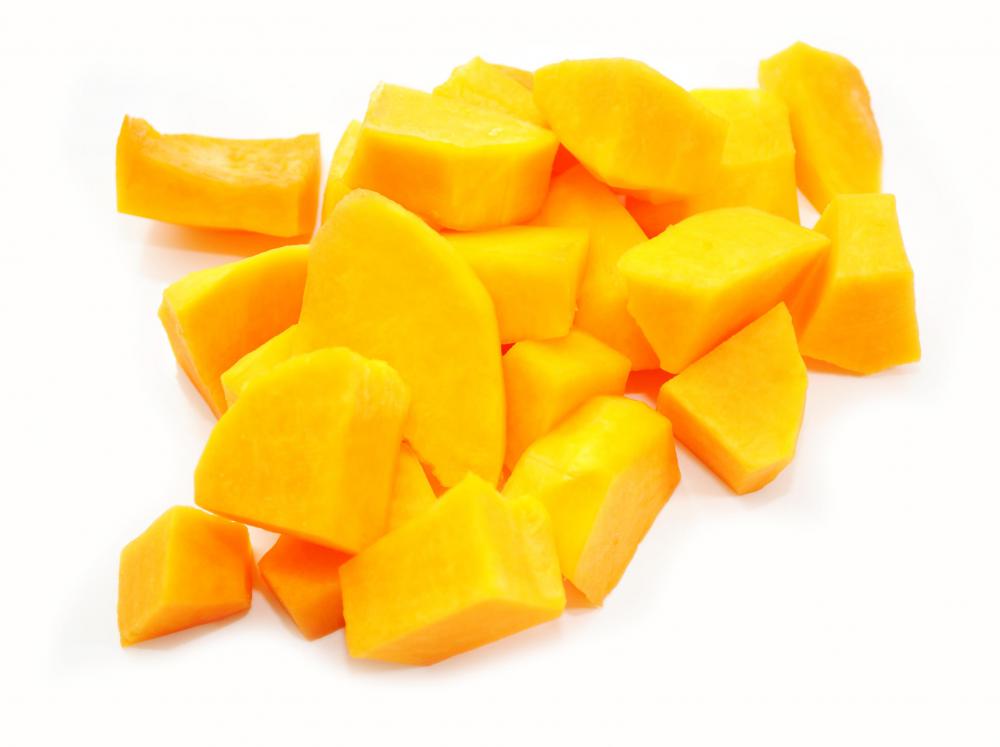
![Native to Mexico and the surrounding areas, the flesh of the squash can be used in many dishes, and is a good source of vitamins.]() By: TupungatoNative to Mexico and the surrounding areas, the flesh of the squash can be used in many dishes, and is a good source of vitamins.
By: TupungatoNative to Mexico and the surrounding areas, the flesh of the squash can be used in many dishes, and is a good source of vitamins. -
![The most popular butternut squash is the Waltham Butternut, which was originally grown in Massachusetts.]() By: pavalenaThe most popular butternut squash is the Waltham Butternut, which was originally grown in Massachusetts.
By: pavalenaThe most popular butternut squash is the Waltham Butternut, which was originally grown in Massachusetts. -
![Butternut squash is often used in soup.]() By: rickegrantButternut squash is often used in soup.
By: rickegrantButternut squash is often used in soup. -
![A ripe butternut squash will have a deep orange color.]() By: BillA ripe butternut squash will have a deep orange color.
By: BillA ripe butternut squash will have a deep orange color.


Discussion Comments
are you saying this is a food that won't irritate the bowels.
i have just had a bowel surgery & i am wondering if butternut squash is suitable to eat, i am on a soft diet.
Butternut squash is a great source of vitamin A, as well as vitamin C. As such it protects the skin and helps it stay younger. So include it in your diet, together with other orange vegetables.
Post your comments