
At DelightedCooking, we're committed to delivering accurate, trustworthy information. Our expert-authored content is rigorously fact-checked and sourced from credible authorities. Discover how we uphold the highest standards in providing you with reliable knowledge.
What is Buckwheat?
 Mary McMahon
Mary McMahon
Mary McMahon
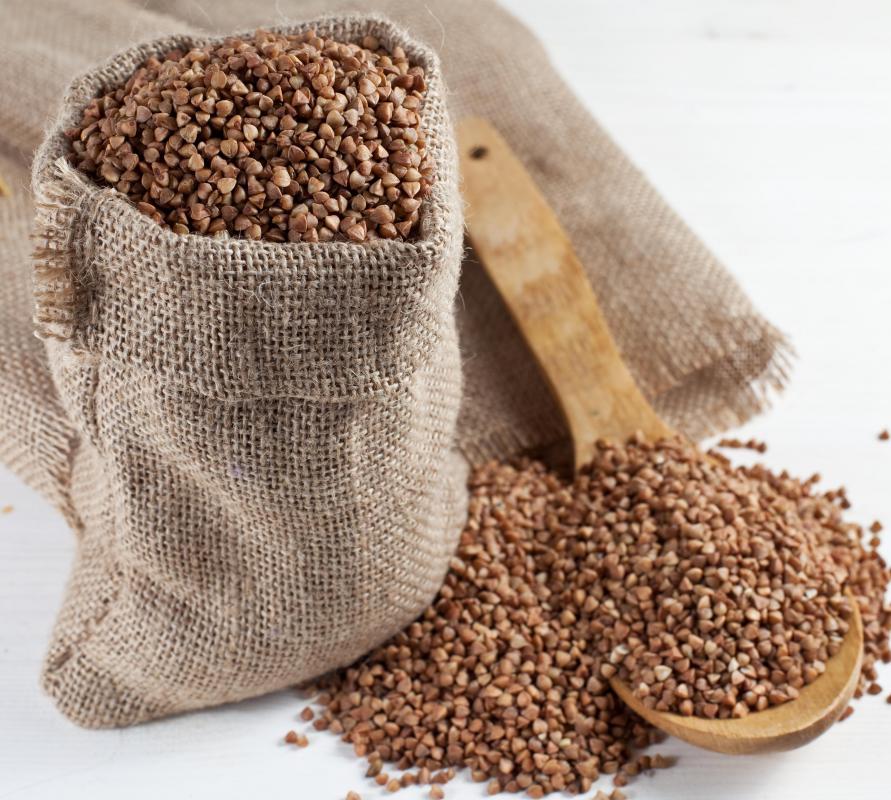
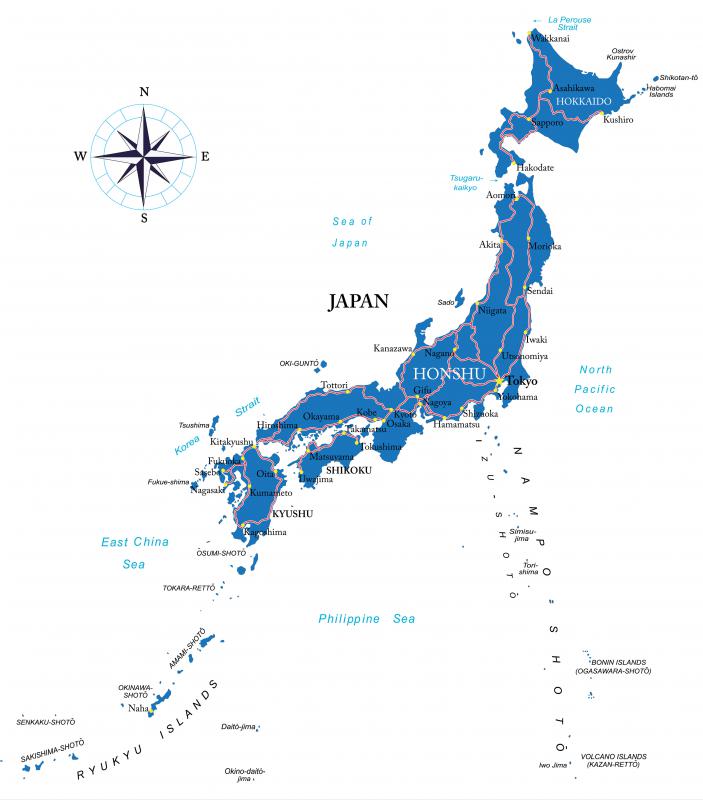
Buckwheat is a plant cultivated for its triangular grains. Unlike most other grains, it's not a grass but a plant crop. That means it has broad, spreading leaves; it also has lacy white flowers. Cultivation of this plant is on the decline in the United States, where other grains have supplanted it in popularity, but it continues to be produced in a number of countries, including Japan and Canada.
Most commonly sold as a dark flour, buckwheat gets its color from husks that are left behind during the milling process. This grain is usually included in a variety of types of flour mixes, like pancake and waffle mix. Plain flour, perhaps for baking bread, is also available. It is also sold in whole or cracked form for use in breakfast cereals or to add texture to breads and other baked products. The grain has a distinctive nutty flavor that can be quite pleasing to the palate, especially when contrasted with other, more mild flours.

Buckwheat is grown over the summer months, when the risk of frost is over. The plant ranges from 2 to 4 feet (marginally over 0.5 meter to 1.25 meters) in height. It takes approximately two months to mature, and when it's ready to be harvested, the entire field is mowed and the plants are stacked. After they've dried, they are threshed — a process where the hard, outer shell is removed so that the grains can be packaged for sale and use.

Nutritionally, buckwheat is generally considered to be quite healthy. It does have a high fat content, and therefore requires special handling because it can go rancid. Drying the grain completely helps to reduce this problem, and according to some, is thought to be well worth the effort for its other nutritional values, including high fiber and protein content. It should be stored in a cool dry place, or refrigerated in more intense heat, to prevent spoilage.

Flour made from the grain is often used in Japan to make traditional soba noodles. In the West, in addition to food uses, it is also frequently used as animal fodder, either in the form of a grazing crop or in the creation of feed formulas. It's also used as a cover crop because it establishes itself well, protecting the soil and choking out weed species. Beekeepers use buckwheat to produce honey because it flowers well into the summer and produces a large volume of rich, flavorful nectar. This arrangement is mutually beneficial to the beekeeper and the farmer, because the plant requires pollinators to reproduce.

If eaten in large amounts, this grain can cause allergic reactions, usually manifested as rashes on the skin. Severe reactions warrant the attention of a health care professional. Mild reactions can usually be safely treated by discontinuing consumption until the skin has cleared, and eating moderate amounts in the future.
Mary McMahon
Ever since she began contributing to the site several years ago, Mary has embraced the exciting challenge of being a DelightedCooking researcher and writer. Mary has a liberal arts degree from Goddard College and spends her free time reading, cooking, and exploring the great outdoors.
Learn more...
Mary McMahon
Ever since she began contributing to the site several years ago, Mary has embraced the exciting challenge of being a DelightedCooking researcher and writer. Mary has a liberal arts degree from Goddard College and spends her free time reading, cooking, and exploring the great outdoors.
Learn more...AS FEATURED ON:
AS FEATURED ON:


-
![Bundles of uncooked soba noodles, which contain buckwheat.]()
Bundles of uncooked soba noodles, which contain buckwheat. -
![Beekeepers commonly use buckwheat in honey production.]() By: schlagBeekeepers commonly use buckwheat in honey production.
By: schlagBeekeepers commonly use buckwheat in honey production. -
![Buckwheat groats are a pseudo-cereal.]() By: yuliakotinaBuckwheat groats are a pseudo-cereal.
By: yuliakotinaBuckwheat groats are a pseudo-cereal. -
![Buckwheat honey comes in various hues and consistencies.]() By: NitrBuckwheat honey comes in various hues and consistencies.
By: NitrBuckwheat honey comes in various hues and consistencies. -
![In Japan, buckwheat is used to make soba noodles.]() By: bogdanserbanIn Japan, buckwheat is used to make soba noodles.
By: bogdanserbanIn Japan, buckwheat is used to make soba noodles.



Discussion Comments
How can you refrigerate in more intense heat?
I live in Russia and buckwheat is very popular here. There are lots of ways to cook it and it really is healthy! --Anastasia
to #3... I think that the crêpes made with buckwheat flour that you described, really are better than those made from all-purpose flour. It yields a much heartier flavor.
Dessert crêpes, however, seem to be better when made with a more refined wheat flour.
Here in western France buckwheat is still grown and in a good season produces a good harvest.
The flour is used for "Crêpes de Blé Noir" with a well seasoned filling, often egg, ham and cheese. A noble plant that should not be lost. --Pat
Researchers are paying more attention to buckwheat, because it appears that buckwheat has an ability to reduce cholesterol and body fat. Buckwheat honey on the other hand seems to have more of the anti-aging power than other types of honey have.
Post your comments