
At WiseGEEK, we're committed to delivering accurate, trustworthy information. Our expert-authored content is rigorously fact-checked and sourced from credible authorities. Discover how we uphold the highest standards in providing you with reliable knowledge.
What is Blood Serum?
Blood serum is essentially the most basic, neutral part of blood, and is often described as plasma with all of its clotting elements removed. It acts as a fluid backdrop for many of blood’s most important functions, namely transporting red and white blood cells and shuttling minerals, sugars, and fatty acids from one place to the next. On its own serum doesn’t really consist of much beyond water and certain fatty proteins, but blood wouldn’t have the right consistency or chemistry without it. Its neutrality makes it valuable in a number of different medical tests, too, and researchers have perfected ways of isolating the substance in order to diagnose a range of different conditions and problems. It is sometimes also used to make eye drops for people with tear duct problems since its consistency often closely mimics that of natural tears.
Why It’s Important

Blood often looks relatively simple, but its composition, from a chemical standpoint at least, tends to be somewhat complex. In most cases it has five main components: serum, plasma, clotting factors, lipids and proteins, and blood cells. The “lipids and proteins” category tends to be the most variable, and can contain any number of sugars, fats, vitamins, hormones, enzymes, and antibodies, among other things. Blood moves these things around in the body to do things like aid in digestion or fuel muscle movement. Serum essentially provides an ideal consistency and climate for allowing these and other blood particles free movement.
How It’s Isolated

Getting serum on its own isn’t always easy. One of the biggest traits of blood is that it sticks together, and one of the main points of all the elements working together is to end up with a smooth, even fluid. Medical experts and lab workers usually have to subject blood to a number of tests to get the individual components to separate.
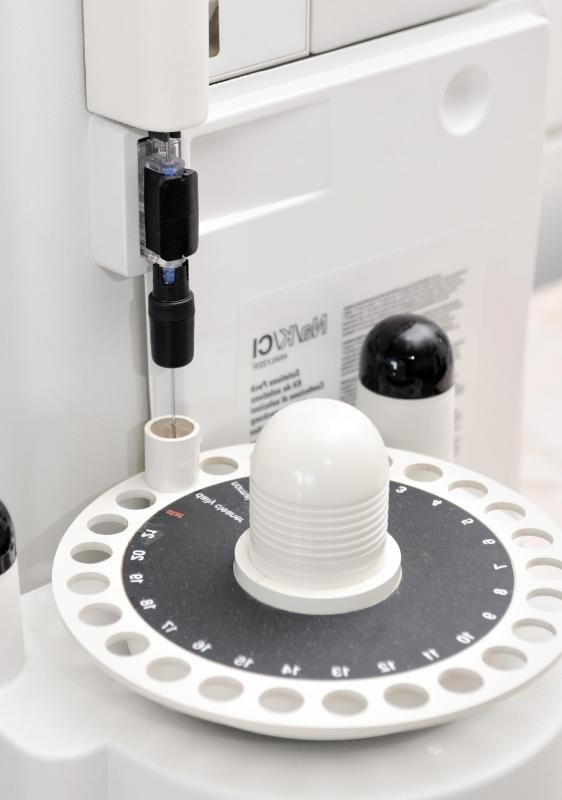
One of the most common methods is the centrifuge, which is a machine that spins the blood very quickly. This rotating motion, known as “centrifugal force,” typically causes things to pull apart on a cellular level, and technicians with the right knowledge and equipment can often get the serum on its own through this process.
Diagnostic Abilities

Many blood tests are actually conducted with the blood serum, not the blood cells or plasma. Though the serum is generally thought to be neutral, it can carry trace amounts of certain proteins and hormones when they are coursing through the blood, and these things are often easier to see here since they are occurring in relative isolation. Some types of early pregnancy tests, for instance, are specifically performed on this part of the blood. They test for the presence of human chorionic gonadotropin (HCG), a hormone that is produced during pregnancy, and tend to be more accurate and can be performed earlier than urine-based tests, though these usually also look for the same hormone. Serum will usually have trace amounts of HCG if there is a pregnancy.

Another serum blood test checks for certain enzymes that are normally only found in the liver, usually as a way to detect liver disease. Protein levels may also be the focus. Elevated or depressed levels of various proteins are indicative of medical conditions that may need further treatment. For example, an overall decrease in proteins may indicate malnutrition or other conditions that can be detrimental to the kidneys. An increase in alpha-1 globulin proteins can reveal the presence of an inflammatory disease, such as rheumatoid arthritis.
Preventative Screening

Medical experts may order serum tests as a way to get a baseline understanding of a patient’s health even when there isn’t a reason to suspect any particular condition. Things can be caught early this way, which can lead to better preventative care. Some of the most common serum tests check cholesterol, triglyceride, lipoprotein, and sugar or glucose levels. Cholesterol is a fatty substance in the blood which, while necessary, can lead to greater risk of heart disease and stroke if elevated. Elevated levels of triglycerides and lipoproteins are also risk indicators for stroke and heart disease. Elevated glucose levels indicate diabetes, while low glucose levels are responsible for a condition known as hypoglycemia. Blood serum tests are also performed to check thyroid and insulin levels.
Blood serum screening is continuing to expand, and new tests are being developed to help provide earlier detection of diseases such as Alzheimer’s and Parkinson’s. Though true cures are not available for these conditions, early diagnosis may allow for more effective treatment.
Use in Eye Drops
Another innovative development is the use of a patient’s own serum to produce eye drops to treat severe dry eyes and other surface eye disorders that do not respond to synthetic medications. In most cases the drops are made from a person’s own serum, which means there is usually no danger of an allergic reaction. The process for making drops from blood can be time intensive and expensive, but patients often say it works the best of any other options.
AS FEATURED ON:
AS FEATURED ON:









-
![Pouches of blood.]() By: ksena32@ukrpost.uaPouches of blood.
By: ksena32@ukrpost.uaPouches of blood. -
![Plasma transports red and white blood cells throughout in the body.]() By: Max TacticPlasma transports red and white blood cells throughout in the body.
By: Max TacticPlasma transports red and white blood cells throughout in the body. -
![Most blood tests are conducted with blood serum, not blood cells.]() By: KadmyMost blood tests are conducted with blood serum, not blood cells.
By: KadmyMost blood tests are conducted with blood serum, not blood cells. -
![Testing blood serum can indicate risk factors for heart disease.]() By: digitexTesting blood serum can indicate risk factors for heart disease.
By: digitexTesting blood serum can indicate risk factors for heart disease. -
![Blood serum tests can be used to check cholesterol and triglyceride levels.]() By: Goran BogicevicBlood serum tests can be used to check cholesterol and triglyceride levels.
By: Goran BogicevicBlood serum tests can be used to check cholesterol and triglyceride levels.




Discussion Comments
@anamur-- You will need to give separate samples for each test that is required.
Both blood sugar testing and thyroid function testing are considered endocrine tests and blood serum is used for both. However, since the serum is being checked for different substances, there needs to be separate samples that can be centrifuged.
A centrifuge is the equipment that is used to separate blood plasma from the serum. The blood sample is put inside and it rotates super fast causing these two components of blood to separate. Then they check the anti-coagulated blood serum for different substances, like glucose or hormones.
@anamur-- My close friend uses blood serum eye drops and speaks very highly of it. As far as I know, they take some blood concentration from the individual, separate the blood serum and then use it to make eye drops. It's supposed to be the closes thing available to natural tears.
My friend has it processed at a compounding pharmacy near her. It's apparently kind of expensive but she says it's worth it. She has had severe dry eye and an issue with her cornea. She says the eye drops have helped her a lot. Her eyes are not as irritated, dry and painful as they used to be.
I think it sounds kind of odd, but if it helps, then why not use it? Your mom can ask her doctor if this is available in her area because not every lab has the equipment to prepare it.
I'm scheduled to have a blood serum test next week to check my thyroid as well as blood sugar levels. I've been experiencing fatigue, weight gain, increased thirst and cravings recently. I have diabetes in my family and I have symptoms of a low functioning thyroid so my doctor wants to check both.
I'm curious, is one sample of blood serum enough for both tests or will I have to give multiple ones? I'm a little scared because I can't stand the sight of blood and hate giving samples for testing.
And does anyone know more about blood serum eye drops? My mom has dry eyes and uses synthetic eye drops regularly. I had never heard about eye drops made from blood serum before.
Post your comments