
At TheHealthBoard, we're committed to delivering accurate, trustworthy information. Our expert-authored content is rigorously fact-checked and sourced from credible authorities. Discover how we uphold the highest standards in providing you with reliable knowledge.
What is Bleeding out?
Bleeding out, or exsanguination, is a condition characterized by a fatal loss of blood. In humans, the process is usually called bleeding to death. While the condition can occur in either humans or animals, it is rare for a human being to die as a result of exsanguination. It is used as a method for slaughtering animals, however.
Before beginning the process of bleeding out an animal, some slaughterhouses incapacitate the animal so that it will not feel any pain during the procedure. This is often done using a device called a captive bolt, a heavy rod that is usually made from stainless steel or another type of non-rusting alloy. The captive bolt is forcefully struck against the animal’s forehead, rendering it unconscious. Electrical and chemical methods may also be used to debilitate the animal.

Once the animal has been rendered unconscious, the slaughterer customarily inserts a knife through the animal’s skin, just below its neck bones and behind its jaw. Next, the slaughterer cuts the animal’s jugular vein, carotid artery, and trachea. These maneuvers ordinarily cause the animal to start bleeding, and it usually dies within a few minutes.

Some religions require animals to be bled out when they are slaughtered for eating. Judaic kosher laws require slaughter by exsanguination, for example, and Islamic halal laws also mandate this method of slaughter through a ritual known as Zibah. There is some debate in these communities whether or not an animal may be rendered unconscious prior to the exsanguination procedure being performed. Usually, the slaughter must be performed by a butcher of the same faith.

In humans, bleeding out generally occurs as the result of a fatal injury or internal bleeding. It may, for example, occur if a person attempts to commit suicide by cutting an artery, such as the carotid, radial, ulnar, brachial, or femoral arteries. If a person experiences a large amount of blood loss as a result of a fatal injury and the bleeding is not blocked, he or she may bleed to death. This occurs most often on a war battlefield or if a limb gets severed.

Blood loss from internal bleeding can also lead to exsanguination in humans. A person who develops a peptic ulcer may suffer from internal bleeding, for example, and it can also occur as a result of forceful blows to the spleen, liver, lungs, or kidneys. Alcoholics and people with liver disease can be more susceptible to this problem.
AS FEATURED ON:
AS FEATURED ON:


-
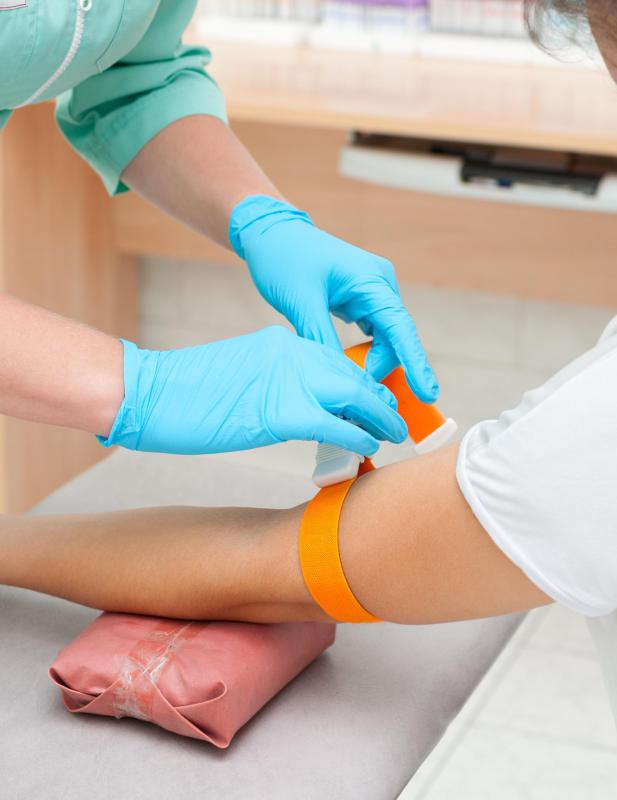
![Tourniquets can be applied around extremities to prevent fatal blood loss.]() By: withGodTourniquets can be applied around extremities to prevent fatal blood loss.
By: withGodTourniquets can be applied around extremities to prevent fatal blood loss. -
![A cut behind the ear is usually used to bleed out stock animals before slaughter.]() By: smukiA cut behind the ear is usually used to bleed out stock animals before slaughter.
By: smukiA cut behind the ear is usually used to bleed out stock animals before slaughter. -
![Islamic law requires that food animals be slaughtered by bleeding out.]() By: Orhan ÇamIslamic law requires that food animals be slaughtered by bleeding out.
By: Orhan ÇamIslamic law requires that food animals be slaughtered by bleeding out. -
![Chronic drinking can lead to peptic ulcers that cause internal bleeding.]() By: yellowjChronic drinking can lead to peptic ulcers that cause internal bleeding.
By: yellowjChronic drinking can lead to peptic ulcers that cause internal bleeding. -
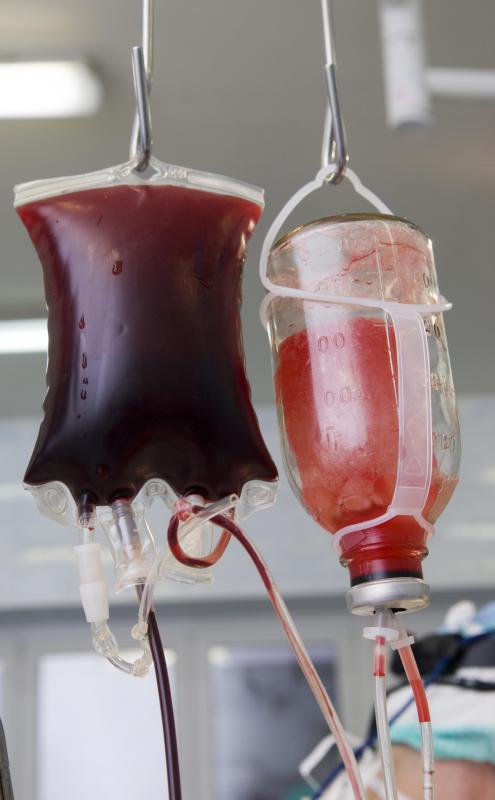
![A patient suffering from a severe loss of blood may require a blood transfusion.]() By: Max TacticA patient suffering from a severe loss of blood may require a blood transfusion.
By: Max TacticA patient suffering from a severe loss of blood may require a blood transfusion.


Discussion Comments
Thanks. I was on the fence about eating meat. Not anymore.
Don't listen to any of these idiots online who say that death by blood loss is painless or even peaceful. I tried this once and severed my radial artery. I thought I would just pass out after a couple minutes and die. I did happen to pass out after a couple minutes, but this was due to an initial drop in blood pressure.
When I woke up, my radial artery collapsed and it stopped bleeding. I would guess that I lost 2 or 3 liters of blood. Every part of my body was screaming out for oxygen. It was hard to breathe. I had a huge migraine from the dehydration. I was lying on my bed, puking my guts out for seven hours. I was too weak to puke off the side of the bed, so I just laid there and puked all over my face. I was also too weak to yell or move at all. But the worst of it all is the primal fear I felt, knowing that I was going to die without help. Somebody found me, thankfully.
I think it's important for people to know that, while bleeding out from an obvious injury is a rare way to die since others notice and help, bleeding out unexpectedly is more common. In fact, many patients who seem perfectly okay in hospitals can abruptly die from bleeding out.
Don't worry, you can't just spontaneously bleed out. The kind of incident I'm referring to is the most easily-overlooked case of bleeding: the internal kind.
People who have been in car accidents or other traumatic incidents, or who have had surgery recently, can be bleeding on the inside and look fine on the outside, especially when they're on strong painkillers so they don't feel the damage inside of them increasing. It's a really scary thought.
Surgery patients are monitored closely to prevent any internal bleeding from getting too far if it gets started at all. Car accident patients with trauma to certain organs can bleed to death on the inside before anybody notices, though, or before they get to a hospital.
Also, if lungs bleed out, you can actually drown in the blood. Ugh -- I better stop thinking about this subject so much, I'm grossing myself out, here. Bottom line, if you've been in an accident, let the doctors examine you -- it's better safe than sorry, even if you think you're fine.
@gimbell - I can confirm that yes, holding a bleeding injury higher than the heart will slow bleeding slightly -- in fact, they teach this technique in first aid classes, so it's a great thing to remember in an emergency. It could save somebody's life.
Another way to prevent bleeding out is to apply steady pressure to the injury. This helps hold the arteries closed so that less blood can escape. If possible, use both of these techniques at the same time in an emergency to give the injured person the longest amount of time so that medical help has a chance to arrive.
@Hawthorne - I agree that humans are supposed to have meat in their diets, but I don't think I would have the stomach to actually do my own butchering.
I'll definitely keep that part about gravity in mind, though, if I've ever got a serious bleeding injury -- keep the heart lower than the injury to slow the bleeding works, right? It's the opposite of putting the bleeding injury lower than the heart to make it flow better, after all.
I'm glad that the article explains that most animals are unconscious when they are killed using exsanguination. Judging by the process of cutting the arteries, if the trachea is cut as well then the animal may also smother at the same time it bleeds to death, and that was be cruel to do to any living thing if it was conscious for it.
I'm sure there are people out there who hate the fact that any animal slaughter goes on at all, but I firmly believe that human beings are made to eat at least some meat in their diets, so it's necessary.
At least we're more humane about it now, killing them by letting them bleed out. Back in my grandfather's day, he says they would simply take a rifle and shoot the animal before butchering it on his father's farm. Any way you look at it, a bullet is a more violent way to go than unconsciously bleeding out.
On that note, if you bleed an animal out while doing any home butchering you should position it so that the head is lower than the chest. Gravity will help the bleeding go faster, making the animal's death that much quicker and more painless.
@Kat919 - In my experience, doctors are pretty discreet when the patient is in trouble. I had a C-section after a very long labor. The thing with a C-section is that after the baby's out, the mom is kind of forgotten about. Your husband's on the other side of the room with the baby and the surgical team is on the other side of a sheet working on your bottom half.
So I was lying there and I heard them saying that my uterus wasn't very firm and calling for "more Pitocin." I knew that meant they were worried about postpartum hemorrhage! But they didn't use scary words like that.
I've seen this term used on TV medical-type shows. They'll be doing an operation or patching up someone who's injured and they'll show, "S/he's bleeding out!" I guess it just means that the person is bleeding uncontrollably and it has the potential to be fatal. Not that the person necessarily will bleed to death, but that they could.
I don't know if doctors in real life are quite that dramatic. I hope not, if the patient is awake!
Post your comments