
At WiseGEEK, we're committed to delivering accurate, trustworthy information. Our expert-authored content is rigorously fact-checked and sourced from credible authorities. Discover how we uphold the highest standards in providing you with reliable knowledge.
What is Bladderwrack?
 Michael Pollick
Michael Pollick
Michael Pollick
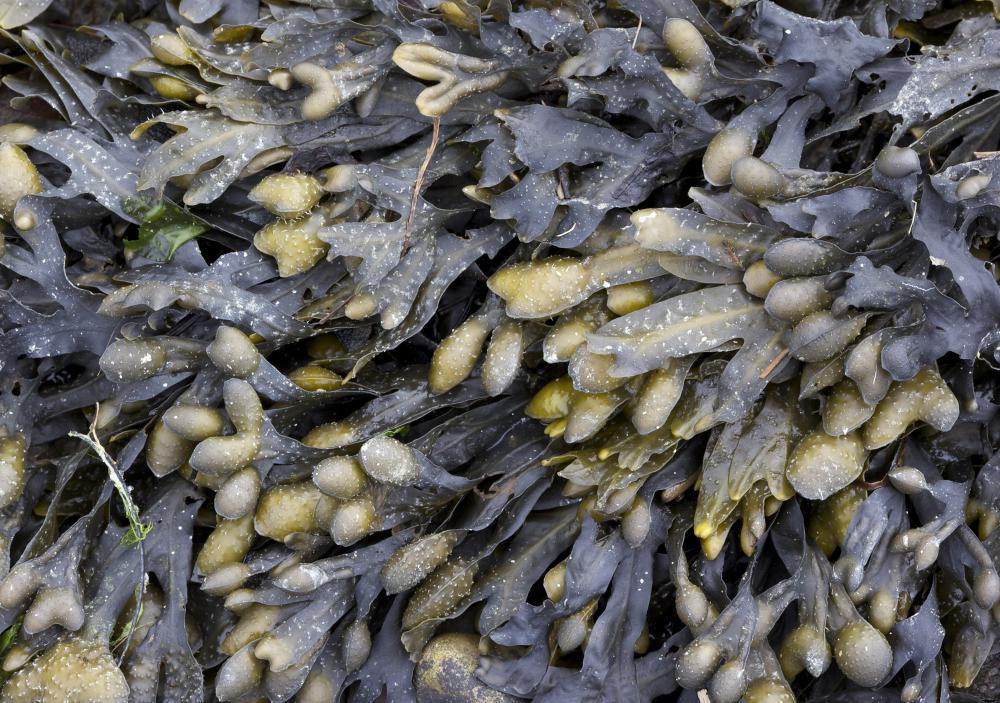
The form of seaweed known as bladderwrack (Fucus vesiculosus) is an edible brown plant that grows primarily in the upper coastal regions of the United States and the Atlantic and Baltic regions of Europe. Many sources refer to it as a type of kelp, but this is not entirely accurate. Bladderwrack often grows alongside other seaweeds, including kelp, but it is its own species. The plant derives its name from the sets of air-filled sacs or bladders which run along its center and help keep it afloat in ocean waters. Only the center stalk of the plant is generally used for medicinal purposes.
Because bladderwrack grows in the sea, it accumulates and concentrates various minerals and nutrients not readily found in earthbound plants. One of the most important elements found in it is iodine, a chemical compound prized for its antiseptic properties and its effect on the human thyroid. As early as 1811, bladderwrack became a popular source of medicinal iodine. Eventually, it became known as a miracle plant, used to cure or treat diseases such as coughs, asthma, hemorrhoids, boils, goiters, stomach ailments, urinary infections and headaches. Not all of the treatments using this seaweed proved to be effective, however.

The high concentration of iodine does make bladderwrack a useful plant for legitimate medical purposes, primarily in the treatment of thyroid conditions which trigger metabolism problems. Since the extract improves thyroid function, a person's metabolism may also be expected to improve. A higher metabolism rate generally leads to improved weight loss, so by extension, bladderwrack extract could be considered a weight-loss aid. A number of people take diet supplements containing this extract as a way to increase their metabolic rate and digest food more efficiently.

Other products such as cosmetics and skin creams may include bladderwrack extract because of its effect on human skin. Many people have reported noticeable improvements to skin conditions such as eczema and acne after applying ointments containing this plant. Some cosmetic companies even claim that regular use of its extract can help tighten skin and reduce the appearance of wrinkles and fine lines. There appears to be some scientific evidence to back up many of these claims, although bladderwrack by itself is not considered to be a miracle plant.

Bladderwrack extract can be ordered through many natural health food and herbal medicine outlets, although it may be marketed under numerous names, including black-tang, bladder, bladder fucus, Blasen-tang, brown algae, common seawrack, cut weed, Dyers fucus, edible seaweed, fucoidan, fucoxantin, Fucus, green algae, Hai-ts'ao, kelp, kelpware, knotted wrack, Meereiche, Quercus marina, popping wrack, red algae, red fucus, rockrack, rockweed, schweintang, sea kelp, sea oak, seetang, seaware, seaweed, sea wrack, swine tang, tang, Varech vesiculeux, vraic, and wrack.
Michael Pollick
A regular WiseGEEK contributor, Michael enjoys doing research in order to satisfy his wide-ranging curiosity about a variety of arcane topics. Before becoming a professional writer, Michael worked as an English tutor, poet, voice-over artist, and DJ.
Learn more...
Michael Pollick
A regular WiseGEEK contributor, Michael enjoys doing research in order to satisfy his wide-ranging curiosity about a variety of arcane topics. Before becoming a professional writer, Michael worked as an English tutor, poet, voice-over artist, and DJ.
Learn more...AS FEATURED ON:
AS FEATURED ON:









-
![A pile of bladderwrack.]() By: Graham ShanksA pile of bladderwrack.
By: Graham ShanksA pile of bladderwrack. -
![Iodine, a major component of bladderwrack, is used as an antiseptic.]() By: fotoart-wallrafIodine, a major component of bladderwrack, is used as an antiseptic.
By: fotoart-wallrafIodine, a major component of bladderwrack, is used as an antiseptic. -
![Bladderwrack extract is used in some skin creams because of its anti-aging effect.]() By: volffBladderwrack extract is used in some skin creams because of its anti-aging effect.
By: volffBladderwrack extract is used in some skin creams because of its anti-aging effect. -
![Bladderwrack ointments can be used to treat eczema.]() By: quaysideBladderwrack ointments can be used to treat eczema.
By: quaysideBladderwrack ointments can be used to treat eczema. -
![Ointments with bladderwrack might help treat acne.]() By: Ocskay BenceOintments with bladderwrack might help treat acne.
By: Ocskay BenceOintments with bladderwrack might help treat acne.


Discussion Comments
I am taking bladderwrack at the moment for weight loss. I am not overweight, but I have been asked to try it out to see if it works and I'm always up for trying these kinds of things as I have a very healthy diet and I don't eat anything really other than salads and meats in portioned sizes. but If it makes a difference then I shall post back to let you know. --kat
I have a problem with bladder control. Is there a remedy for it or better yet, a cure? That would be really great. I await your reply. Thank you.
Bladderwrack itself is not usually marketed as a weight loss drug, but it is often used as a metabolism booster in a larger blend of herbal diet aids. In that sense, moderate levels of bladderwrack are just as safe as any other natural health food supplement. Many commercial weight loss tablets use ingredients which stimulate bowel movements and/or increase urine output. This can have some benefits for people who have trouble losing water weight or have gastrointestinal problems, but dieters should try to avoid taking diet pills which have strong side effects like nervousness, frequent bowel movements or increased urination.
is it safe to use to help lose weight? i've heard of people taking commercial weight loss tablets suffering with chronic, uncontrollable bowel movements.
I have frequent urination.........do you think making tea with bladderwrack would be helpful?
Post your comments