
At WiseGEEK, we're committed to delivering accurate, trustworthy information. Our expert-authored content is rigorously fact-checked and sourced from credible authorities. Discover how we uphold the highest standards in providing you with reliable knowledge.
What is Black Tongue?
 Mary McMahon
Mary McMahon
Mary McMahon
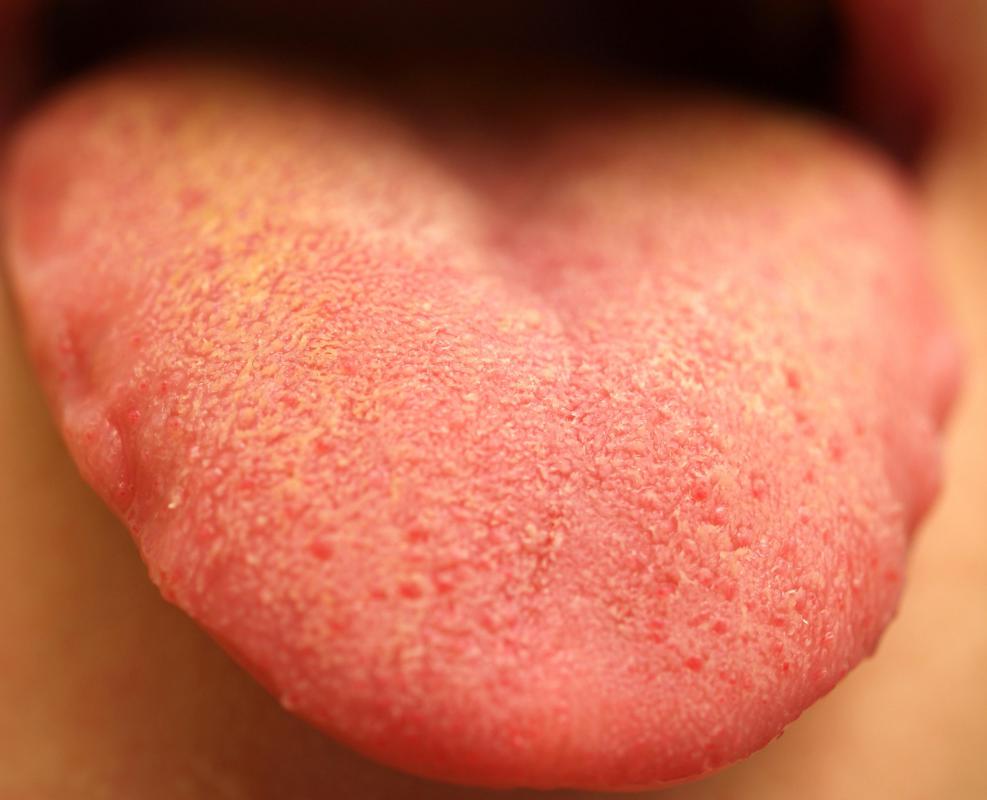
Black tongue, also known as melanoglossia, is a condition in which the surface of the tongue turns dark or black. It may also become rough and develop a hairy appearance, in which case the condition may be known as black hairy tongue. Although this condition looks unsightly, it is not usually harmful, and it can be resolved with care at home in most cases. In a few instances, however, it may be necessary for someone wkith this problem to see a medical professional for a prescription.
There are a number of causes for black tongue. It can be caused by an overgrowth of fungi or bacteria in the mouth, in which case drugs may be needed to limit the growth, and it has been linked with a number of medications, including antibiotics and drugs that contain bismuth. Smokers, the elderly, people with poor oral hygiene, and people undergoing radiation treatments are all at risk for developing this condition.

Treatment usually involves scraping the tongue with a tongue scraper or brushing it with a toothbrush, in addition to observing better oral hygiene, with regular tooth brushing, flossing, and use of mouthwash. If the problem is persistent, a healthcare professional may take a culture of the black growth to find out what it is and recommend a medication to manage it.

This condition usually starts out as a series of dark spots on the tongue, which gradually merge to form a large dark patch. The tongue may feel heavy or rough in the mouth, and the sense of taste can be disrupted. In some cases, the papillae, also known as the tastebuds, can become swollen and elongated, contributing to the rough appearance. People sometimes develop black tongue overnight, often after taking a medication and not brushing their teeth, and it can be startling to wake up to.

When this problem develops, patients may opt to try self care at home to manage it. If a patient is on medication, it's a good idea to report the black tongue to a medical professional, just in case it's an unexpected side effect. Likewise, patients with compromised immune systems should speak to their healthcare provider about any unusual medical symptoms or conditions that emerge, so that he or she can decide whether or not the patient needs to come in for treatment. As with all conditions that can be managed at home, if the issue does not resolve after several days to a week of treatment, it's best to speak to a healthcare professional.
Mary McMahon
Ever since she began contributing to the site several years ago, Mary has embraced the exciting challenge of being a WiseGEEK researcher and writer. Mary has a liberal arts degree from Goddard College and spends her free time reading, cooking, and exploring the great outdoors.
Learn more...
Mary McMahon
Ever since she began contributing to the site several years ago, Mary has embraced the exciting challenge of being a WiseGEEK researcher and writer. Mary has a liberal arts degree from Goddard College and spends her free time reading, cooking, and exploring the great outdoors.
Learn more...AS FEATURED ON:
AS FEATURED ON:









-
![Black tongue may occur as a result of poor oral hygiene.]() By: michelaubryphotoBlack tongue may occur as a result of poor oral hygiene.
By: michelaubryphotoBlack tongue may occur as a result of poor oral hygiene. -
![A prescription may be required to treat black tongue.]() By: andreaobzerovaA prescription may be required to treat black tongue.
By: andreaobzerovaA prescription may be required to treat black tongue. -
![A tongue scraper, which is used to treat black tongue.]() By: chatursunilA tongue scraper, which is used to treat black tongue.
By: chatursunilA tongue scraper, which is used to treat black tongue. -
![Mouthwash is part of the treatment for black tongue.]() By: Piotr MarcinskiMouthwash is part of the treatment for black tongue.
By: Piotr MarcinskiMouthwash is part of the treatment for black tongue. -
![Elderly smokers are at risk for developing black tongue.]() By: Brett MulcahyElderly smokers are at risk for developing black tongue.
By: Brett MulcahyElderly smokers are at risk for developing black tongue. -
![A black tongue can be caused by an overgrowth of fungi in the mouth.]() By: Adrian CosteaA black tongue can be caused by an overgrowth of fungi in the mouth.
By: Adrian CosteaA black tongue can be caused by an overgrowth of fungi in the mouth. -
![Brushing the tongue is a common treatment for several tongue disorders, including black tongue.]() By: gosphotodesignBrushing the tongue is a common treatment for several tongue disorders, including black tongue.
By: gosphotodesignBrushing the tongue is a common treatment for several tongue disorders, including black tongue.






Discussion Comments
Are Pepto Bismol and other similar medications the only cause of black tongue rings, or are there other causes?
@ GenevaMech- The black residue on your tongue after ingesting pepto bismol is a result of the bismuth subsalicylate (C7H5BiO4) reacting with trace amounts of sulfur in your mouth and digestive track. When this compound reacts with sulfur, it creates bismuth sulfide, which is what turns your tongue, and possibly your stool black.
It is a harmless substance for the most part, only becoming dangerous when taken while recovering form chicken pox or the flu. When you have the chicken pox or the flu and you take C7H5BiO4 you can trigger the onset of Reye's syndrome, a deadly illness where fat starts to accumulate in the liver and other organs. Reye's syndrome is often misdiagnosed, and will often lead to coma or death.
I never knew about black tongue until I was sick with a stomach bug. I must of drank a half a bottle of pepto bismal and got black tongue. It actually freaked me out, and I had no idea what it was. My tongue did not feel rough or anything, but it was black and i could taste a slightly metallic taste. I must have scrubber my tongue with a toothbrush for twenty minutes trying to get it to go away. I asked some friends about it and I was told that my tongue can turn black if I drink old pepto bismal that has started to separate. I do not know if this is true, but ever since that instance I cannot drink pepto bismal anymore.
Post your comments