
At DelightedCooking, we're committed to delivering accurate, trustworthy information. Our expert-authored content is rigorously fact-checked and sourced from credible authorities. Discover how we uphold the highest standards in providing you with reliable knowledge.
What is Aspic?
 Mary McMahon
Mary McMahon
Mary McMahon
Aspic is a savory jelly typically made from meat stock that has been boiled long enough to release natural gelatin. Cooks have been using aspics as a means of preserving meats for centuries, but most modern recipes have their roots in French cuisine. The dish can be prepared as a mold, as a garnish, and as a glaze. It is notoriously challenging and sometimes smelly to work with, leading some cooks to avoid it — or at least simplify the cooking process by adding prepared gelatin.
How It's Made

The base of a traditional aspic is meat. Though nearly any variety will work, beef, pork, poultry, and fish are the most common. Cooks often use scraps or pieces that would otherwise be considered waste, and cook them slowly to make a dense broth or consommé. The broth is strained and clarified with egg white until it is clear. Depending on the meat used, the broth may be supplemented with a commercial gelatin to complement the natural pectin present.

Proportions are very important to an aspic’s success. Too few pieces of meat, and the jelly will never set — but too many and the flavor may be overwhelming. Most cooks have to experiment with different ingredients and combinations a few times in order to get good results.
Vegetable Variations
Meat is not strictly required for aspics. Vegetables with high natural gelatin levels will often work as well; tomatoes are often a favorite for this purpose. The process for making a vegetable gelatin is essentially the same as with meat, as the vegetable must be boiled into a broth, then thickened and left to set.

Cooks often find that they have to add at least a bit of commercial gelatin to a vegetable aspic, which can make it unsuitable for some vegetarians since gelatin is most often derived from animals. Though it is not usually considered a meat, some vegetarians — and all vegans — seek to avoid any foods that contain animal products.
Flavor Profile and Appearance
Most aspics are savory and rich, as they take on concentrated flavors from the meats and vegetables they were made with. Cooks can often boost or highlight certain flavors by adding herbs and spices to the broth as it boils.
Aspic is not always the most visually appealing dish, however, since it usually takes the form of a solid block with murky inclusions of meat pieces and vegetable chunks. Working with aspic is a good learning experience for cooks who want to explore traditional culinary arts, since it takes time to learn to handle it well and make it look as good as many say it tastes.
Molds and Presentation
Many cooks elect to serve aspics in decorative molds, which often improves their aesthetics. Depending on the occasion, a large mold can be used as a centerpiece, or each diner can be presented with an individually portioned aspic. In either case, the broth must usually be poured into the molds while still hot in order to retain the best shape, though aspics that come out oddly shaped or that do not set up properly can always be used as a garnish. Cooks simply cut small chunks of the jelly, then serve them decoratively alongside a main dish. When warm, the nearly-set jelly can also be used as a glaze for a number of different meats. As the meat sits, the glaze will solidify.
Use in Cat and Other Pet Food
Some pet food brands also use the aspic culinary technique when packaging meats destined for domestic animals, particularly cats. In these instances, the idea is usually convenience more than it is gourmet. Jellied broth is almost always less expensive than pure meat, and industrial machines can achieve the right temperature and gelatin mixture very quickly. The finished product is portioned into individual tins, sealed, and left to set. Cats tend to get similar nutrition from jellied food as they would from standard cat food, and manufacturers can often save money in the process.
Mary McMahon
Ever since she began contributing to the site several years ago, Mary has embraced the exciting challenge of being a DelightedCooking researcher and writer. Mary has a liberal arts degree from Goddard College and spends her free time reading, cooking, and exploring the great outdoors.
Learn more...
Mary McMahon
Ever since she began contributing to the site several years ago, Mary has embraced the exciting challenge of being a DelightedCooking researcher and writer. Mary has a liberal arts degree from Goddard College and spends her free time reading, cooking, and exploring the great outdoors.
Learn more...AS FEATURED ON:
AS FEATURED ON:


-
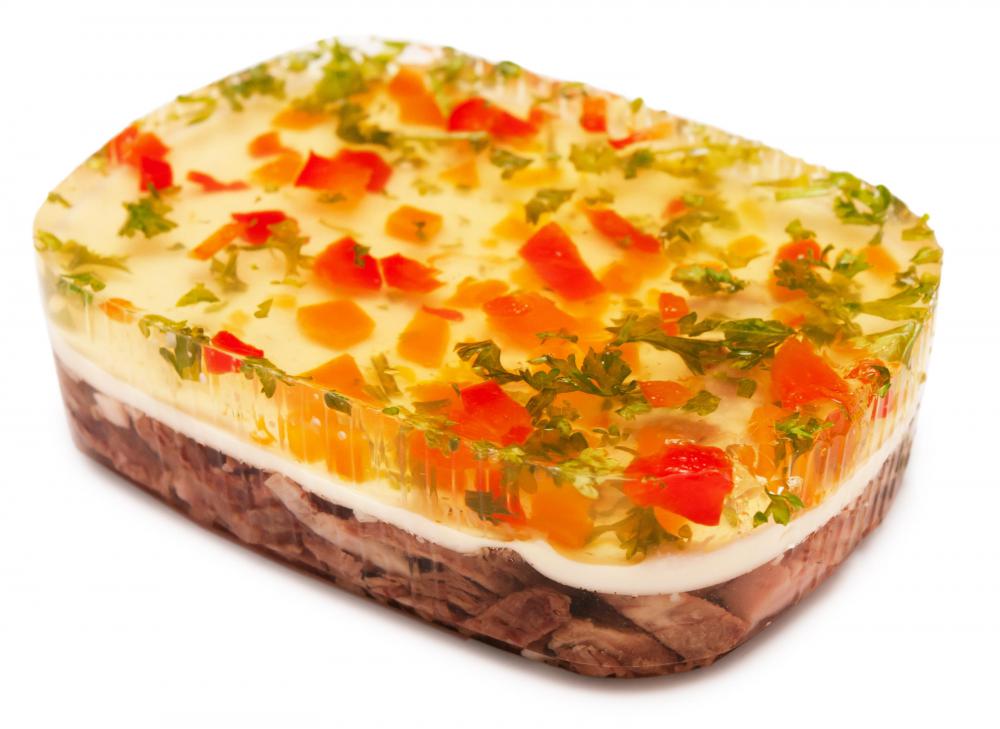
![Aspic is a jelly made from beef, pork, poultry, or fish.]() By: FirstBloodAspic is a jelly made from beef, pork, poultry, or fish.
By: FirstBloodAspic is a jelly made from beef, pork, poultry, or fish. -
![Beef may be featured in aspic.]() By: angoriusBeef may be featured in aspic.
By: angoriusBeef may be featured in aspic. -
![Many different combinations of veggies can be incorporated into a vegetable aspic.]() By: BoggyMany different combinations of veggies can be incorporated into a vegetable aspic.
By: BoggyMany different combinations of veggies can be incorporated into a vegetable aspic.


Discussion Comments
My picky new babies just scarfed up three old cans of pro-plan sardine and aspic I had just found again. It was my old baby's favorite and I can't find it anymore. I've been everywhere and live in the US. I need some too. Anyone?
try sophistacat supreme or shop n stop they both have canned food in aspic! hope i helped.
I am (almost) ashamed to ask this, but where can I purchase packets of aspic jelly mix to make my favorite seafood terrine? Even in Sainsburys here in Northern Ireland, I cannot find any. I have made the terrine using gelatin and stock, but it was not as tasty. Sorry not to be high brow! R
B.F.F Cat Food has flavors in Aspic as well as gravy for those of you with picky cats (mine love aspic as well!)
I think gelatin is a protein found in animals, so it occurs naturally in the broths.
Does anyone know of any published sources about aspic?
My picky 10 year old cat will only eat cat food with aspic juice. now sheba cat food is no longer available! Lucky she is on a special dry food from the vet but she will come every morning just to get two bites of her prawns and tuna in aspic from sheba. Now she just sits and looks at me as if to say, well.
I recently bought some canned cat-food for my notoriously picky kitties and I was shocked when I opened it and instead of the usual gravy it was molded into an aspic mold. I then read the ingredients to find out what this jelly fatty like substance was and I'd never heard of it before. It was aspic. French gourmet cuisine for cats! What's next, people?
Gelatin is a product of collagen when it is broken down by heat. Collagen makes up 70 percent of the connective tissue in the body, including a significant proportion of bone, skin and tendon. I assume that you cannot make aspic just by boiling a steak (muscle), but have to also include collagen containing parts of the animal.
Where does the gelatin in aspic come from, if it's not added separately?
Post your comments