
At TheHealthBoard, we're committed to delivering accurate, trustworthy information. Our expert-authored content is rigorously fact-checked and sourced from credible authorities. Discover how we uphold the highest standards in providing you with reliable knowledge.
What is an Underbite?
 Tricia Christensen
Tricia Christensen
Tricia Christensen
An underbite refers to the structure and placement of the teeth and is often contrasted with an overjet, more commonly, if incorrectly, called an overbite. In an overjet, the front top teeth stick out far above the bottom teeth. An underbite is perhaps more pronounced; the lower front teeth are in front of the top teeth, and the lower jaw can be much more prominent. The condition can be minor or very noticeable, and it can result in greater risk of tempero-mandibular joint (TMJ) disorder, poor bite, and wearing of the teeth unevenly.
A discussion of this issue often leads orthodontists to explain why early orthodontic treatment may be essential for some kids. When children are young, usually under the age of eight, their mouths and jaws are much easier to reshape. Older kids, teens, and adults may have a challenging time getting an underbite corrected. Severe cases may require surgery on the jaws, teeth extraction, and very long use of braces to correct the problem. In most instances, the problem is correctable at any age via these interventions, but it is definitely easiest to address this issue when children are still young.
Some dental experts tie the position of the jaw to genetics, and it is pretty clear to see how this works in certain dog breeds, like bulldogs. Almost all bulldogs have the protruding lower jaw, which is a desirable breed trait.

Some populations of humans seem more prone to underbites. People of Asian descent tend to have them occur more frequently than do other racial groups. Behavior, especially tongue thrust and mouth breathing, can also result in the problem, even when this isn't something that shows up in a person's family. For instance, a child who suffers from significant allergies and nasal congestion might breathe through the mouth constantly, causing the tongue to sit against the front bottom teeth at all times, which can lead to protrusion of the lower teeth.

Many orthodontists state that it is impossible to fully correct an underbite if the underlying issues that may have caused or worsened the issue are not addressed. Even when things like jaw surgery are performed, the teeth may gradually move into the wrong position again if tongue thrust problems are not treated or a patient is not helped to find successful treatments for chronic nasal congestion. In these instances, the underlying issues may be addressed through the placement of orthodontic devices to prohibit the tongue from pushing against the lower teeth with force when a person swallows. Patients with allergies and chronic congestion are urged to see a medical professional to help get those issues under control so that mouth breathing occurs less frequently.
Tricia Christensen
Tricia has a Literature degree from Sonoma State University and has been a frequent TheHealthBoard contributor for many years. She is especially passionate about reading and writing, although her other interests include medicine, art, film, history, politics, ethics, and religion. Tricia lives in Northern California and is currently working on her first novel.
Learn more...
Tricia Christensen
Tricia has a Literature degree from Sonoma State University and has been a frequent TheHealthBoard contributor for many years. She is especially passionate about reading and writing, although her other interests include medicine, art, film, history, politics, ethics, and religion. Tricia lives in Northern California and is currently working on her first novel.
Learn more...AS FEATURED ON:
AS FEATURED ON:


-
![In some dog breeds, like bulldogs, a protruding lower jaw, or underbite, is a desirable trait.]() By: adogslifephotoIn some dog breeds, like bulldogs, a protruding lower jaw, or underbite, is a desirable trait.
By: adogslifephotoIn some dog breeds, like bulldogs, a protruding lower jaw, or underbite, is a desirable trait. -
![A child who suffers from chronic allergies may develop an underbite.]() By: tatyanaA child who suffers from chronic allergies may develop an underbite.
By: tatyanaA child who suffers from chronic allergies may develop an underbite. -
![People of Asian descent may be more likely to have an underbite.]() By: DragonImagesPeople of Asian descent may be more likely to have an underbite.
By: DragonImagesPeople of Asian descent may be more likely to have an underbite. -
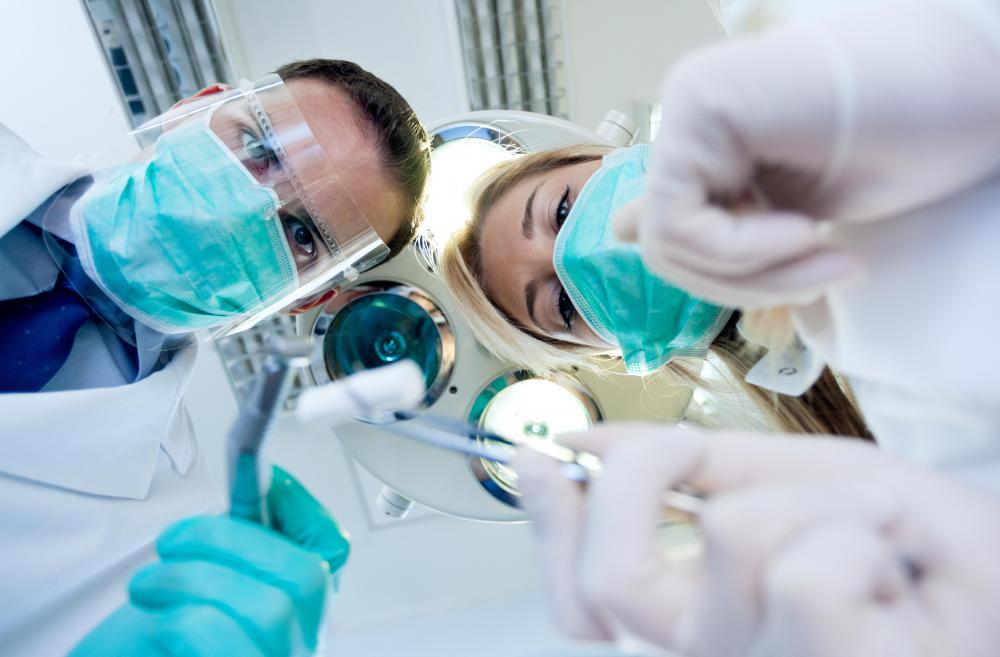
![An underbite may require surgery.]() By: Igor MojzesAn underbite may require surgery.
By: Igor MojzesAn underbite may require surgery.



Discussion Comments
I have an underbite, have all my life, and it's never caused any problems for me so far whatsoever!
It's slight and unnoticeable as far as I can tell. I have zero issues with biting or anything. Also as a baby and young child I was exceptional in that I did not suck my thumb or use pacifiers like my siblings did, whom all have overbites.
Sucking the thumb clearly puts pressure on the underside of the top teeth, and the outside of the lower teeth, why would it cause underbites? I've always heard it causes "buck teeth", or pronounced overbite, which makes perfect sense to me.
What I'm wondering is why is an underbite considered a deformation? I feel I am formed just perfectly fine! I have no wisdom teeth issues either. Mine are present and looking feeling great, doing a great job back there.
The thing dentists don't tell you is that you could keep from having this surgery by putting your tongue up in your mouth instead of letting it rest in its place, because it's a long tongue that causes an underbite.
I have an underbite and a crossbite.
@plaid - An underbite correction can really be painful if your dentist or Orthodontist does it too early on in the braces process. I think underbite surgery is a bit extreme, though. Just makes me go, "Yikes!"
@empanadas - Typically the cross bite is corrected by orthodontics. A lot of people thing that jaw surgery for an underbite might be necessary, but braces can correct that, too. I know that the Invisalign alleviates an underbite in some cases as well.
@anon88306 - There is also what is called a "cross bite" where the teeth are angled inward on top and slightly outward on bottom (though it might not always be both at the same time).
An overbite is where the top incisor teeth VERTICALLY overlap the lower incisors by more than a couple of millimeters. A horizontal discrepancy is called an overjet. This is a common mistake in orthodontic terminology made by lay-persons. Where the overbite is so severe that the lower incisors bite against the palate, this is called a 'traumatic overbite'. Where the lower teeth lie in front of the upper incisors (a class III relation) it is known as a 'reverse overjet'
Post your comments