
At WiseGEEK, we're committed to delivering accurate, trustworthy information. Our expert-authored content is rigorously fact-checked and sourced from credible authorities. Discover how we uphold the highest standards in providing you with reliable knowledge.
What is an Ophthalmologist?
An ophthalmologist, also known as an eye doctor, is a medical professional who deals exclusively with parts of the body related to the visual passageways — the eyes, parts of the brain, and the areas around the eye, such as the eyelids. This doctor will inspect the eye for disease, and may perform surgery in some cases. He or she may also be able to identify problems that aren't directly related to vision, such as brain tumors or diabetes mellitus.
This vision professional is different from an optometrist. An ophthalmologist is a fully licensed medical doctor who is qualified to practice surgery, while an optometrist has completed a graduate degree in optometry. Optometrists deal with prescribing glasses or contact lenses for vision problems, but cannot perform surgery.
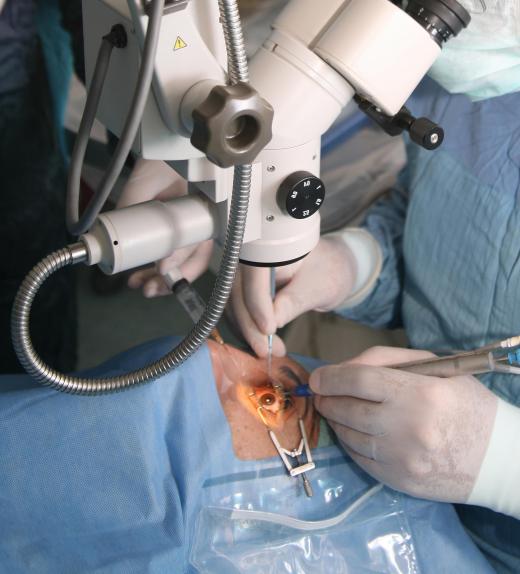
Sometimes, an ophthalmologist may have a particular specialty, such as diseases of the cornea, retina, and vitreous diseases; glaucoma; eye problems in children; or plastic surgery. He or she may have a more generalized practice, however, and may be involved with testing vision and prescribing corrective eye wear or contact lenses, as an optometrist would.

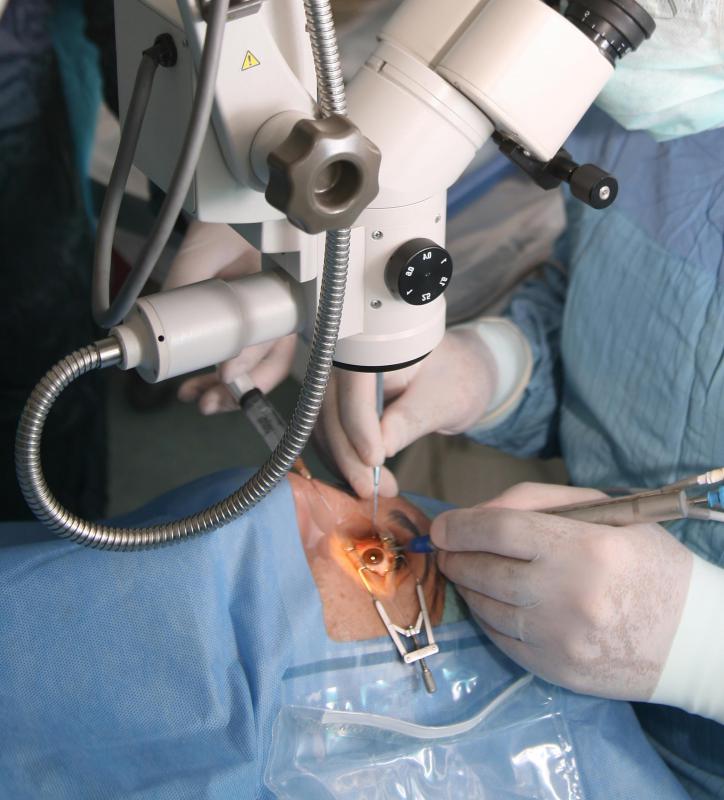
When surgery is required to correct a vision problem, there are several different techniques that an ophthalmologist may use. In some cases, he or she may need to use a scalpel and other invasive tools to remove obstructions from the eye; however, recently, laser eye surgery, or LASIK, has become very common.
In the LASIK system, the doctor creates a flap in the patient's cornea and then uses a highly accurate laser to remodel the middle section of the cornea, which improves the patient's vision. The technique relies on an advanced eye tracking system, and it is much safer than traditional eye surgery. It is not always as effective as it should be, however, and some reports indicate that as many as 18% of patients needed to go back for another treatment.

Besides the ophthalmologist and the optometrist, there are many other types of professionals who are involved in eye care. These include opticians, who design and fit eyeglasses and contact lenses; ophthalmic medical assistants, who assist doctors with general procedures; ophthalmic technicians, who assist with more advanced surgical procedures; and ophthalmic photographers, who take photographic images to document the quality of a patient's eye.
AS FEATURED ON:
AS FEATURED ON:









-
![An ophthalmologist differs from an optometrist in that an ophthalmologist is a fully licensed medical doctor who is qualified to practice surgery.]() By: mehmetcanturkeiAn ophthalmologist differs from an optometrist in that an ophthalmologist is a fully licensed medical doctor who is qualified to practice surgery.
By: mehmetcanturkeiAn ophthalmologist differs from an optometrist in that an ophthalmologist is a fully licensed medical doctor who is qualified to practice surgery. -
![An ophthalmologist may prescribe eyeglasses, although he or she is a licensed medical doctor who performs a range of other services.]() By: prosotphotoAn ophthalmologist may prescribe eyeglasses, although he or she is a licensed medical doctor who performs a range of other services.
By: prosotphotoAn ophthalmologist may prescribe eyeglasses, although he or she is a licensed medical doctor who performs a range of other services. -
![An ophthalmologist examines a patient eyes.]() By: daniel rajszczakAn ophthalmologist examines a patient eyes.
By: daniel rajszczakAn ophthalmologist examines a patient eyes. -
![Checking eyes for disease is one job of an ophthalmologist.]() By: Lisa F. YoungChecking eyes for disease is one job of an ophthalmologist.
By: Lisa F. YoungChecking eyes for disease is one job of an ophthalmologist. -
![An ophthalmologist handles eyelid issues.]() By: DelphimagesAn ophthalmologist handles eyelid issues.
By: DelphimagesAn ophthalmologist handles eyelid issues. -
![An ophthalmologist is a doctor who specializes in eye care.]() By: blueringmediaAn ophthalmologist is a doctor who specializes in eye care.
By: blueringmediaAn ophthalmologist is a doctor who specializes in eye care. -
![An ophthalmologist may use a scalpel to remove obstructions from the eye.]() By: Marina LohrbachAn ophthalmologist may use a scalpel to remove obstructions from the eye.
By: Marina LohrbachAn ophthalmologist may use a scalpel to remove obstructions from the eye. -
![Some ophthalmologists perform laser eye surgery.]() By: Monkey BusinessSome ophthalmologists perform laser eye surgery.
By: Monkey BusinessSome ophthalmologists perform laser eye surgery.


Discussion Comments
My niece has had some eye problems ever since she was born. I am not sure what the medical diagnosis is for this condition, but her eyes are cross-eyed. They are hoping she won't have to have surgery for this, but they won't know for sure for a couple years yet.
They see a pediatric ophthalmologist for this and if she were to require surgery, he would be the doctor that would perform this for her.
I had LASIK surgery done about 8 years ago so that I wouldn't have to wear contacts or glasses anymore. This surgery was done by an ophthalmologist who had been practicing for a long time.
While I had the surgery and my follow up appointments done by an ophthalmologist, now I see an optometrist for my annual eye exam. My eye exams are done in the same building where I had my surgery, but it is much cheaper to pay an optometrist instead of an ophthalmologist for a regular exam.
Unfortunately my LASIK surgery did not stay, and I am almost back to the same correction I needed before I ever had the surgery. I don't want to take any chances so have no interest in having any more LASIK surgery.
@Perdido -- My dad had his eyes checked by an optometrist and they said he tested borderline for glaucoma. He went to an ophthalmologist to get a second opinion and he told him he tested just fine and didn't have glaucoma.
That was over 20 years ago and he has never had to be treated for glaucoma. He was pretty relieved to know he didn't have glaucoma and now has all of his eye testing done only by an ophthalmologist.
@strawCake -- I think a few more years of school would be worth it for twice the salary over a lifetime of working. An ophthalmologist would have more responsibility on their shoulders when it came to performing surgery, but the increase in salary would really be worth it for many people thinking about this career.
@sunnySkys - A friend of mine was looking into a career as an eye doctor, so she did the salary comparison between optometrist and ophthalmologist. An ophthalmologist salary can be almost twice as much as what an optometrist makes! However, you have to go to a few more years of school.
If you're going into the field of ophthalmology, it sounds like it would be a better idea to become an ophthalmologist instead of an optometrist. It seems like there are a lot more options for an ophthalmologist.
An optometrist is pretty limited to just doing eye exams and prescribing glasses or contact lenses. However, an ophthalmologist can do that, as well as do surgery and treat diseases. It seems like being an ophthalmologist would be way more lucrative and interesting than being an optometrist.
@Ted41 - That makes sense. I think I would feel perfectly comfortably going to an optometrist for a regular eye exam. But if I were having problems with my eyes and needed specialized care, I would want an ophthalmologist.
Then again, I have no idea which kind of practitioner my current eye doctor is so I guess I'm not that concerned about it!
@Perdido - I'm pretty sure an optometrist can check for "everything" just like an ophthalmologist can. I think the only difference is that an optometrist can't perform surgery.
If you're really concerned over what your checkup is going to entail, and don't want to worry about having to find an ophthalmologist, you could always call your current optometrist and ask! I'm sure you can find out what tests the optometrist will do before making the appointment, then you can decide which kind of doctor you'd prefer.
Optometrists and ophthalmologists can both check your eyes for signs of glaucoma. I suppose that an optometrist would have to refer you to an ophthalmologist if you actually needed surgery, though.
I went to an optometrist for the first time when I was in my early twenties. The nurse asked me if I wanted to be tested for glaucoma, but since I didn't have vision insurance and the cost of the test was high, I didn't get it.
I know that I really need to see an ophthalmologist for a checkup, but I keep putting it off. If I do go back to an eye doctor, it will be an ophthalmologist, because I want to go ahead and get checked for everything once I bite the bullet.
Optometrists can also treat eye diseases.
Post your comments