
At TheHealthBoard, we're committed to delivering accurate, trustworthy information. Our expert-authored content is rigorously fact-checked and sourced from credible authorities. Discover how we uphold the highest standards in providing you with reliable knowledge.
What is an Enlarged Ovary?
An enlarged ovary is a condition in which one of the female reproductive organs that produces the ova, or eggs, grows beyond its normal size. Several different diseases and conditions can cause ovaries to get larger. Most of the time, an enlarged ovary is a symptom of ovarian cysts, polycystic ovary syndrome, or ovarian cancer. Doctors usually check the shape and size of the ovaries during a woman's yearly pelvic examination.
Ovarian cysts are sacs filled with fluid that can form inside or outside the ovaries. Most ovarian cysts are not harmful, and they go away on their own in a few months without treatment. Some ovarian cysts can cause symptoms, such as pelvic pain, nausea, frequent urination, breast tenderness, and irregular menstrual period. This usually happens with larger cysts and cysts that rupture.

Most cysts are the result of an egg that does not release as normal. If the follicle holding the egg does not rupture and release the egg, for example, an ovarian cyst can grow. A corpus luteum cysts forms when fluid gets trapped inside the follicle that releases the egg.
Some rare types of cysts can cause additional complications. Dermoid cysts form from human eggs and can contain hair, teeth, or skin. These types of cysts can grow very large, causing an enlarged ovary to move out of position. Cystadenomas are ovarian cysts that can grow very large and lead to twisting of the ovary. Endometriomas are cysts that form in women with endometriosis, a condition that causes uterine cells to grow outside of the uterus.

Since ovarian cysts often go away on their own, sometimes no treatment is needed. Birth control pills can reduce the risk of developing new cysts. If a cyst is large or causes pain or other symptoms, a doctor may remove it surgically or remove the entire affected ovary.
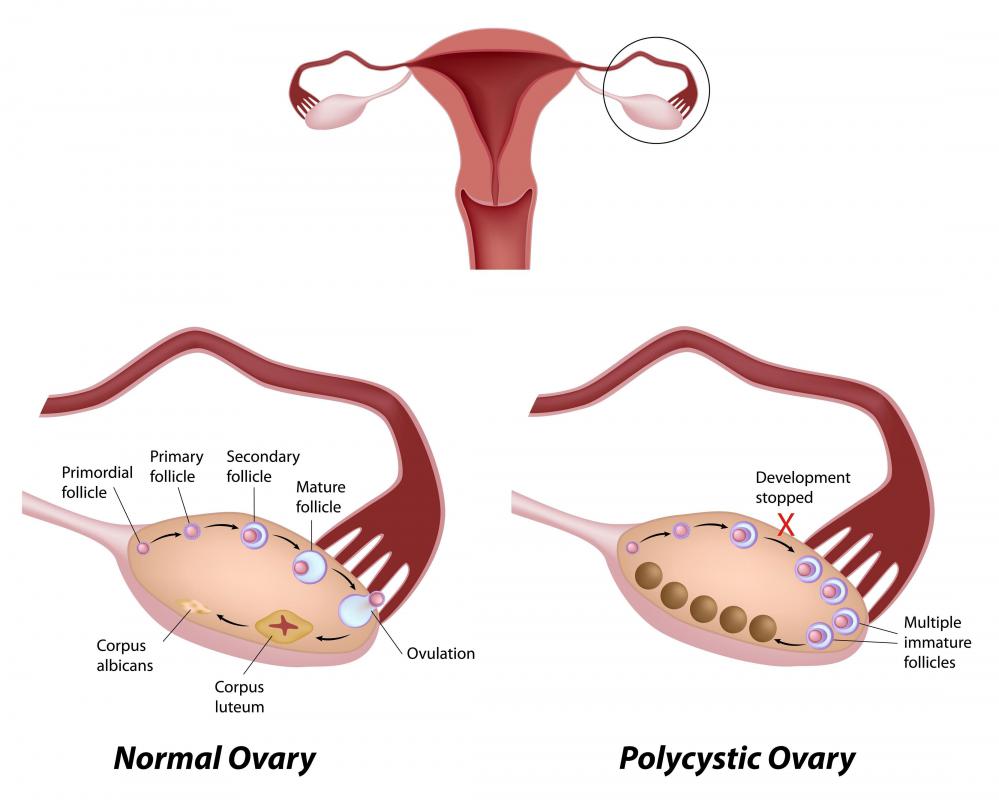
Polycystic ovary syndrome (PCOS) is a condition that causes an enlarged ovary due to many small cysts that form on or in the ovarian tissue. This condition can also cause irregular menstrual cycles and elevated levels of male hormones, which can cause excess hair, acne, and balding. PCOS can also cause infertility. Women with PCOS are more likely to be obese and have certain other conditions, such as type 2 diabetes, high blood pressure, sleep apnea, cholesterol problems, and endometrial cancer.

Treatment for polycystic ovary syndrome usually consists of regular checkups to monitor weight, cholesterol, and blood pressure. Women with PCOS should focus on maintaining a healthy weight, eating a nutritious diet, and getting regular exercise. Some women with PCOS take low-dose birth control pills to decrease the production of male hormones and to regulate their menstrual cycles.

Some women with an enlarged ovary may have ovarian cancer. Enlarged ovaries in women over 50 are taken very seriously because the ovaries usually shrink during menopause, and ovarian cancer is much more common in patients in their 50s and 60s. Ovarian cancer often produces no symptoms, and the only indication may be an enlarged or misshapen ovary that a doctor feels during a pelvic examination.

Ovarian cancer is usually diagnosed by an ultrasound or blood tests. Most women diagnosed with ovarian cancer will have surgery to remove the cancerous tissue and cysts. If the cancer has spread to other parts of the body, doctors use chemotherapy and radiation treatment to kill cancerous cells and prevent the cancer from spreading further.
AS FEATURED ON:
AS FEATURED ON:


-
![A diagram of a healthy ovary and one that is enlarged because of polycystic ovary syndrome.]() By: AlilaA diagram of a healthy ovary and one that is enlarged because of polycystic ovary syndrome.
By: AlilaA diagram of a healthy ovary and one that is enlarged because of polycystic ovary syndrome. -
![Taking birth control pills can help prevent women from developing ovarian cysts.]() By: Kimberly ReinickTaking birth control pills can help prevent women from developing ovarian cysts.
By: Kimberly ReinickTaking birth control pills can help prevent women from developing ovarian cysts. -
![Ovarian cysts can be a serious concern if they grow or rupture.]() By: AllianceOvarian cysts can be a serious concern if they grow or rupture.
By: AllianceOvarian cysts can be a serious concern if they grow or rupture. -
![Polycystic ovary syndrome (PCOS) may result in enlarged ovaries.]() By: ryanking999Polycystic ovary syndrome (PCOS) may result in enlarged ovaries.
By: ryanking999Polycystic ovary syndrome (PCOS) may result in enlarged ovaries. -
![Most ovarian cysts are benign and will dissolve in a few months without treatment.]() By: javiindyMost ovarian cysts are benign and will dissolve in a few months without treatment.
By: javiindyMost ovarian cysts are benign and will dissolve in a few months without treatment. -
![Some patients may choose to allow an enlarged ovary to resolve on its own.]() By: Zsolnai GergelySome patients may choose to allow an enlarged ovary to resolve on its own.
By: Zsolnai GergelySome patients may choose to allow an enlarged ovary to resolve on its own. -
![Some rare types of cysts can cause additional complications.]() By: michaeljungSome rare types of cysts can cause additional complications.
By: michaeljungSome rare types of cysts can cause additional complications. -
![Ovarian cysts may cause breast tenderness and an irregular menstrual period.]() By: Marin ConicOvarian cysts may cause breast tenderness and an irregular menstrual period.
By: Marin ConicOvarian cysts may cause breast tenderness and an irregular menstrual period.


Discussion Comments
I married three months ago and I am 22. I have a PCOD. My ovaries are enlarged in size. One is 9cc and other is10cc. Will this cause a huge problem. Is this recoverable soon?
It's believed estrogen stimulates the growth of uterine fibroid, so limiting your intake of estrogen might be helpful. I have been suffering from very painful ovarian cysts for years and a Chinese herbal remedy got rid of my cyst.
I have a cyst measuring 70mm by 55mm, alongside my left ovary, which is enlarged over the size of the normal ovary. I am very worried. Please help me.
I am Swapna. I am a 24 year old woman and I have been married two months. Three days ago, I got my sonography report.
It reads: OVARI; RO VOL-12.5CC; LO VOL-10CC; FEW SMALL FOLLICLE SEEN. Both ovaries are normal. No SOL/CYST
Can you please tell me what does it mean and is there any problem with my pregnancy?
I have been diagnosed with bulky ovaries. 32X18mm (right) and 36X18 (Left) and they say tubular cystic lesion in right adnexa measuring 64X34mm? Paraovarian cyst? Hydrosalpnx. Please help.I am not married yet. I am deeply upset by these results. What can I do for this?
Well I have also polycystic ovaries. Can anyone here who is well educated tell me what this is?
The ultrasound of my ovaries shows three ova in right ovary and two ova in my left ovary.
I'm married and age 23. Yesterday I got my sonography reports. My right ovary volume measured 12.8 cc and my left ovary volume measured 13.2 cc. Can you please tel me what does it mean and should I worry about whether I have some condition that is minor or one that has a long treatment?
My wife's ultrasound is showing a lot of cysts 3-5mm on both sides of her ovary. Please tell me, can she get pregnant with the cysts, or not?
I'm married and age 23. Yesterday I got my sonography reports. My right ovary measures 4.5 X 1.8 X 2.8cms volume 12.2cc
My left ovary measures 4.0 X 1.8 X 3.0cms volume:12cc. Can you please tel me what does it mean and how should it be treated?
I can't find anything on the Internet to help me understand what my doctor's nurse just told me about my ultrasound.
The results read as multiple follicles being overdeveloped in both ovaries. So I don't have cysts, but my ovaries are enlarged from my eggs not dispelling as they should. What does this mean for my body and what can be done to fix it?
@anon281690: If you're missing periods or having late periods, you need to see your doctor, who can actually check your ovaries. Chances are, you're fine.
It's nearly impossible to feel a woman's ovaries through the abdomen, which is what I assume you did. In fact, unless you're a doctor, I doubt you can.
When my doc checks my ovaries, it's after she does the Pap smear. She does it with two fingers in the vagina and the other hand pressed very firmly on my abdomen. She knows what she's looking for, and what she's feeling. Someone who is not a doctor, a trained midwife, or is not in the medical profession probably would have no idea what they're feeling.
I recommend you see your doctor, tell him or her your concerns and get an exam. It's not bad. It takes about 30 seconds to do the Pap smear and the ovary exam. It's a few seconds of discomfort and then it's over. Certainly, it's worth the peace of mind.
My period has been delaying for a while. I'm so worried, and it makes me sad all the time.
I felt my left side where the left ovary is at, I guess, and it seems bigger than my right.
I'm so worried. Can someone please tell me what is wrong with me? Why does my head tell me I'm not going to have children and I'm going to die sooner than I thought? I'm only 18.
I'm unmarried and age 30. I've been suffering from delayed periods for one year. I got periods at the age of 14.
Today I got my ultrasound reports that say that my ovary size is large. My right ovary measures 4.5 x 2.2 x 3.2 nal 17.9ml and my left ovary measures 5.5 x 1.3 x 3.6 nal 13.5ml. Can you please tell me what does it mean and how it should be treated?
I just got back my pelvis ultrasound results.
I have a large right ovary 5.2 x 3.9 x 2.7cm. The volume is measured at 27.3cc. There is a 1.5cm follicle on the right ovary.
I feel so sick all the time with constipation, dizziness and anxiety. I feel like I am dying. What do I need to do? I was told to take the paper work over to obygn doctors. I faxed them.
What will they do to help me? I don't want to feel like I'm dying every second of my life. Someone please help.
Is an enlarged uterus caused by the same thing as an enlarged ovary?
One of the other common enlarged ovary causes is in vitro fertilization.
Unfortunately, many doctors fail to mention how common it is to have enlarged ovaries after IVF, so many women are taken completely by surprise.
Most of the time the enlarged ovaries go down on their own, but some women experience a lot of pain from the swelling.
This can occur from extra IVF fluid forming cysts, so if you think that you are having the symptoms of enlarged ovary or pain after IVF, then be sure to contact your doctor as soon as possible to prevent complications.
Thanks for this article -- when I was younger I had ovary pain for quite some time before I got up the courage to go to the doctor.
Luckily it was just a cyst, which went away with treatment, but I wish I had had an article like this to inform me -- it would have saved me a lot of worry!
Post your comments