
At AllTheScience, we're committed to delivering accurate, trustworthy information. Our expert-authored content is rigorously fact-checked and sourced from credible authorities. Discover how we uphold the highest standards in providing you with reliable knowledge.
What is an Electromagnetic Wave?
 Jessica Ellis
Jessica Ellis
Jessica Ellis
The term electromagnetic wave describes the way electromagnetic radiation (EMR) moves through space. Different forms of EMR are distinguished by their wavelengths, which vary from many yards (meters) to a distance smaller than the diameter of an atomic nucleus. The full range, in decreasing order of wavelength, goes from radio waves through microwaves, visible light, ultraviolet and X-rays to gamma rays and is known as the electromagnetic spectrum. Electromagnetic waves have many applications, both in science and in everyday life.
Light Waves

In many respects, an electromagnetic wave behaves similarly to ripples on water, or to sound traveling through a medium such as air. For example, if a light is shone onto a screen through a barrier with two narrow slits, a pattern of light and dark stripes is seen. This is called an interference pattern: where the crests of the waves from one slit meet those from the other, they reinforce one another, forming a bright stripe, but where a crest meets a trough, they cancel out, leaving a dark stripe. Light can also bend around an obstacle, like ocean breakers around a harbor wall: this is known as diffraction. These phenomena provide evidence of the wave-like nature of light.

It was long assumed that, like sound, light must travel through some kind of medium. This was given the name “ether,” sometimes spelled “aether,” and was thought to be an invisible material that filled space, but through which solid objects could pass unhindered. Experiments designed to detect the ether by its effect on the speed of light in different directions all failed to find any evidence for it, and the idea was finally rejected. It was apparent that light, and other forms of EMR, did not require any medium and could travel through empty space.
Wavelength and Frequency

Just like an ocean wave, an electromagnetic wave has peaks and troughs. The wavelength is the distance between two identical points of the wave from cycle to cycle, for instance, the distance between one peak, or crest, and the next. EMR can also be defined in terms of its frequency, which is the number of crests that pass by in a given time interval. All forms of EMR travel at the same speed: the speed of light. Therefore, the frequency depends entirely on the wavelength: the shorter the wavelength, the higher the frequency.
Energy

Shorter wavelength, or higher frequency, EMR carries more energy than longer wavelengths or lower frequencies. The energy carried by an electromagnetic wave determines how it affects matter. Low frequency radio waves mildly perturb atoms and molecules, while microwaves cause them to move about more vigorously: the material heats up. X-rays and gamma rays pack much more of a punch: they can break chemical bonds and knock electrons from atoms, forming ions. For this reason, they are described as ionizing radiation.
The Origin of Electromagnetic Waves

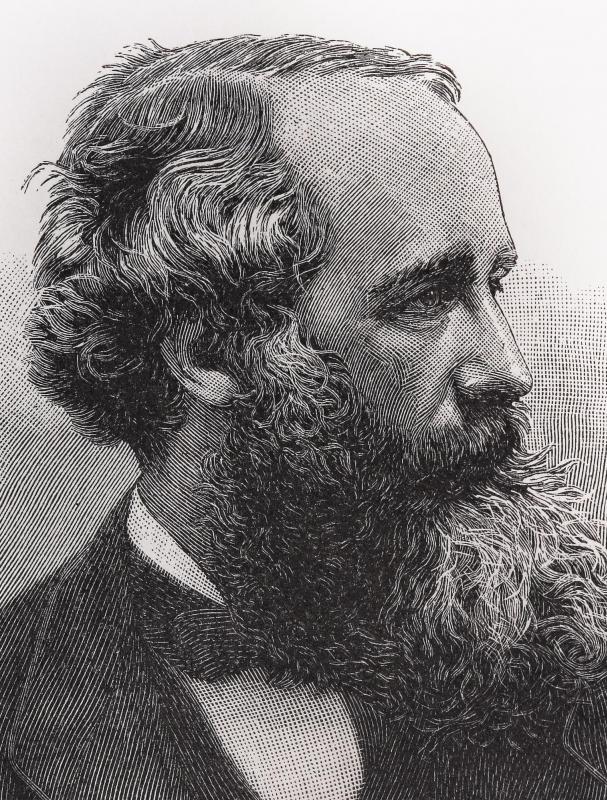
The relationship between light and electromagnetism was established by the work of the physicist James Clerk Maxwell in the 19th century. This led to the study of electrodynamics, in which electromagnetic waves, such as light, are regarded as disturbances, or “ripples,” in an electromagnetic field, created by the movement of electrically charged particles. Unlike the non-existent ether, the electromagnetic field is simply the sphere of influence of a charged particle, and not a tangible, material thing.
Later work, in the early 20th century, showed that EMR also had particle-like properties. The particles that make up electromagnetic radiation are called photons. Although it seems contradictory, EMR can behave as waves or as particles, depending on the type of experiment that is carried out. This is known as the wave-particle duality. It also applies to subatomic particles, whole atoms and even quite large molecules, all of which can sometimes behave as waves.
The wave-particle duality emerged as quantum theory was being developed. According to this theory, the “wave” represents the probability of finding a particle, such as a photon, at a given location. The wave-like nature of particles and the particle-like nature of waves have given rise to a great deal of scientific debate and some mind-boggling ideas, but no overall consensus about what it actually means.
In quantum theory, electromagnetic radiation is produced when subatomic particles release energy. For example, an electron in an atom can absorb energy, but it must eventually drop to a lower energy level and release the energy as EMR. Depending on how it is observed, this radiation can appear as a particle or an electromagnetic wave.
Uses
A great deal of modern technology depends upon electromagnetic waves. Radio, television, mobile phones and the Internet rely on the transmission of radio frequency EMR through air, space or fiber optic cables. The lasers used to record and play DVDs and audio CDs use light waves to write to and read from the discs. X-ray machines are an essential tool in medicine and airport security. In science, our knowledge of the universe comes largely from analysis of light, radio waves and X-rays from distant stars and galaxies.
Hazards
It is not thought that low energy electromagnetic waves, such as radio waves, are harmful. At higher energies, however, EMR poses risks. Ionizing radiation, such as X-rays and gamma rays can kill or damage living cells. They can also alter DNA, which can lead to cancer. The risk to patients from medical X-rays is considered negligible, but radiographers, who are exposed to them regularly, wear lead aprons — which X-rays cannot penetrate — to protect themselves. Ultraviolet light, present in sunlight, can cause sunburn and can also cause skin cancer if exposure is excessive.
Jessica Ellis
With a B.A. in theater from UCLA and a graduate degree in screenwriting from the American Film Institute, Jessica is passionate about drama and film. She has many other interests, and enjoys learning and writing about a wide range of topics in her role as a AllTheScience writer.
Learn more...
Jessica Ellis
With a B.A. in theater from UCLA and a graduate degree in screenwriting from the American Film Institute, Jessica is passionate about drama and film. She has many other interests, and enjoys learning and writing about a wide range of topics in her role as a AllTheScience writer.
Learn more...AS FEATURED ON:
AS FEATURED ON:









-
![Light travels in electromagnetic waves.]() By: Pavel LosevskyLight travels in electromagnetic waves.
By: Pavel LosevskyLight travels in electromagnetic waves. -
![The full range of electromagnetic waves is identified as the electromagnetic spectrum.]() By: designuaThe full range of electromagnetic waves is identified as the electromagnetic spectrum.
By: designuaThe full range of electromagnetic waves is identified as the electromagnetic spectrum. -
![Radio telescopes detect radio waves, a form of electromagnetic radiation, from space.]() By: phuduiRadio telescopes detect radio waves, a form of electromagnetic radiation, from space.
By: phuduiRadio telescopes detect radio waves, a form of electromagnetic radiation, from space. -
![Physicist James Clerk Maxwell was noted for his work with electromagnetism.]() By: nickolaePhysicist James Clerk Maxwell was noted for his work with electromagnetism.
By: nickolaePhysicist James Clerk Maxwell was noted for his work with electromagnetism. -
![X-rays cannot penetrate lead aprons.]() By: Pavel LosevskyX-rays cannot penetrate lead aprons.
By: Pavel LosevskyX-rays cannot penetrate lead aprons.



Discussion Comments
The electromagnetic field of the earth is a strong force which keeps boats heading in the right direction and allows for effective sonar and compass activity. The up and down of the earth is kept in balance by a consistent electromagnetic field. Auroras are also generated by this magnificent magnetic force.
@Tufenkian925
It is interesting to note that using the interconnectivity of various media of waves is how we create new technologies and make new ideas become a reality. If we can learn to harness light and space-time in the future, we may find ways of transmitting information which are even more revolutionary than what is currently happening.
We don't fully understand this force or how electromagnetic waves function, but we use them on a daily basis. Sound systems and microphones make use of the vibrating spring under a magnet to pick up sound waves and convert them to electromagnetic waves, carrying them to a speaker which magnifies the sound waves using this electromagnetic/ air sound wave function. The sound is magnified using electric power from a power source.
Electromagnetic wave theory seems to indicate that there are intrinsic similarities between gravitational waves, light, and the space-time forces behind all of the universes main atomic forces. These forces are thought to be derived from one ultimate force, which is encapsulated in many theories concerning cosmology and the theory of everything.
Post your comments