
At TheHealthBoard, we're committed to delivering accurate, trustworthy information. Our expert-authored content is rigorously fact-checked and sourced from credible authorities. Discover how we uphold the highest standards in providing you with reliable knowledge.
What Is an Ear Polyp?
An ear polyp, also known as an aural polyp, is an abnormal growth of skin and soft tissue extending from the ear canal. Polyps are fleshy, swollen lumps, sometimes containing bloody pus. Typically, an ear polyp arises from either the ear canal or the tympanic membrane, better known as the eardrum. Seldom are such polyps deemed to be cancerous growths, but rather are benign cysts or the result of aggressive bone infections. Although normally not cancerous, a polyp in the ear can be considered malignant when referencing polyps arising from a bone infection, due to their aggressive speed of growth and hazardous nature.
In regard to cause, an ear polyp can result from several possible scenarios. Acute otitis externa, or severe swimmer's ear can result in the formation of a polyp. When water remains in the ear canal, such as with regular swimming, the moist environment serves as a breeding ground for both bacterial and fungal infections. If left untreated, such an infection can result in the formation of a polyp between the eardrum and the outer ear.

Malignant otitis externs are aggressive abnormal growths in the ear canal that begin with a bone infection inside the ear. Diagnosing these polyps as malignant does not mean they are cancerous growths, but rather references the aggressive, cancer-like behavior of such polyps. As the infection develops and grows in intensity, irritation of the sensitive tissues in the bottom of the ear canal creates a polyp. The risk of complications from malignant otitis externs are high. If left untreated, a malignant polyp can lead to infection of the skull bones, brain abscesses, permanent loss of hearing, and paralysis of facial muscles.

Skin cysts are another cause of ear polyps. Like polyps caused by swimmer's ear or bone infections, skin cysts in the ear canal are typically the result of prolonged irritation. Under chronically irritated conditions, the risk of infection and the development of cysts — the body's defense against chronic irritation or inflammation — greatly increases. Surgically implanted tubes used to relieve chronic ear infections can sometimes lead to similar skin cysts or polyps. Tiny bones in the mastoid or middle ear are susceptible to irreparable damage from the development of such ear polyps.

Symptoms associated with these polyps include extreme sensitivity to touch, excessive drainage from the ear, bloody drainage, pain, and itching within the ear canal. Hearing loss or a reduction in hearing capabilities are common with all polyps in the ears. In some cases, even a soft touch to a polyp in the ear can cause pain and bloody drainage. Firm ear polyps that do not bleed easily are an indication of tumorous growth. Soft, inflamed polyps that bleed easily are usually indicative of chronic or severe infection.
AS FEATURED ON:
AS FEATURED ON:


-
![Swimmer's ear, or water that remains in the ear canal, possibly from regular swimming, may result in the formation of an ear polyp.]() By: yanlevSwimmer's ear, or water that remains in the ear canal, possibly from regular swimming, may result in the formation of an ear polyp.
By: yanlevSwimmer's ear, or water that remains in the ear canal, possibly from regular swimming, may result in the formation of an ear polyp. -
![Untreated ear polyps may result in hearing loss.]() By: dotweb.dkUntreated ear polyps may result in hearing loss.
By: dotweb.dkUntreated ear polyps may result in hearing loss. -
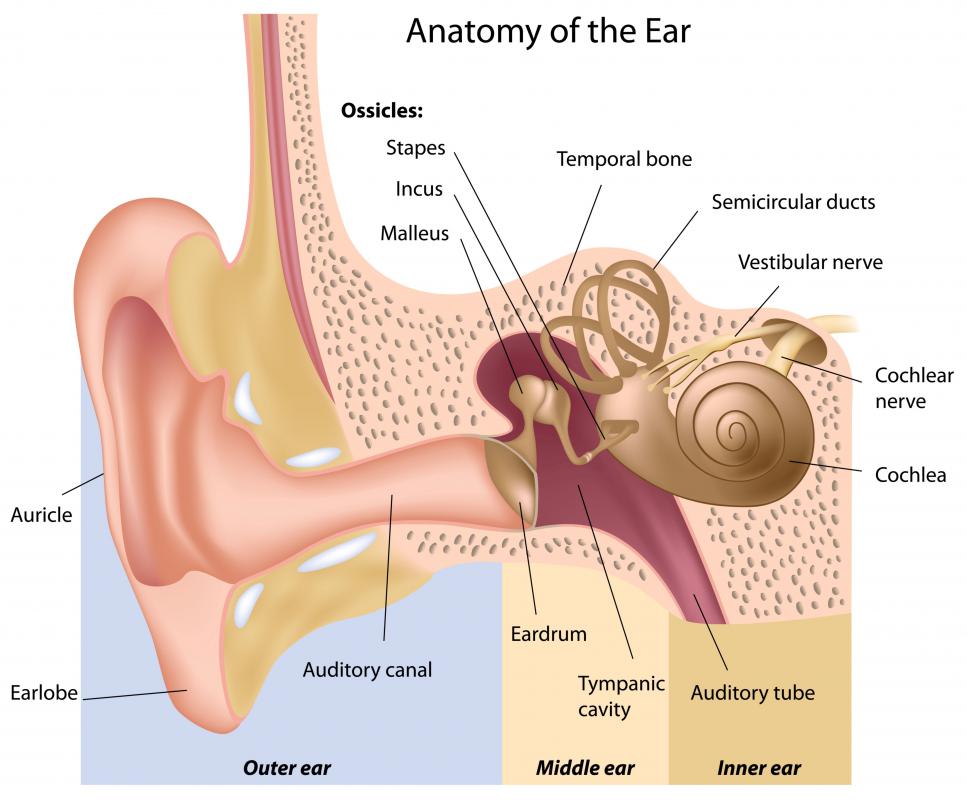
![Soft tissue and skin abnormally growing from the ear canal causes an ear polyp.]() By: Alila Medical MediaSoft tissue and skin abnormally growing from the ear canal causes an ear polyp.
By: Alila Medical MediaSoft tissue and skin abnormally growing from the ear canal causes an ear polyp. -
![An untreated malignant ear polyp may cause a brain abscess.]() By: Von SchonertagenAn untreated malignant ear polyp may cause a brain abscess.
By: Von SchonertagenAn untreated malignant ear polyp may cause a brain abscess. -
![Ear polyps may cause pain.]() By: Vladimir VoroninEar polyps may cause pain.
By: Vladimir VoroninEar polyps may cause pain.




Discussion Comments
I read this article and I have some similar issues. Six days back, I experienced a dull pain in my left ear. Slowly the pain increased in severity. I consulted a doctor and he thought it was due to wax in the ear and prescribed dewax drops and some antibiotics.
I used them but got no relief. Two days back, when I woke up, I experienced severe pain. I thought it was due to wax, so I took an ear bud to clean it. When I inserted it into my ear, there was pus on that bud, so again I put it inside and this time there was blood.
I ran to the doctor and explained my condition. He checked and said it looked like a polyp. He gave me another prescription and said if these medicines are useless a surgery is needed. Yesterday, I followed the prescription and there was no pain, but today the pain recurred, and it was severe. There is pus inside my ear.
For two days, it continuously stuck to the cotton, which I close my ear with from external dust, but there was no blood.
What should I do now? Please tell me what is my condition? Another thing is the pain is pulsating and very severe. I don't know when it comes and goes. There are no relieving factors for my pain. Even now, I am experiencing it. Please explain my condition.
Post your comments