
At TheHealthBoard, we're committed to delivering accurate, trustworthy information. Our expert-authored content is rigorously fact-checked and sourced from credible authorities. Discover how we uphold the highest standards in providing you with reliable knowledge.
What is an Antibody?
 Mary McMahon
Mary McMahon
Mary McMahon
An antibody, also known as an immunoglobulin, is a protein found in the blood or body fluid of an animal. These proteins have special receptors that allow them to bind to foreign substances known as antigens. Their purpose is to identify and neutralize antigens so that they cannot make the host organism sick. Antibodies make up the core of the immune system, acting like shock troops to quickly quell incursions from antigens.
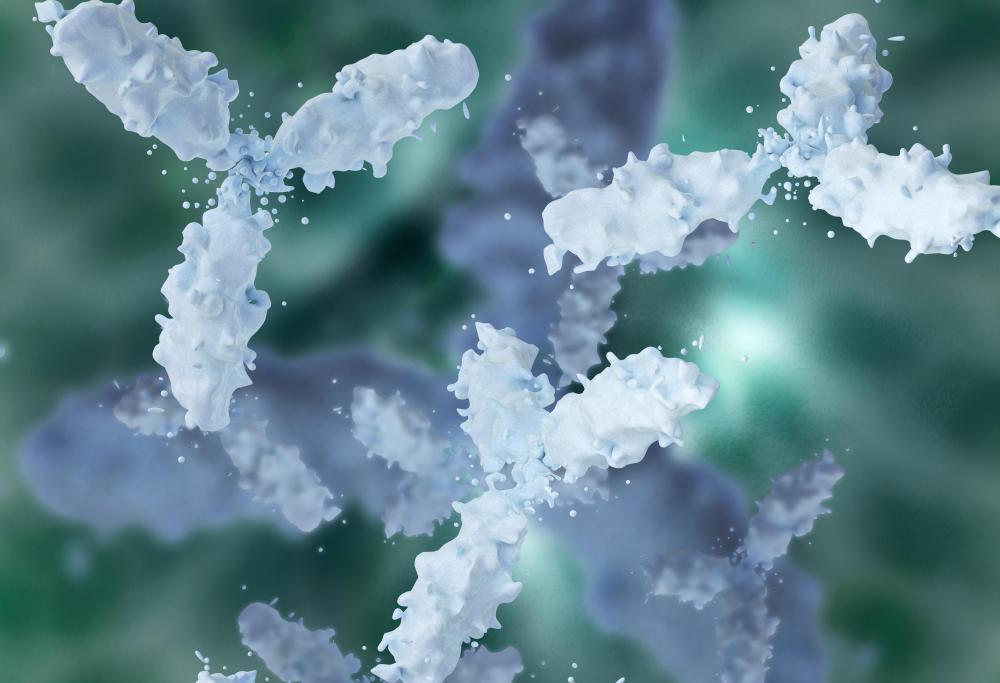
The chemical structure of antibodies can get quite complex, but the short version is that they are Y-shaped structures composed of linked chains of polypeptides known as light and heavy chains. The string of amino acids determines what class the antibody is in, and also which antigens it can bind to. Each can bind with only one antigen, in a system that could be compared to a lock and key. Receptors at the tips of the structures allow it to bind to a particular antigen.

Some antibodies float freely in the blood, produced by the B cells as needed. B cells know when to produce more of these proteins because they have membrane-bound ones that stick to their surfaces at all times. These antibodies act as invasion detectors, alerting the B cell when they detect an antigen they bind to so that the B cell can trigger the production of more proteins to fight the antigen.

Some examples of antigens include bacteria and viruses. The body develops antibodies when it is initially exposed to the antigen, and it stores them for future usage. Some antigens are wily, capable of changing their genetic code just enough so that future generations will not interact with antibodies because the lock and key do not match. Others are dependable and common enough that people can be vaccinated against them by being introduced to a small sample of the antigen so that their bodies are prepared to recognize and fight the antigen in the future.

Occasionally, the production of antibodies goes haywire. In autoimmune disorders, the body develops antibodies to itself, and they will start to attack substances that are actually created by the body under the mistaken impression that these substances are harmful. People may also develop the proteins when they are exposed to certain normally harmless compounds, like food, pet dander, or dust mites. When the body meets these substances again, it will produce more and trigger an allergic reaction as the body attempts to fight the perceived antigen.
Mary McMahon
Ever since she began contributing to the site several years ago, Mary has embraced the exciting challenge of being a TheHealthBoard researcher and writer. Mary has a liberal arts degree from Goddard College and spends her free time reading, cooking, and exploring the great outdoors.
Learn more...
Mary McMahon
Ever since she began contributing to the site several years ago, Mary has embraced the exciting challenge of being a TheHealthBoard researcher and writer. Mary has a liberal arts degree from Goddard College and spends her free time reading, cooking, and exploring the great outdoors.
Learn more...AS FEATURED ON:
AS FEATURED ON:


-
![Antibodies have a Y-shaped structure.]() By: fotoliaxrenderAntibodies have a Y-shaped structure.
By: fotoliaxrenderAntibodies have a Y-shaped structure. -
![People may develop antibodies when they are exposed to certain compounds, like pet dander.]() By: V&P Photo StudioPeople may develop antibodies when they are exposed to certain compounds, like pet dander.
By: V&P Photo StudioPeople may develop antibodies when they are exposed to certain compounds, like pet dander. -
![Allergies are caused by an improper antibody reaction to normally harmless compounds.]() By: Evgenia TiplyashinaAllergies are caused by an improper antibody reaction to normally harmless compounds.
By: Evgenia TiplyashinaAllergies are caused by an improper antibody reaction to normally harmless compounds. -
![Antibodies are responses of the immune system to an antigen, which is generally a foreign object.]() By: designuaAntibodies are responses of the immune system to an antigen, which is generally a foreign object.
By: designuaAntibodies are responses of the immune system to an antigen, which is generally a foreign object.



Discussion Comments
I've heard that babies get their antibodies from their mothers while still in the womb. That's pretty convenient, considering that the babies haven't developed their own immune systems yet.
Mothers who breastfeed are giving even more antibodies to their babies over a longer period. The milk contains the antibodies, so that is why breast milk is best.
@healthy4life – The flu vaccine contains dead antigens, so you are not exposing yourself to a living virus. The risk of getting sick is minimal.
I have gotten a flu shot every year for the past ten years, and I haven't gotten the flu. In fact, I rarely even get a cold or sickness of any kind.
The dead antigens are really good at making my body produce antibodies. I will continue to get vaccinated every year.
I've never quite understood how vaccination works. If you get injected with an antigen, what keeps it from making you sick?
It just seems like a bad idea to intentionally expose yourself to antigens in order to keep from reacting to them later. I have never gotten a flu shot because of this.
@anon47171 -- I think of the production of antibodies as being kind of like soldiers gathering to fight a war in defense of their land. You have the general, which is the B cell, and he sends out a few scouts, these being antibodies, to search for any enemies that may be trying to invade.
If those antibody "scouts" detect any enemies, these are the antigens like a virus or bacteria, they let the B cell "general" know to produce more antibodies to defend the body, in the same way a real general would call in more troops to defend the land, in the case of an enemy attack.
I don't know if that helps, but it makes sense to me to think of it that way.
I never realized that allergies were the result of a problem with antibodies. So my body has decided that strawberries are a harmful substance and has produced antibodies against them. How interesting!
I wonder why the production of those antibodies results in me being covered with itchy hives. Is it the body trying to get rid of the so-called harmful substance through the skin?
I really wish my body would get it's antibody production under control -- I hate hives, but I love strawberries!
i am doing a project and i have no idea what i'm doing. can someone help me understand this better?
Post your comments