
At AllThingsNature, we're committed to delivering accurate, trustworthy information. Our expert-authored content is rigorously fact-checked and sourced from credible authorities. Discover how we uphold the highest standards in providing you with reliable knowledge.
What is an Amanita?
 Mary McMahon
Mary McMahon
Mary McMahon
Mushrooms in the Amanita genus can be found on every continent, including Antarctica. One of the most famous mushrooms on earth is in this genus — the fly agaric or Amanita muscaria, which is well-known for its psychoactive properties. Other members of the genus are also extremely toxic, although some are edible and even delicious. If collecting edible Amanitas for food, extreme caution is advised, as edible species can closely resemble toxic species.
All Amanita mushrooms have a set of distinguishing features which makes them readily identifiable. Young mushrooms have a universal veil which covers the entire mushroom, forming what some mushroom hunters unfortunately mistake as a puffball. As the mushrooms mature, they push through the veil, leaving a cup-like volva at the base of the mushroom. To find the volva, the mushroom may need to be dug up, as it often lurks underground.

Amanitas also have a white spore print and closely packed gills which are fully attached to the stem. Many Amanitas also have a partial veil which covers the delicate gills while the mushroom matures, leaving a ring around the stem of the mushroom after it pulls away. The universal veil often leaves patches or warts on the surface of the mushroom, and the remains of the partial veil sometimes dangle from the cap of the mushroom.

Although most Amanitas are toxic, there are several edible species in the genus. The most well known edible Amanita is Caesar's Mushroom, a pink mushroom with a similarly pink spore print. The mushroom is found widely distributed throughout Europe, and similar North American species are also edible. This particular Amanita is quite tasty, and can sometimes be found in European markets in season. The fleshy, somewhat dry mushroom is delicious in a wide variety of preparations.

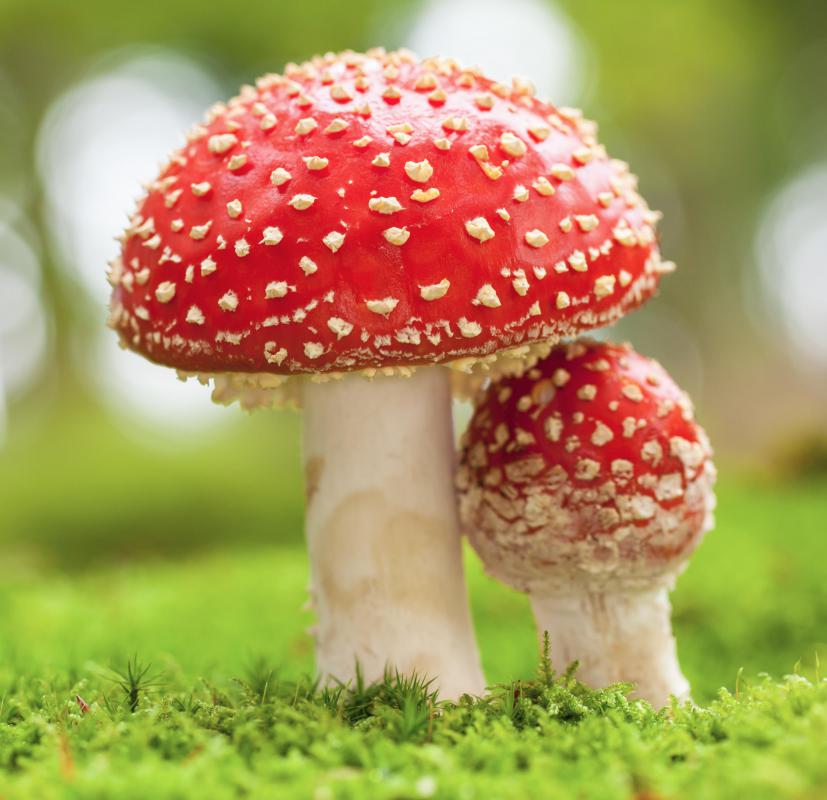
Amanita muscaria is one of the most famous Amanita, and can be readily identified by its bright red cap with distinctive white warts. The mushroom actually originates in Europe, but was brought over to North America with shipments of plants and timber, taking readily to the soil environment provided by hardwood trees such as oaks. Other well known Amanitas include the death cap, also known as the destroying angel, a distinctive white gilled mushroom. The genus also includes the death angels, several white fleshed Amanita species which are highly deadly.
Midly toxic Amanitas can cause vomiting, diarrhea, and abdominal pain. Some of the most toxic mushrooms in this genus can also cause severe damage to the liver and kidneys, which will ultimately lead to death if the poisoning is not treated. Amanitas are the leading cause of mushroom related death. They are found on every continent and closely resemble many harmless or edible species, so it is crucial that mushroom hunters learn how to properly identify mushrooms before eating them: if in doubt, throw it out!
Frequently Asked Questions
What is an Amanita?
An Amanita is a genus of mushrooms that includes both toxic and edible species. These fungi are known for their distinctive features, such as a cap with white gills, a stem with a ring, and a bulbous base with a universal veil. Amanitas are found worldwide and play ecological roles in forest ecosystems as decomposers and in symbiotic relationships with trees.
How can you identify an Amanita mushroom in the wild?
To identify an Amanita, look for mushrooms with a cap that often has white spots or warts, which are remnants of the universal veil. They typically have white gills underneath the cap, a central stem with a skirt-like ring, and a bulbous base encased in a cup-like structure called a volva. Always exercise caution, as some species are highly toxic.
Are all Amanita mushrooms poisonous?
Not all Amanita mushrooms are poisonous; the genus includes both deadly species like Amanita phalloides, known as the "death cap," and edible species such as Amanita caesarea, the "Caesar's mushroom." However, due to the presence of highly toxic species and the difficulty in distinguishing them, foragers are generally advised to avoid Amanitas unless they are expert mycologists.
What are the effects of consuming a poisonous Amanita mushroom?
Consuming a poisonous Amanita mushroom can lead to severe symptoms, including stomach pain, vomiting, diarrhea, liver and kidney failure, and even death. The toxins present, such as amatoxins and phallotoxins, can cause irreversible damage to cells, particularly in the liver. Symptoms may not appear until 6 to 24 hours after ingestion, complicating timely treatment.
How should one handle an Amanita mushroom?
When handling an Amanita mushroom, it's important to do so with caution. Use gloves or a paper towel to avoid direct skin contact, especially with the more toxic species. If you're foraging, only collect Amanitas if you are certain of their identification and edibility. Always keep them separate from other mushrooms to prevent cross-contamination.
What ecological role do Amanita mushrooms play?
Amanita mushrooms play a crucial ecological role in forest ecosystems. Many species form symbiotic relationships with trees, known as mycorrhizae, where they exchange nutrients with plant roots, aiding in the growth and health of both organisms. They also contribute to the decomposition of organic matter, recycling nutrients back into the soil and supporting the ecosystem's balance.
Mary McMahon
Ever since she began contributing to the site several years ago, Mary has embraced the exciting challenge of being a AllThingsNature researcher and writer. Mary has a liberal arts degree from Goddard College and spends her free time reading, cooking, and exploring the great outdoors.
Learn more...
Mary McMahon
Ever since she began contributing to the site several years ago, Mary has embraced the exciting challenge of being a AllThingsNature researcher and writer. Mary has a liberal arts degree from Goddard College and spends her free time reading, cooking, and exploring the great outdoors.
Learn more...AS FEATURED ON:
AS FEATURED ON:









-
![Amanita muscaria is a poisonous mushroom.]() By: Jag_czAmanita muscaria is a poisonous mushroom.
By: Jag_czAmanita muscaria is a poisonous mushroom. -
![Consuming Amanitas that are mildly toxic may cause abdominal pain, vomiting, and diarrhea.]() By: lightwavemediaConsuming Amanitas that are mildly toxic may cause abdominal pain, vomiting, and diarrhea.
By: lightwavemediaConsuming Amanitas that are mildly toxic may cause abdominal pain, vomiting, and diarrhea. -
![Mushrooms in the Amanita genus can be found on every continent, including Antarctica.]() By: axilyMushrooms in the Amanita genus can be found on every continent, including Antarctica.
By: axilyMushrooms in the Amanita genus can be found on every continent, including Antarctica.


Discuss this Article
Post your comments