
At DelightedCooking, we're committed to delivering accurate, trustworthy information. Our expert-authored content is rigorously fact-checked and sourced from credible authorities. Discover how we uphold the highest standards in providing you with reliable knowledge.
What is an Air Popper?
 Michael Pollick
Michael Pollick
Michael Pollick
An air popper is a device that uses hot air to pop popcorn. Historically, corn was popped by exposing the kernels to an open fire or by using heated vegetable oil in a pot. Neither method proved to be especially reliable or healthy. Air poppers add no additional fat to the popcorn, and heat each kernel evenly to help reduce waste.
Popcorn kernels pop because an outside heat source converts water to steam. When the pressure from the steam becomes too great, the outer hull explodes and the result is a fluffy taste treat. It makes no difference to the popcorn kernels how the heat arrives, as long as it stays hot enough long enough to generate the steam.

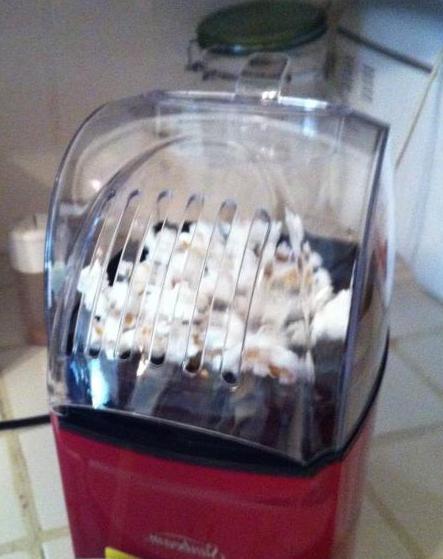
A hot air popper works by spinning raw popcorn kernels in a central chamber. As the kernels reach the outside vanes, hot air generated by an electrical element is introduced. Within a few minutes, the small amount of water trapped in every kernel converts to steam. When the fibrous hull can no longer resist the pressure, the entire kernel explodes and the starchy fibers inside combine with the air to form the finished product. Since the popcorn is now much lighter, the popper's circulating airstream blows it out of the chamber.

Once the kernel has popped, the finished popcorn travels through a plastic chute until it lands in a waiting bowl. A typical air popper may also contain a special compartment for melting butter or adding seasonings. Most models also include a means for measuring additional batches of popcorn. Since no oil is required, this device can generate several batches of popcorn in a row without stopping.
There are some who say an air popper produces a healthier batch of popcorn because it does not add oil to the process. Others suggest that the amount of oil used in other popcorn makers is negligible, and the additional moisture and seasonings make the finished product taste better. Proponents of the air popper method suggest using a gourmet popping corn with a higher moisture content to avoid dryness. A hot air popper generally produces fewer unpopped kernels compared to oil-based poppers, and the individual kernels are often fluffier.
Michael Pollick
A regular DelightedCooking contributor, Michael enjoys doing research in order to satisfy his wide-ranging curiosity about a variety of arcane topics. Before becoming a professional writer, Michael worked as an English tutor, poet, voice-over artist, and DJ.
Learn more...
Michael Pollick
A regular DelightedCooking contributor, Michael enjoys doing research in order to satisfy his wide-ranging curiosity about a variety of arcane topics. Before becoming a professional writer, Michael worked as an English tutor, poet, voice-over artist, and DJ.
Learn more...AS FEATURED ON:
AS FEATURED ON:


-
![Air poppers evenly distribute heat to help reduce wasted popcorn kernels.]() By: Przemyslaw SitekAir poppers evenly distribute heat to help reduce wasted popcorn kernels.
By: Przemyslaw SitekAir poppers evenly distribute heat to help reduce wasted popcorn kernels. -
![Air poppers use hot air, not fire or heated vegetable oil, to produce popcorn.]() By: Brandi JordanAir poppers use hot air, not fire or heated vegetable oil, to produce popcorn.
By: Brandi JordanAir poppers use hot air, not fire or heated vegetable oil, to produce popcorn.

Discussion Comments
How hot does an air popper get?
I am also at altitude (8000 feet) and the popcorn from my air popper does not come out as crunchy as it does at sea level. I thought maybe the kernels were stale and bought a new jar of it but it is the same. Is this because of the altitude or something else? (microwave popcorn comes out fine!)
I live at 9000 feet in elevation and my air popper does not work very well. Does altitude affect the popping?
If the unpopped kernels are flying out of the popper, the popcorn you are using is too light. There are heavy popcorn kernels sold specifically for air poppers. it should be written on the label.
my popcorn machine doesn't work on just regular kernels, so the other day I tried with microwave popcorn (i took the kernels out of the bag) and that is all my air popper works on. is this bad?
Some hot air popcorn poppers have a limited capacity for raw kernels, so you may want to try popping a smaller batch to see if the problem continues. You may also want to check for cracks or misalignments which are allowing too much air to pass through the kernels before they pop. As far as popping finger millet is concerned, you may want to experiment with a small batch. A hot air popper can be used to toast or pop other seeds besides popcorn, but it may take a long time for some grains or seeds to generate enough steam to pop. Another method for heating finger millet may produce better results.
Can the hot air popper be used to pop finger millet? The grains are very small but they have a hard bran skin.
I have a Doral Design hot air popper it throws out as half of the kernels as it is popping so only half of the popcorn pops. What suggestions do you have?
Post your comments