
At AllThingsNature, we're committed to delivering accurate, trustworthy information. Our expert-authored content is rigorously fact-checked and sourced from credible authorities. Discover how we uphold the highest standards in providing you with reliable knowledge.
What is Amber?
 Diane Goettel
Diane Goettel
Diane Goettel
Amber, which is in fact a fossil, is often held in the same class as semi-precious stones such as turquoise and jade because of its ornamental uses. Unlike these stones, amber is not mineralized. Rather, it is simply the fossil of resin. Most that exists today is between 30 and 90 million years old. Resin that is only semi-fossilized is referred to as copal or sub-fossil amber.
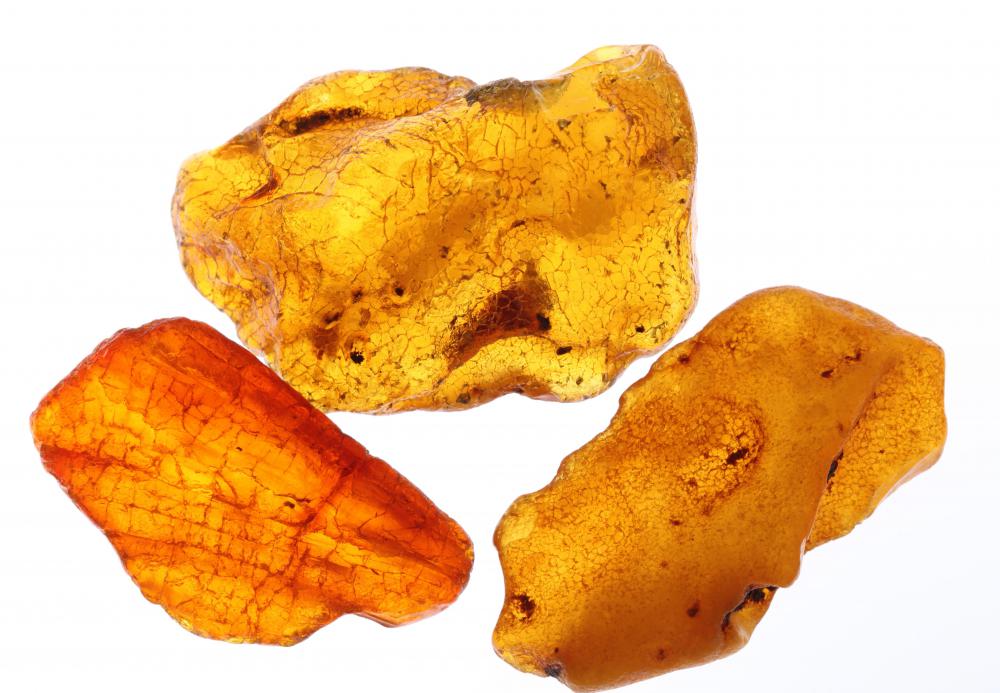
This fossilized resin ranges from pale yellow to deep orange in hue. Some actually has a lovely green cast to it. Furthermore, amber can have smoky, even opaque swirls within, and some enthusiasts prefer it with such milky inclusions. Because amber is made of tree resin, it often includes insects that were trapped within the pitch many millions of years ago. A piece with a visible and well-arranged insect is often prized over a piece with no such inclusions.

Amber can be found on the shores of the North Sea and the Baltic Sea. The main producer worldwide is Russia. In fact about 90% of the world’s available amber is located in the Kaliningrad region of Russia, which is located on the Baltic. Here, the resin is washed up on the coast after being dislodged from the ocean floor by years of water and ocean currents. It can also be found in the forests of Ukraine, and that found within the marshy forest floor in the area surrounding the Volhyn-Polesie border is prized for its wide range of tones and colors.

The resin has been valued as an ornamental material for centuries. It has been found in Mycenaean tombs and Neolithic remains. In England, artifacts from the Bronze Age have been discovered with amber inclusions. In fact, a beautiful Bronze Age cup made entirely of amber was found in Hove, a town on the south coast of England. The cup now resides in the Brighton Museum. Historians have found that it was also prized as a material for amulets by the Anglo-Saxons.

Amber is still widely used in jewelry and ornament today. Many jewelers who create stately designs enjoy working with the resin because such large pieces are available. Furthermore, it is significantly less expensive than gemstones. Because of the color range, a necklace made of amber beads can include a stunning arrangement of tones and hues.
Frequently Asked Questions
What exactly is amber?
Amber is a fossilized tree resin that has been appreciated for its color and natural beauty since Neolithic times. It is formed through a natural polymerization process, which can take millions of years. Amber is often found in shades of yellow, orange, and brown, and it's not uncommon to find ancient organic matter like insects trapped inside.
How old is amber typically?
Amber's age can vary widely, but most pieces are between 30 million and 90 million years old. The oldest known amber dates back to around 320 million years ago. These timeframes provide a fascinating window into prehistoric ecosystems, as amber often encapsulates flora and fauna, preserving them in remarkable detail.
Where is amber commonly found?
Amber deposits are found around the world, with significant sources including the Baltic region, the Dominican Republic, and Myanmar. The Baltic region is renowned for its amber, sometimes called Baltic gold, which accounts for approximately 80% of the known amber in the world.
What types of organisms are typically found in amber?
Amber is famous for containing well-preserved specimens of prehistoric life, including insects, spiders, and even small vertebrates like lizards. Plant material such as leaves, flowers, and seeds can also be found. These inclusions provide invaluable scientific insights into past ecosystems and the evolution of life on Earth.
Is amber used in jewelry?
Yes, amber has been used in jewelry and decorative objects for thousands of years. Its warm luster and the potential for intriguing inclusions make it a favorite among jewelers and collectors. Amber's relative softness allows for intricate carving, and it can be polished to a fine sheen, enhancing its natural allure.
Can amber be synthetically produced?
While natural amber is formed over millions of years, synthetic amber can be produced by polymerizing resins in a laboratory. However, synthetic amber lacks the historical and geological significance of natural amber, and it typically does not contain the ancient inclusions that contribute to the natural variety's unique character and scientific value.
Diane Goettel
In addition to her work as a freelance writer for AllThingsNature, Diane is the executive editor of Black Lawrence Press, an independent publishing company based in upstate New York. She has also edited several anthologies, the e-newsletter Sapling, and The Adirondack Review. Diane has a B.A. from Sarah Lawrence College and an M.A. from Brooklyn College.
Learn more...
Diane Goettel
In addition to her work as a freelance writer for AllThingsNature, Diane is the executive editor of Black Lawrence Press, an independent publishing company based in upstate New York. She has also edited several anthologies, the e-newsletter Sapling, and The Adirondack Review. Diane has a B.A. from Sarah Lawrence College and an M.A. from Brooklyn College.
Learn more...AS FEATURED ON:
AS FEATURED ON:









-
![Amber.]() By: tadomaAmber.
By: tadomaAmber. -
![Amber can be found in the forests of the Ukraine.]() By: Alex YeungAmber can be found in the forests of the Ukraine.
By: Alex YeungAmber can be found in the forests of the Ukraine. -
![A Bronze Age cup made entirely of amber was found in Hove, a town on the south coast of England.]() By: Negura DincoloA Bronze Age cup made entirely of amber was found in Hove, a town on the south coast of England.
By: Negura DincoloA Bronze Age cup made entirely of amber was found in Hove, a town on the south coast of England.

Discussion Comments
People DO refer to semi-fossilized amber as "copal." But they are wrong to do so. Copal is a derivative of a Nahuatl word used by the peoples of pre-Columbian Mesoamerica that simply means "incense." It was, and still is, correctly applied only to the resin from trees in the genus Bursera, all of which are native to South and Central America, and to the North American southwest.
However, the name "copal" is often incorrectly applied as a generic term to any tree resin that is not either frankincense or myrrh. In the case of Amber, there are five different kinds, depending upon their chemical composition. I don't believe we know the botanical name of the plants it came from, as they are long extinct.
@willie - If you have found a piece of amber and want to know its value you should do an online search for amber appraisers. Often jewelry stores that sell amber pieces have an amber appraiser on staff and for a small fee they will let you know the value of what they have.
Amber comes in a lot of colors, and if yours is blue, green or deep red it will be more valuable, as these are rare colors.
Also, if has any fossils in it, like a trapped spider or insect, the price can go up quite a bit.
A lot of people who buy amber are actually looking for a unique fossil, more than the color of the piece. If you have a pristine insect the price can increase tenfold from a piece with nothing in it.
If you enjoy beautiful jewelry that isn't horribly expensive, collecting some amber pieces can be a great way to get the look of fine jewelry without the cost.
Often amber is set in silver settings and if you visit local craft shows and markets that showcase artisans, the chance of you finding an amber jewelry seller is pretty high.
I purchased my first piece many years ago at an outdoor market. It is a gorgeous pear shaped pendant with a piece of amber in it about two inches high and an inch wide. I love the rich honey color of it and the beautiful silver work. I paid less than $100 USD for it and I still love it.
@dfoster85 - No, they don't chew on them, and yes, amber or other jewelry can be dangerous for a baby.
The idea is that amber contains a natural analgesic. When warmed by the skin, this analgesic (so the theory goes) is released into the bloodstream and makes baby feel better. I'm more a baby Tylenol kind of gal, myself. Now that's an analgesic that really makes a teething baby feel better!
There are two dangerous with a necklace--it's a choking and a strangulation hazard. Any beads with which a child plays should be individually knotted to prevent all the beads from coming off at once, but I still would never leave my child along with beads of any kind. Especially a loop, because then there's the chance they could strangle. (Ever notice how baby hoodies have no strings? There's a reason for that.)
I heard some people at my La Leche League meeting talking about amber teething necklaces. What are these? Does the baby chew on them?! Isn't it dangerous for a baby to wear jewelry?
I saw one baby at the meeting wearing one and the stones looked kind of sharp, so I guess they don't chew them--but otherwise I don't get the point. How is it supposed to help?
you would not.
if i found a 12lb piece of amber how would i find its value?
Post your comments