
At TheHealthBoard, we're committed to delivering accurate, trustworthy information. Our expert-authored content is rigorously fact-checked and sourced from credible authorities. Discover how we uphold the highest standards in providing you with reliable knowledge.
What is Aldosterone?
Aldosterone is a mineralocorticoid hormone that is essential to life because it regulates the amounts of electrolytes in the body. It's secreted by the adrenal cortex, part of the adrenal gland, and is responsible for the reabsorption of sodium into the bloodstream. This hormone also stimulates the excretion of potassium.
Sodium and potassium levels are regulated simultaneously by aldosterone, helping to maintain both blood pressure and bodily fluids. If levels of this hormone fall out of sync, it can cause problems in the body. High levels can cause high blood pressure, muscle cramps and weakness, while low levels may indicate a disease, such as diabetes. Often, aldosterone levels vary between the sexes and may be affected by the amount of sodium in a person’s diet. Women often have significantly higher levels when pregnant.

The hormone renin, which is produced by the kidney, helps to regulate the release of aldosterone, and levels of both hormones are often compared for diagnostic purposes. An aldosterone test may be performed to determine the cause of high or low blood potassium or of certain conditions, such as heart failure or kidney disease.
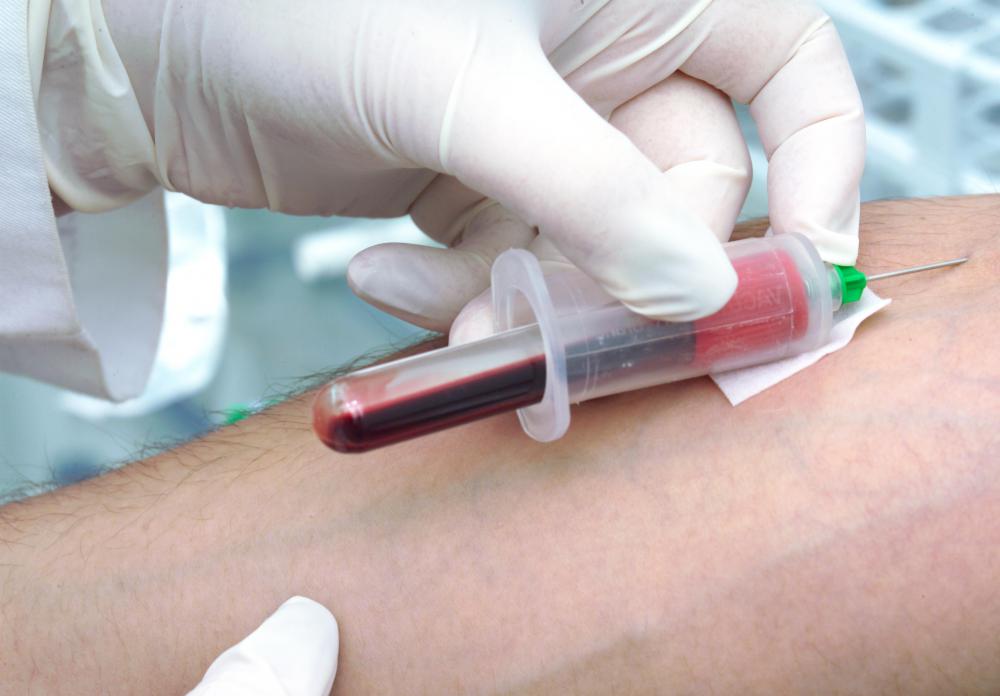
Most often, aldosterone levels are determined through a blood test. A urine test may be ordered as an alternative, though it is uncommon. People who are being tested for their hormone levels may be asked to stop taking certain medications that could affect the results, including certain hormone supplements and some medications that control high blood pressure. A patient may also be required to eat a specific diet for the two-week period before the test.

Normal laboratory values may vary slightly, and the accuracy of test results may depend on proper preparation as advised by a medical professional. He or she will discuss the results of the test with the patient and explain what the values mean during a follow-up appointment.
AS FEATURED ON:
AS FEATURED ON:


-
![An illustration of the human kidney where the adrenal gland is visible (top of kidney).]() By: freshideaAn illustration of the human kidney where the adrenal gland is visible (top of kidney).
By: freshideaAn illustration of the human kidney where the adrenal gland is visible (top of kidney). -
![Aldosterone levels are usually determined through a blood test.]() By: Tim URAldosterone levels are usually determined through a blood test.
By: Tim URAldosterone levels are usually determined through a blood test. -
![Aldosterone can trigger high blood pressure and other cardiovascular problems.]() By: dambusterAldosterone can trigger high blood pressure and other cardiovascular problems.
By: dambusterAldosterone can trigger high blood pressure and other cardiovascular problems. -
![High levels of aldosterone may cause muscle cramps.]() By: Jane DoeHigh levels of aldosterone may cause muscle cramps.
By: Jane DoeHigh levels of aldosterone may cause muscle cramps.



Discussion Comments
@Post No. 3: Find yourself a good Endocrinologist as soon as possible. Don't wait too late.
See the chapters on aldosterone in The Hormone Handbook by Thierry Hertoghe, MD published by International Medical Publications. Unfortunately, he is in Belgium, but his relatives have been studying cortisol, and aldostereone for years. He mentions how pesticides and chemicals are toxic to the adrenals.
Meridian Valley Labs in Renton, Washington does a 24 hour urine test for 17 different adrenal hormones, metabolites and ratios. He exlains why he doesn't use one time blood tests, because aldosterone is secreted in pulses throughout the day. I'd say urine and blood together would be good.
Dr. Jonathan V. Wright, a leader and one of the originators of ACAM (American College of Advancement in Medicine) if you go to their web site you MIGHT find a dr who could help. Frankly, even endocinologists don't test for increases, or deficiencies in aldostereone, or cortisol. So, finding a doctor is a challenge. Find a doc who believes you and wants to help.
Meridian Valley's lab will walk your doc through the results. Also, Dr. Wright has many articles on his web site, called the Tahoma clinic (in Renton, also in Seattle). There is also a radio show called "Green Medicine" you can listen to old programs on the topic of adrenal or aldosterone. God bless.
Please review scientific papers by Dr. Richard Lifton at Yale University. His laboratory has written many papers on high and low pressure caused by high and low levels of aldosterone. His laboratory has tested many subjects for mutations causing these conditions and have found mutations implicated in the diseases.
Take a look at his papers. They have helped me when I brought them to the attention of my primary care physician. Best to all.
I went to the ER six years ago because of a kidney stone. After the CT scan, they told me that they had found an 8cm cyst above my right kidney. After several tests, they determined that the cyst was benign. They told me that since the cyst wasn't causing any damage, surgery was unnecessary and they chose to monitor it every three months by MRI.
I stopped having the cyst monitored when I moved to a different state two years ago and no longer had insurance. Last year, I started going into hypertension. I am 32, and my GYN was concerned of hypertension at my age. Three months ago, she finally decided that I must discontinue my oral contraceptives. A month after this happened, I started having stomach problems.
I finally passed out and had to be rushed to the ER again. My cyst had grown to 11cm and had caused the lower lobe of my right lung to collapse! They drained the cyst three different times (over a few days each time) and it kept growing right back. Finally, two weeks ago, they decided to operate and take the cyst out. During the procedure, the surgeon discovered the cyst was growing from my adrenal gland (they thought it was coming from my kidney), so they had to remove part of my right adrenal gland with the cyst. The surgeon said he had only seen four cases of this before and that it's very rare. I am so glad to finally know why my blood pressure has been so high though!
More than that, I am glad to finally know there is a name to what I have and that it is not considerably life threatening.
@ anon137030: My doctors couldn't help either. Finally, I believe the Lord directed me to someone who does natural health care with a biofeedback-type machine, a Physics model, but some others are good.
I was also having major weakness, foggy thinking, low BP and pulse; feeling very sick. Turned out my whole endocrine system was out of whack after a biopsy with anesthetic, starting with the hypothalamus, the grandaddy of our glands. Also, my adrenals were weak from some cortisone topicals I used long-term for skin although I'd stopped them years before this.
It helped me to find a very good adrenal supplement (on my own). The best I've found is by Enzymatic Therapies called "Adrenal Stress End." The homeopathic health care provider in Dallas first picked up radiation, then hypothalamus, etc. He gives me homeopathic drops and that's been a lifesaver, but it's not enough without the supplements.
Also, a really great adrenal supplement is Black Currant (also found on my own) that can be ordered online at Rite Care Pharmacy in Encino, Ca. It's one of the very best for adrenal strengthening. I also use sea salt, even a tiny bit in my bottled water. I try to reduce stress and get plenty of sleep, take lots of Vitamin C and B complex. Licorice capsules are also very good for adrenals and will help with BP.
If you're female, a lack of reproductive hormones will also pull on the adrenals. Hope this helps. Keep praying. God bless.
Is spironlactone ever prescribed for hair loss?
I have taken 10mg Prednisone for 19 years. I have paper skin, osteoporosis, hardening of my arteries, etc. Is this because my Adrenal Cortex is atrophied and the prednisone I take does not cover ALL (123?) the chemicals normally produced? (besides just cortisol). I feel like I'm missing some of what the Adrenal Cortex produces. Am I crazy?
i keep getting low blood pressure. this has been going on for three months now. It gets as low as 87/47 at night. That is the extreme lowest its gotten. I feel terribly weak, can't think straight, and dizzy.
i am eating and drinking enough. Before anyone asks, I have been to my family doctor more then once, and he doesn't know why its happening, and I've been to the ER
and everyone plays it off.
i am frustrated, to say the least, that they aren't looking into it more. I've been putting salt on everything because i was told it could help, but i think i may be overdoing it. How long does it take for salt to take affect? Any suggestions on how i can get someone to take it more seriously?
I am heavy and one would think with my weight it would be high, not low. Before this all, it always was normal or high normal. If it helps any, the hormone aldosterone was checked, that is one that regulates blood pressure. It came back as only 1.
My doctor said it was low but doesn't know how to treat it.
They are just now testing my husband's aldosterone levels after he had a heart attack seven months ago from his potassium level being at 2.5. Since then they have had him on potassium pills 24, 10megs each plus two powder packs of 20megs each day. that's 240megs in pills and 40megs in powder and his levels are still not going above 3.0 and he's just sick all the time from having to take so many pills.
He also has hbp and is in constant pain. I am really hoping that with this test we may finally get some answers.
The same exact thing happened to me as in #21. I had uncontrolled hypertension for years and to no avail. After going to an endocrinologist, it's like a dream come true.
What is the target tissue by the aldosterone? What is the most direct affect of aldosterone?
I had uncontrolled HBP for many years (20yrs) and have been to several doctors. lots of medications and to no avail. I recently went to an endocrinologist who found out it was high aldosterone low potassium - I now feel great.
Have had high BP for more then ten years and now have recently found out that my potassium is low (2) which put me in the hospital for 10 days. Bottom line: I have Conn's Syndrome. They found it after blood work was done and a CT scan and MRI. I have a nice size tumor on the left adrenal gland. I am scheduled to have the gland and tumor taken out in a couple of months.
Hope this is the right thing to do. I'm feeling like crap in the meantime. -- Donna
My doctor said that my high aldosterone levels can be the cause of my hair loss. Has anyone else experienced this?
one year ago the doctor took out my left adrenal gland and now I am suffering from adrenal insufficiency.
My aldersterone level is high and this is the cause of my high blood pressure. My potassium level is low 3.1
My husband has a similar problem and a few years ago was diagnosed with Conn Syndrome. It's quite rare. Get your GP to read up on it. It's controlled by medication.
In my husband's case it was caused by a tumour on the adrenal gland, which prevented it producing potassium.
Good luck to your baby nephew.
my nephew, he is only 20 days old and his body cannot excrete potassium and keeps it in his blood, and excretes lots of sodium from his urine, doctors still couldn't find what the reason might be, that is strange, they think it might be because of aldosterone that his body doesn't produce that hormone at all, if you guys have any info about it please let's share it,
i have been diagnosed with gra since i was 15. now i am 44. i have been given steroids like prednisone for it but too many side effects. now i am taking amiloride with hcl and works great. my blood pressure is within normal range.
My 15 son was diagnosed with high aldosterone and low potassium with low renin. He has what is known as GRA = Glucocorticoid Remedial Aldosteronism. It is genetic. It is very rare. If you have high blood pressure that is uncontrollable with medication you may want to see an endocrinologist and have your blood tested for low potassium, low renin and/or high aldosterone levels.
Licorice root extract has amazing results for hypo-aldosteronism. Google it.
VW, BC Canada
Aldosterone is a hormone your body makes in your adrenal glands. It is a "vital" hormone, meaning you *must* make aldosterone to live. Some people have diseases that cause them to make too much aldosterone, which leads to high blood pressure and low patassium. Aldosterone primarily acts on the distal tubules in the kidneys where it causes the kidney to retain sodium and excrete potassium into the urine.
Aldosterone has to do with your adrenal glands. That is the organ it involves. Also your kidneys
just heard on tv that aldosterone helps to restore your hearing. has anyone else heard that?
lots of cool comments. I was doing a bio assignment and I found this to be much more informative. google aldosterone and go to the wiki article lots more info there.
Is there a natural alternative to take regulate sodium in the blood?
Why would a doctor prescribe cozarre and spironolactone to be taken together?
If you have low potassium, then you probably have high aldosterone. I have large amounts and had to take 60 mgs of potassium per day until I began using Aldactone to block some of the Aldosterone. After MRI, I was diagnosed with Primary Hyperaldosteronism.
I read an article on Dr Mercola's website relating to hearing loss in the elderly (age related)and the experimental use of aldosterone to restore full hearing.
Regards, John
I am trying to find out what organ is involved when you produce too little aldosterone. I take 4 potassium 10meg daily and my potassium is still just 3.8...My doctor has never mentioned the hormone aldosterone...He just says he doesn't know why my body doesn't produce enough potassium. He does blood work quarterly on me but still never mentions aldosterone...I am confused as to why he doesn't know any more about it than he does.
What is the treatment for people who cannot secrete aldosterone? also what are the advantages and disadvantages of this treatment?
what are the target organs of aldosterone?
Post your comments