
At AllTheScience, we're committed to delivering accurate, trustworthy information. Our expert-authored content is rigorously fact-checked and sourced from credible authorities. Discover how we uphold the highest standards in providing you with reliable knowledge.
What is Aerobic Respiration?
Cellular respiration is the process by which living organisms obtain energy from food. There are two main methods. Aerobic respiration — employed by all multicellular and some unicellular life forms — uses oxygen in the atmosphere, or dissolved in water, as part of a complex process that releases and stores energy. Anaerobic respiration is used by a variety of single-celled organisms and does not involve uncombined oxygen.
The Emergence of Aerobic Respiration

The first life forms on Earth came into existence in a world devoid of free oxygen. They used anaerobic processes to provide themselves with energy. At some point, still early in Earth’s history, organisms evolved that employed photosynthesis to produce sugar molecules using carbon dioxide, obtained from the atmosphere, and water. The sugar served as a source of energy and the process produced oxygen as a by-product. Oxygen was toxic to many anaerobic organisms, but some evolved to use it in a new kind of respiration that actually provided much more energy than the anaerobic process.

The earliest life forms consisted of cells that had no nuclei or other well-defined structures. These are known as prokaryotes and comprise organisms such as bacteria and cyanobacteria, also known as blue-green algae. Later, cells with nuclei and other structures emerged; these are known as eukaryotes. They include some unicellular and all multicellular organisms, such as plants and animals. All eukaryotes and some prokaryotes use aerobic respiration.
How Aerobic Respiration Works
Cells store energy in a molecule called adenosine triphosphate (ATP). This compound contains three phosphate (PO4) groups, but can release energy by losing one of these to form adenosine diphosphate (ADP). Conversely, ADP can gain a phosphate group to become ATP, thus storing energy.
Another important molecule is nicotinamide adenine dinucleotide. It can exist in two forms: NAD+, which can accept two electrons and one hydrogen (H+) ion to form NADH, which can give electrons to other molecules. The compound is used in respiration to transport electrons from one place to another.

The starting point for respiration is glucose (C6H12O6), one of the simplest carbohydrates. More complex sugar molecules in food are first broken down into this compound. Glucose is in turn broken down by a process called glycolysis, which takes place in the cytoplasm, or cellular fluid, and is common to both anaerobic and aerobic respiration.
Glycolysis

The glycolysis process uses two ATP molecules to convert glucose, which has six carbon atoms, into two three-carbon molecules of a compound called pyruvate in a series of steps. By the end of this process, four ATP molecules are produced, so that there is an overall gain of two ATPs, which represents a gain in stored energy. Glycolysis also results in two NAD+ molecules each taking two electrons and one hydrogen ion from the glucose to form NADH. Overall, therefore, glycolysis results in two molecules of pyruvate, two of ATP and two of NADH.
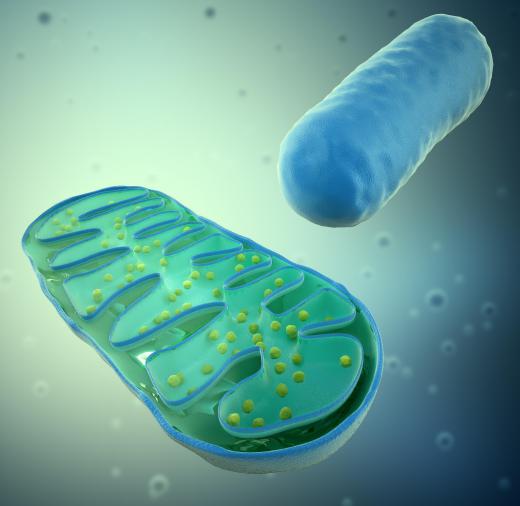
In eukaryotic cells, the remaining stages of aerobic respiration take place in structures known as mitochondria. These tiny organs are thought to have once been independent organisms that were incorporated into the cells at some time in the distant past. Each pyruvate molecule is converted, with the aid of NAD+, to a compound called acetyl coA, losing a carbon and two oxygen atoms to form carbon dioxide as a waste product and forming another molecule of NADH.
The Krebs Cycle
The next stage is called the Krebs cycle, also known as the tricarboxylic acid (TCA) or citric acid cycle. Acetyl coA from pyruvate combines with a compound called oxaolacetate to produce citrate, or citric acid, which, in a series of steps involving NAD+, produces ATP as well as NADH and another molecule called FADH2, which has a similar function. This results in the citric acid being converted back to oxaloacetate to begin the cycle again. Each completed cycle produces two molecules of ATP, eight of NADH and two of FADH2 from two molecules of pyruvate.
Electron Transport Phosphorylation
The final stage is known as electron transport phosphorylation, or oxidative phosphorylation. At this point in the process, the electrons carried by NADH and FADH2 are used to provide the energy to attach phosphate groups to ADP molecules to produce up to 32 molecules of ATP. This takes place at the mitochondrion membrane via a series of five proteins, across which the electrons are transported. Oxygen, which readily accepts electrons, is required to remove them at the end of the process. The oxygen then combines with hydrogen ions released from NADH to form water.
Efficiency
Overall, the aerobic respiration process can, in theory, produce up to 36 energy-storing molecules of ATP for each molecule of glucose, as compared with just two for anaerobic respiration, making it a much more energy-efficient process. In practice, however, it is thought that around 31 or 32 ATP molecules are typically produced, as other reactions can take place in the final stages. Although this process is a highly efficient way of producing and storing energy, it also produces small amounts of very reactive forms of oxygen, known as peroxides and superoxides. These are potentially damaging to cells and it is thought by some scientists that they may be involved in aging and in some diseases.
AS FEATURED ON:
AS FEATURED ON:









-
![Aerobic respiration is the cellular process through which humans obtain energy from food.]() By: RidoAerobic respiration is the cellular process through which humans obtain energy from food.
By: RidoAerobic respiration is the cellular process through which humans obtain energy from food. -
![Glucose, or simple sugar, molecules are converted into pyruvate, which provides energy to cells, during glycolysis.]() By: michaeljayberlinGlucose, or simple sugar, molecules are converted into pyruvate, which provides energy to cells, during glycolysis.
By: michaeljayberlinGlucose, or simple sugar, molecules are converted into pyruvate, which provides energy to cells, during glycolysis. -
![The breakdown of glucose into cellular energy takes place mostly inside mitochondria.]() By: MopicThe breakdown of glucose into cellular energy takes place mostly inside mitochondria.
By: MopicThe breakdown of glucose into cellular energy takes place mostly inside mitochondria. -
![Weightlifting can increase anaerobic power.]() By: ArenaCreativeWeightlifting can increase anaerobic power.
By: ArenaCreativeWeightlifting can increase anaerobic power. -
![Cells store energy in a molecule called adenosine triphosphate (ATP).]() By: molekuul.beCells store energy in a molecule called adenosine triphosphate (ATP).
By: molekuul.beCells store energy in a molecule called adenosine triphosphate (ATP).


Discussion Comments
@FrameMaker: Plants don't use aerobic respiration.
@Framemaker: Plants do not emit carbon dioxide. They emit oxygen that our body absorbs and uses to breathe and release energy and carbon dioxide. The carbon dioxide is then absorbed by plants that turn around and create energy as well and emit oxygen. The process then continues. Without our carbon dioxide, plants do not survive. Without the oxygen from plants, we do not survive.
@ FrameMaker- You ask a good question about aerobic respiration in plants. The answer is that both aerobic respiration and photosynthesis happens in a plant. A plant’s roots draw in oxygen and water, and I think (do not quote me on this) the leaves draw in oxygen at night. All cells in a plant undergo aerobic respiration, but only chlorophyll cells undergo photosynthesis. Photosynthesis provides the sugar needed by cells for aerobic respiration as well as the by-products oxygen and ATP. At the same time, each cell will undergo respiration producing carbon dioxide, water, and ATP. I hope this helps.
If I am following this correctly, aerobic respiration results in the by-products of carbon dioxide and water. Why then, does a plant need carbon dioxide, and water to perform photosynthesis? This is what I do not get. Plants are the biggest producers of oxygen and the biggest carbon scrubbers on the planet. How does this work if they emit carbon dioxide and water? Can anyone help me understand how aerobic respiration in pants works?
Aerobic respiration is when food substances break down in the presence of oxygen to release large amounts of energy. Carbon dioxide and water are also released. Animals and plants mostly use this form of respiration.
Post your comments