
At BeautyAnswered, we're committed to delivering accurate, trustworthy information. Our expert-authored content is rigorously fact-checked and sourced from credible authorities. Discover how we uphold the highest standards in providing you with reliable knowledge.
What Is Acne Vulgaris?
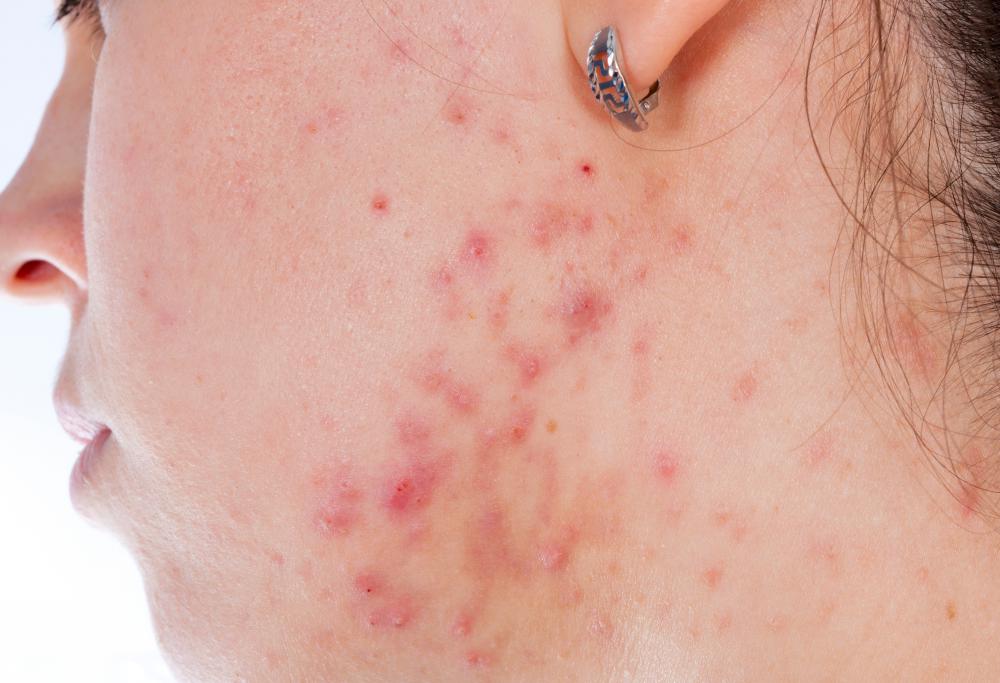
Acne vulgaris often appears as red bumps, frequently on the facial area. It is commonly known as acne, pimples, zits, whiteheads, or blackheads. Whiteheads and blackheads are also known as comedones, which occur when oil and dead skin cells clog the opening of a hair follicle. Blackheads have a wide opening with a black hue. Whiteheads have a nearly closed opening with no hue.
A dermatologist can diagnose the severity of a patient’s acne. Mild acne vulgaris is classified as less than 20 comedones, or less than 30 total instances of lesions. Moderate acne is anywhere from 20 to 100 comedones, or a total of 30 to 125 lesions. If a person has severe acne, they have more than 100 comedones, or more than 125 total lesions.

Acne is fairly easy to diagnose. One may notice small, raised lumps on the skin that may be tender, red, or have pus at the tip. A person may have larger solid and painful bumps, as well. Lumps filled with pus that are beneath the surface of the skin are called cysts. These may lead to infection and scarring.
Human skin has many tiny hair follicles, or a structure of the skin that grows hair. These follicles can become clogged with the natural oil of the skin, called sebum. Clogging can occur due to an overproduction of sebum. The follicles can also be clogged with dead skin cells. When the hair follicle becomes clogged, acne vulgaris can form.

There are a few risk factors that may increase the likelihood of a person developing acne. Teenagers are more susceptible to it, due to hormonal changes that can increase the production of sebum. Women, particularly pregnant women, are also more susceptible to acne. A person using cosmetics, or any other oily or greasy substance, is also more likely to have acne breakouts.

For most mild cases of acne vulgaris, some basic skin care can help prevent breakouts. The skin can be gently washed with a mild cleanser rather than a harsh astringent or facial scrub. Some over-the-counter acne products can help treat oily skin. Products most likely to help will include salicylic acid or benzoyl peroxide.
If over-the-counter products are not enough to control breakouts of acne, a dermatologist can write a prescription for stronger medications. Some options include tretinoin, adapalene, and tazarotene. These are applied topically to the skin. Oral medications, such as antibiotics or isotretinoin, may also help.

Some patients may find that laser therapy helps heal acne vulgaris. Laser therapy may help decrease the production of sebum, as well as reduce inflammation. A dermatologist may also recommend microdermabrasion or a chemical peel to control acne. These techniques help to resurface the skin.
AS FEATURED ON:
AS FEATURED ON:


-
![A boy with acne.]() By: Jörg HackemannA boy with acne.
By: Jörg HackemannA boy with acne. -
![Acne vulgarism frequently appears as red bumps on the face.]() By: S.A.N.Acne vulgarism frequently appears as red bumps on the face.
By: S.A.N.Acne vulgarism frequently appears as red bumps on the face. -
![Acne vulgaris commonly affects teenagers.]() By: Cheryl CaseyAcne vulgaris commonly affects teenagers.
By: Cheryl CaseyAcne vulgaris commonly affects teenagers. -
![A person with moderate acne vulgaris has 20-100 comedones.]() By: badmanproductionA person with moderate acne vulgaris has 20-100 comedones.
By: badmanproductionA person with moderate acne vulgaris has 20-100 comedones. -
![Human skin has many hair follicles which can become clogged.]() By: Deyan GeorgievHuman skin has many hair follicles which can become clogged.
By: Deyan GeorgievHuman skin has many hair follicles which can become clogged.



Discussion Comments
@Pippinwhite -- My husband had a similar experience. He said he used to blaze through bottles of Clearasil, trying to help his acne. Antibiotics helped him too, as did steroid cream.
Nowadays, he uses my exfoliate cream, believe it or not. He uses it about once a week and says it works wonders for his skin, that the dead cells can't get a good handle on his skin because he scrubs them away. He even used to use those strips that get the gunk out of your pores. His skin is clearer now than it's ever been.
I was blessed. I had some acne, like most teenagers, but never had a lot. I attribute it in part to the fact that I didn't wear heavy makeup and stayed out of the sun.
I had a friend who had severe acne, and his life was a trial. He said it seemed like he spent half his life at the dermatologist's office. He finally got some treatment when he was taking antibiotics for an infection, and his skin just cleared up! It was like he got a new face or something. So, his dermatologist prescribed him a low dosage of antibiotics to take and it made a huge difference. Seems like he took the meds for about three months, and that was the last of his acne troubles.
Post your comments