
At WiseGEEK, we're committed to delivering accurate, trustworthy information. Our expert-authored content is rigorously fact-checked and sourced from credible authorities. Discover how we uphold the highest standards in providing you with reliable knowledge.
What is Acid Stained Concrete?
Acid stained concrete gives color and texture to the adaptable aggregate material. Benches, floors, walls, walkways, and countertops can all be colored using chemical stains to create warm earthtones with an organic appearance. Acid penetrates the surface of the concrete, triggering reactions that create colors.
Modern design has embraced concrete as a durable, minimalist, and flexible material. Manufacturers and designers now routinely incorporate cement into homes in bathroom and kitchen counters, floors, patios, decks, and short, exterior walls. Bored with the plain grey color, they came up with a multi-step process to stain new or established concrete a wide range of rich colors using acid and salts.
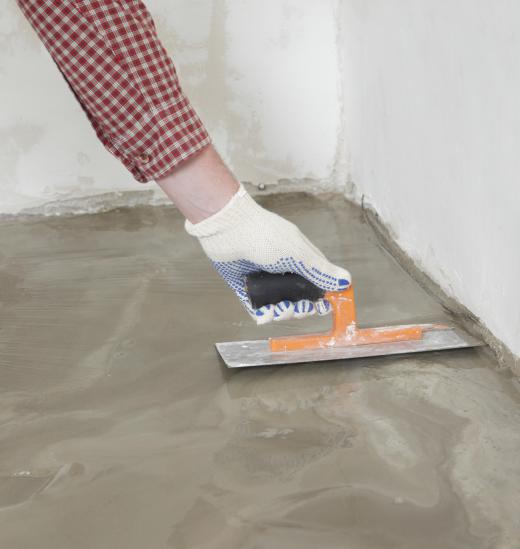
Chemically speaking, the process of creating acid stained concrete is easy to explain but difficult to tightly control. A trained expert first applies a water-soluble acid solution to the surface of the concrete. It will penetrate down to 1/4 inch (6 mm). In this depth, a mineral called lime, or calcium hydroxide, lays dormant as part of the materials that always make up concrete. When the stainer introduces a mixture of special metallic salts, they flow through the porous surface and change the lime through a chemical reaction.

The stages of staining depend on many uncontrollable circumstances, such as the aggregate material in the cement, types of acid and salts, amount of water, temperature and humidity, age of old cement, and the method of sealing and buffing. This organic evolution and unpredictable outcome is part of the appeal of acid stained concrete to many installers and consumers.
Over the next few hours, as the mixture cures, the color will emerge. Eventually that shade will settle as a permanent addition to the chemistry of the concrete. However, the color may evolve and age for up to a month. For those concerned about controlling or anticipating the final color, you could try applying the acid solution to a hidden part of concrete, such as underneath a cabinet for a floor or where a cushion may go for a bench. The resultant colors are usually in the family of brown, green, and tan.
Versatile textures, such as veining and mottling, will become apparent when you seal the concrete with wax. Just like old-fashioned waxes on hardwood floors, the wax will be machine-buffed until it shines. The surface might look subtly translucent, or resemble terra cotta, granite, limestone, or marble. Experts in acid stained concrete have experimented to create certain textural effects by interfering with the acid by wiping, blotting, splotching, or saturating.
AS FEATURED ON:
AS FEATURED ON:









-
![Modern design has embraced concrete as a versatile foundation for creativity.]() By: Lilyana VynogradovaModern design has embraced concrete as a versatile foundation for creativity.
By: Lilyana VynogradovaModern design has embraced concrete as a versatile foundation for creativity. -
![Concrete must be fully cured before it can be acid stained.]() By: podsolnykhConcrete must be fully cured before it can be acid stained.
By: podsolnykhConcrete must be fully cured before it can be acid stained.


Discussion Comments
was this interior/exterior? was the slab cured at least 28 days? how did your contractor prep the slab before staining, and was the stain neutralized to get rid of the calcium oxide before applying the sealer(if it was not neutralized the calcium oxide will create a weakened barrier between sealer and slab and possibly be causing the dullness, either way if you find out it was not neutralized properly rip all of the sealer off). what type of sealer did the contrator apply, matte finish of "wet look"? even some "wet look" sealers may appear dull if the contractor cut the sealer with acetone(the reason for cutting is to create a breathable sealer and the reason the contractor may have wanted a breathable sealer is to go ahead and seal the slab before it is cured or simply to allow the slab to properly breath). buffing and waxing may help. but if you apply a good quality sealer in the right way you will have that glossy wet look. xylene strips off sealer. euclid chemical company has a wet look sealer that is acrylic and breathable(meaning it allows moisture to escape the slab, other sealers can hold the moisture in creating a "hazed look")
We just had our concrete acid stained. The contractors put sealer on the floor; however, the floor still looks dull--not shiny. We weren't told we were to buff, but is that what we need to do to get the shiny look?
Post your comments