
At HomeQuestionsAnswered, we're committed to delivering accurate, trustworthy information. Our expert-authored content is rigorously fact-checked and sourced from credible authorities. Discover how we uphold the highest standards in providing you with reliable knowledge.
What is a Water Closet?
 Mary McMahon
Mary McMahon
Mary McMahon
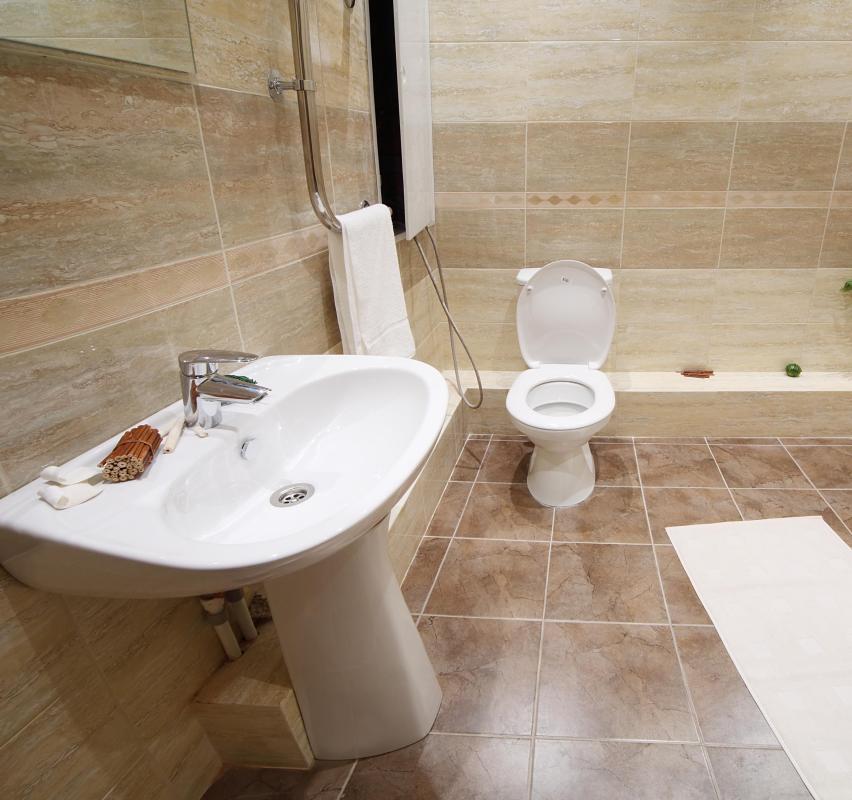
A water closet is a room that contains a flush toilet, usually accompanied by a washbowl or sink, and the term may also be used to refer specifically to a flush toilet. Speakers of British English may refer to such a room as a “W.C.,” referencing the initials for this term. The development of the flush toilet revolutionized human sanitation and contributed a number of interesting developments to plumbing and architecture as structures began to be built to accommodate such toilets.
Although people may think of the flush toilet as a relatively modern invention, versions of it actually date back thousands of years. The design allows people to eliminate waste and then flush it away through a series of pipes which lead, ideally, to a water treatment facility, although water closets may also empty directly into waterways. This is in contrast with outhouses, which store waste on site; incinerating toilets, which burn the waste; and other methods of waste disposal.

The 1880s marked the widespread introduction of the flush toilet, and the development of a variety of terms to refer to the device. Many people do not like to discuss human waste and ways of dealing with it in company, making polite euphemisms very common. “Water closet” is also a term that clearly separates a room with a flush toilet from a room with a tub or shower that has been designed for bathing and may be known as a “bathroom.”

Historically, toilets and tubs were often kept separate, with bathing and excretion being separated for hygienic and aesthetic reasons. Toilets, flush or otherwise, were often kept in small rooms known as closets to provide people with privacy. With the development of compact flush toilets, some architects began combining all of the devices that required plumbing in a single room, allowing people to bathe, wash their hands, and eliminate waste in a single room.

The water closet helped improve hygiene in many regions by moving human waste away from inhabited buildings and areas. When combined with sewage management systems, they also cut down on communicable disease by keeping human waste out of waterways. Flush toilets also allowed architects to install toilets inside homes without having to worry about odor issues, thereby keeping people more comfortable, since they no longer had to venture to a separate outhouse to use the bathroom or use chamber pots to relieve themselves indoors in inclement weather. Several variations have been devised, including squat toilets seen in some parts of Asia.
Mary McMahon
Ever since she began contributing to the site several years ago, Mary has embraced the exciting challenge of being a HomeQuestionsAnswered researcher and writer. Mary has a liberal arts degree from Goddard College and spends her free time reading, cooking, and exploring the great outdoors.
Learn more...
Mary McMahon
Ever since she began contributing to the site several years ago, Mary has embraced the exciting challenge of being a HomeQuestionsAnswered researcher and writer. Mary has a liberal arts degree from Goddard College and spends her free time reading, cooking, and exploring the great outdoors.
Learn more...AS FEATURED ON:
AS FEATURED ON:


-
![Water closet with toilet only.]() By: Tomas SeredaWater closet with toilet only.
By: Tomas SeredaWater closet with toilet only. -
![Water closet with sink.]() By: Pavel LosevskyWater closet with sink.
By: Pavel LosevskyWater closet with sink. -
![A water closet usually has a sink for hand washing in it.]() By: xyA water closet usually has a sink for hand washing in it.
By: xyA water closet usually has a sink for hand washing in it. -
![Water closets eliminated the need for chamber pots.]()
Water closets eliminated the need for chamber pots.



Discussion Comments
Incinerating toilet: you put a paper liner in, do your biz in it, pull the handle which opens a trapdoor and the liner falls into an incineration chamber.
“Water closet” just sounds like a polite way of saying “toilet room.” It boggles my mind that some people have issues with even saying the word “toilet.” It's a fact of life that we all have to use one, so there is no shame in speaking of it.
@giddion – I suppose you could. I've read that incinerating toilets have pipes to release the smoke outside the home, so it should be safe.
Incinerating toilets are usually found at campsite bathrooms. There is no water in them, and the waste is burned to ashes. Someone has to dump the ashes now and then.
I've read that the burner will shut down if someone opens up the lid. It's all very well contained. I've never heard of anyone having a toilet like this in their home water closet, but I suppose it would be feasible.
I didn't know that “water closet” and “toilet” meant the same thing. Of course, I live in America, and I've never even heard the term “water closet.”
I'm curious about the incinerating toilet mentioned in the article. How does this work, and could you put this in a water closet?
I like the idea of having a water closet separate from the actual bathroom. I have heard that every time you flush the toilet, little particles get sent up into the air, so I hate to store my toothbrush in the same room as the toilet.
I would much rather keep it in the bathroom where the shower and tub are. I don't worry about tiny bits of feces floating around in there.
That is really interesting, as I had always heard that the flush toilet was first invented by Thomas Crapper (no pun intended), a London plumber who was said to have installed flushable toilets for Queen Victoria herself. The Chinese sure were innovative for their time!
I recently came across an article regarding that the Chinese actually invented the water closet 2000 years ago. In 2000, archaeologists found an antique latrine in the tomb of a king of the Western Han dynasty, c. 206 BC to 24 AD. This toilet possessed running water, a stone seat and a comfortable armrest. It is the earliest of its kind ever discovered in the world and yet another example of Chinese social civilization of the time. The Chinese are also noted for discovering toilet paper, fireworks, gunpowder, the compass, paper money, kites, printing, and the clock.
Post your comments